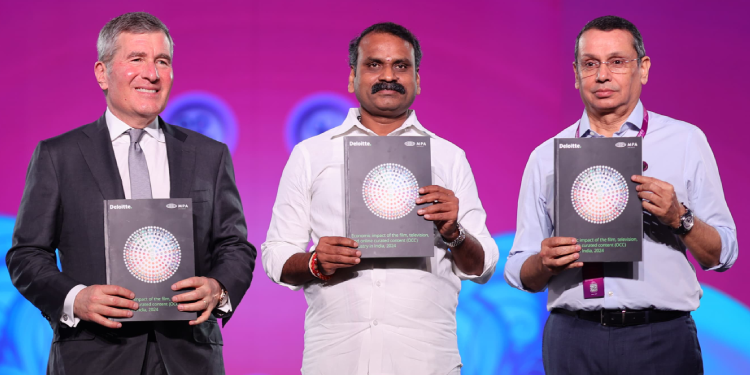
Mumbai, India – The Indian film, television, and online video services industry has emerged as a formidable engine of economic growth, cultural diplomacy, and digital transformation. According to a new report jointly released by the Ministry of Information & Broadcasting (MIB), the Motion Picture Association (MPA), Deloitte, and JioStar Studios, the screen sector contributed an impressive USD 61.2 billion (INR 514,000 crore) to the Indian economy in 2024, supporting 2.64 million jobs nationwide.
Launched during the inaugural Waves summit in Mumbai, and backed by industry heavyweights including the Federation of Indian Chambers of Commerce & Industry (FICCI), the Producers Guild of India (PGI), and Creative First, the report outlines the vast direct and indirect impacts of India’s screen sector and charts a robust growth trajectory through the end of the decade.
A Recovered and Rebounding Industry
The report estimates the direct gross output of the industry in 2024 at USD 16.8 billion (INR 141,000 crore), reflecting a resilient recovery from the disruptions of the COVID-19 pandemic. With a vibrant ecosystem spanning content creation, exhibition, digital streaming, and broadcast, the sector is now on a steady path of expansion.
Projections for the next five years are bullish. The report forecasts a Compound Annual Growth Rate (CAGR) of 6–7%, projecting industry revenues of USD 17.5 billion by FY 2029. If supported by strategic policy interventions and streamlined regulation, this could accelerate to 9–10% CAGR, lifting revenues close to USD 20 billion (INR 165,000 crore) in the same period.

MPA Chairman and CEO Charles Rivkin emphasized the strategic importance of India to global entertainment: “India is a critical global market for MPA members – and its dynamic film, television, and streaming industry is a powerful driver of jobs, cultural influence, and the country’s overall creative economy,” Rivkin said.
“Our members are proud to invest in developing local stories that reflect the unmatched imagination of creators from every corner of India and sharing them with international audiences. With the right policies and continued investment, India can build an even stronger production ecosystem – one that rewards creativity, fuels innovation, and cements India’s place as a global hub for media and entertainment.”
An Engine for Employment and Inclusion
In 2024, the screen sector created and sustained 2.64 million jobs, from cinematographers and sound engineers to marketing personnel, makeup artists, and set designers. This includes a vast network of indirect employment in hospitality, transportation, food services, and construction—making the industry a critical livelihood generator, especially for semi-skilled workers.
The report emphasizes the need to formalize this workforce and expand training through partnerships with institutions like the Film and Television Institute of India (FTII) and private initiatives by Netflix, JioStar, and Amazon Prime Video. The authors also advocate for the creation of a National Media Skills Mission, a centralized initiative to develop standardized and accredited vocational programs tailored to the sector’s evolving needs.
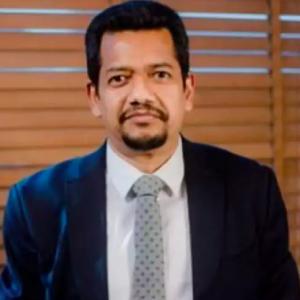
Shibasish Sarkar, President of the Producers Guild of India, commented on the potential of the industry to become a flagship global sector: “The film and television industry could well become a flagship sector in India’s global trade ambitions, as well as a beacon for India’s culture, if all stakeholders work together to create the best possible environment for growth and continued innovation,” he noted.
“In recent years, we’ve seen important developments in skills and training and the ability of Indian crews to deliver high quality production and post-production. Progress on these areas will stand our industry in good stead as we build our capacity for higher levels of production.”
Soft Power and Global Reach
India remains the world’s largest producer of films, generating nearly 2,000 titles per year in multiple languages. Yet, Indian cinema’s share of the global box office is under 1%, a striking gap given its volume and cultural richness.
Nonetheless, Indian stories are gaining global traction via OTT platforms, film festivals, and international co-productions. The growth of regional content, increasingly dubbed or subtitled for wider audiences, has helped transcend geographic boundaries.
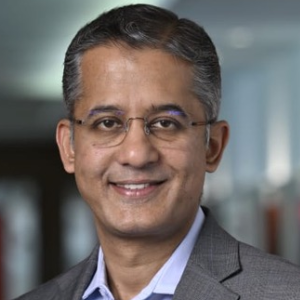
In the foreword to the report, Kevin Vaz, CEO of Jiostar Entertainment and FICCI M&E Chair, reflected on the future of India’s storytelling influence: “To evolve, the next phase of storytelling must reflect the full breadth of India’s cultural fabric, expanding our creative ecosystem to embrace voices, stories, and talent from regions far beyond the traditional production hubs,” he said.
“Rather than relying solely on the metros, the industry must now channel its resources and ambition toward uncovering the rich creative potential in places as far and disparate as Bilaspur in Chhattisgarh or Ranchi in Jharkhand. The south has done this beautifully by rooting its narratives in regional authenticity while delivering cinematic excellence.”
The report recommends several steps to enhance India’s soft power and global presence. These include expanding film co-production treaties with more countries to foster international collaboration, introducing export subsidies for Indian content to improve its global competitiveness, and leveraging India’s diplomatic and cultural networks to boost film tourism and enhance international distribution channels.
Infrastructure and Technology: The Next Frontier
One of the sector’s critical challenges remains the lack of modern film infrastructure, especially outside major cities. To address this, the report calls for the development of regional film cities equipped with advanced facilities, the establishment of a national single-window clearance system to streamline approvals for shoots and post-production work, and targeted financial incentives aimed at decentralizing production and enhancing regional capacity.
India is also seeing the rise of advanced technologies that are revolutionizing storytelling and production. Virtual production and sophisticated VFX are streamlining filmmaking processes and cutting down costs. AI-driven tools are helping in content analysis, script development, and personalized audience engagement. Furthermore, cloud-based workflows and blockchain solutions are reshaping how content is distributed, archived, and monetized.
Policy Reform: The Path to Unlocking Potential
To catalyze further growth, the report strongly advocates for policy modernization across multiple dimensions. It proposes the establishment of a unified media regulator that would oversee film, television, OTT, and digital sectors, thereby eliminating overlapping jurisdictions and inconsistent guidelines.
The report also recommends rationalizing GST rates to reduce the tax burden on content consumption and ticketing, which currently acts as a barrier to accessibility and affordability. To boost infrastructure and innovation, it proposes launching a Media Infrastructure Development Fund (MIDF) that would provide financing and incentives for the development of film cities, sound stages, and post-production facilities. Additionally, a Content Development Fund should be introduced to support independent filmmakers and promote regional storytelling. Lastly, deploying a digital-first licensing and regulatory system would ensure faster compliance, transparency, and ease of doing business for content creators and studios.
Regional Rise and Cultural Diversity
One of the most exciting trends in the Indian entertainment industry is the explosive growth of regional cinema. In 2023, Telugu-language films overtook Hindi cinema in domestic box office collections, signaling a shift in audience preferences and industry dynamics. This momentum is also visible across Tamil, Malayalam, Bengali, and Marathi cinema.
OTT platforms are playing a pivotal role in this transformation by investing heavily in regional original content. They are enabling creators from Tier 2 and Tier 3 cities to showcase their work to national and global audiences. This democratization of storytelling is allowing India to embrace its rich linguistic and cultural diversity, thereby reinforcing its identity as a truly multicultural media powerhouse.
Capital Infusion and Public-Private Collaboration
The report underscores the growing importance of public-private collaboration in shaping the future of India’s screen sector. Companies like JioStar are entering into strategic partnerships with state governments to build creative infrastructure and roll out targeted training programs for youth in semi-urban and rural areas.
Investor confidence is also growing. In 2023 alone, private equity investment in the digital media segment surpassed INR 15,000 crore, with much of the funding directed toward OTT platforms and the animation/VFX sectors. To build on this momentum, the report suggests developing media Special Economic Zones (SEZs) that offer competitive tax breaks and ease of access for global players. Providing tax incentives for investments in studio spaces, technology, and R&D will also drive growth. Additionally, there is a need to improve access to credit for independent content creators and small-to-medium enterprises (SMEs) in the media and entertainment space.
Addressing Structural Challenges
Despite its significant progress, the Indian screen industry continues to grapple with several structural challenges. Piracy remains a major concern, with estimated annual losses nearing INR 20,000 crore. Regulatory ambiguities and inconsistent censorship rules further complicate content creation and distribution. The industry also struggles with gender and regional disparities, especially in leadership positions and access to funding.
To address these issues, the report calls for systemic reforms, the implementation of robust digital enforcement tools to combat piracy, and the introduction of diversity mandates that ensure fair representation and opportunities across gender, geography, and language.
Vision 2030: India as a Global Storytelling Power
Looking ahead, the report paints a bold and inspiring vision for the future. By 2030, India has the potential to become one of the top three global creators of digital original content. It is expected that OTT consumption will surpass traditional television viewership by 2027, making India an OTT-first economy. The country is also poised to become a leader in immersive storytelling technologies such as augmented reality (AR) and virtual reality (VR), with applications not only in entertainment but also in education and cultural preservation. With the right policies and ecosystem support, India can double its content export revenues and secure its position as a global storytelling powerhouse.
With a USD 61.2 billion economic impact and 2.64 million jobs in 2024 alone, India’s screen industry is far more than a cultural force—it is a pillar of the national economy and a global influencer in the making.
If current momentum is sustained and the right policies enacted, India has the potential to be not just the world’s largest content producer, but one of its most influential creative superpowers.