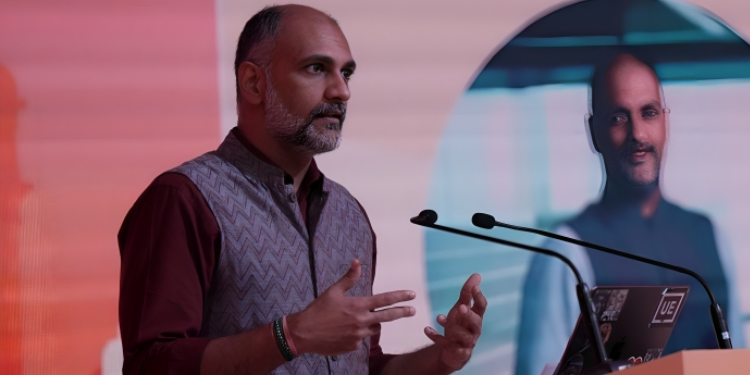
Mumbai: At the SVG Summit 2025, Sanjog Gupta, CEO of Sports & Live Experiences at JioStar, took the stage with the commanding confidence of a media veteran—and the excitement of someone just getting started. In a rousing keynote that blended vision, innovation, and a bold reimagining of the sports viewing experience, Gupta laid out how the merger of Disney Star and Viacom18’s JioCinema—now operating as JioStar—is not just reshaping Indian media, but redefining the global sports and entertainment landscape.
A Year of Transformation
Reflecting on the inaugural SVG India Summit just a year ago, Gupta highlighted how dramatically the landscape has shifted since then. At the time, Disney Star and Viacom18 were in direct competition. Today, they stand united as JioStar—a fusion of Star’s storytelling prowess with Jio’s technological dominance. And the numbers speak volumes.
“In just three months, we merged Disney+ Hotstar and JioCinema into a single platform—JioHotstar—serving a staggering 280 million subscribers, up from 110 million a year ago,” Gupta revealed. Meanwhile, linear Pay TV, thought to be on the decline, saw a resurgence with the Star network adding 3 million new homes in under two months.
And when it comes to live sports, JioStar’s impact has been seismic: record-breaking Test series viewership, the most-watched ODI tournament, highest-ever live digital concurrency, the biggest WPL to date, and a blockbuster start to IPL 2025.
Introducing “Live Experiences”
But the story doesn’t stop at media metrics. JioStar has launched a powerful new vertical—Live Experiences—aimed at blending storytelling, fandom, and interactivity. As Gupta described it, this is about “combining the aggregate power of collective celebrations, shared passion and communal belonging with culture-shaping storytelling and next-gen engagement.”
It’s a strategic expansion that moves JioStar beyond broadcasting into experience engineering.
The JioStar Philosophy: 4 Core Expectations
To understand what drives JioStar internally and externally, Gupta laid out four expectations the company sets for itself and those it collaborates with.
First, think consumer, always. Gupta emphasized the importance of deeply understanding user behavior and preferences. “We must know enough about our users to decode their unspoken desires,” he said. “They invest their attention and passion in us—we owe them a return.” Recognizing that consumers often can’t articulate what they want, Gupta encouraged looking for the subtle signals that indicate unmet needs.
Second, be bold, nimble, and humble. Gupta underscored the importance of having audacious goals and challenging the status quo while staying adaptable and grounded. He noted that JioStar has already demonstrated its willingness to pivot quickly when it sees new opportunities or gaps in delivery. Quoting Winston Churchill—“Success is not final, failure is not fatal. It is the courage that counts”—he encouraged treating both success and failure as milestones on a continuous journey.
Third, chase creativity, not just ideas. Rather than claiming ownership of every great idea, Gupta said JioStar’s goal is to build an ecosystem that attracts them. “You can’t predict where the next breakthrough comes from—but you can make sure it comes to you,” he explained. He emphasized creating a culture where ideas naturally gravitate, because the environment is fertile for innovation.
Finally, execute relentlessly. Gupta stressed that execution is where many great ideas falter. Even strong concepts can fail if not presented clearly or pursued with rigor. He cautioned against letting ideas die due to poor decks or sloppy follow-through. While perfection isn’t the goal, relentless refinement and clear definitions of success are essential. “You don’t need perfection at launch—but you do need persistent improvement,” he said.
MaxView 2.0: A Game-Changer in Mobile Sports Viewing
Saving the showstopper for the end, Gupta unveiled MaxView 2.0, a mobile-first, AI-powered feature launched during IPL 2025. Originally designed to make vertical, portrait-mode viewing intuitive on smartphones, MaxView has evolved into a highly interactive viewing experience.
With MaxView 2.0, users can swipe up to access key moments from the match as short-form video clips—without leaving the live stream. Just one tap brings them back to real-time action. The swipe left feature allows fans to view the game from multiple perspectives—different camera angles, locations on the field, and even “HeroCam” feeds that focus on individual players like Rohit Sharma. Viewers can then swipe right to return to the main broadcast seamlessly.
The innovation has already proven popular, with users engaging 25% more when watching in MaxView. Gupta shared anecdotes of fans using the feature while walking, watching covertly at work, or catching glimpses during traffic stops. “What started as a UI feature has become the most immersive experience on a mobile screen,” he said.
One Fan, Many Moments
For Gupta and the JioStar team, the future lies in hyper-personalised storytelling. He emphasized that fans are not a monolithic group but individuals with varying preferences depending on time, device, and environment. “We don’t serve many fans as one—we serve one fan, many times,” he declared.
This vision is about delivering experiences that are device-specific, cohort-aware, and context-driven. Whether a fan is watching from a metro train, an office cubicle, or a couch, JioStar aims to meet them where they are—with the experience they want.
“As the screen gets smaller, the experience gets bigger,” Gupta concluded, paraphrasing Prime Minister Modi’s recent remarks at Waves. With JioStar’s innovations, the mini screen is becoming the gateway to a mega experience.