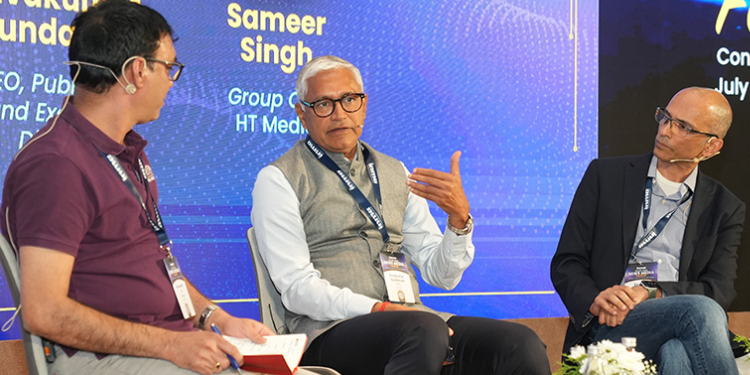
Mumbai: On Day 1 of the INMA South Asia News Media Festival Conference 2025, the spotlight was firmly on the transformative pulse of Indian news media. Advertising and AI dominated the discourse, but it was a powerhouse panel featuring three of India’s most influential media leaders that truly electrified the room.
In a candid, no-holds-barred session titled around leadership transformation, L.V. Navaneeth (CEO, The Hindu), Sivakumar Sundaram (CEO, The Times of India), and Sameer Singh (CEO, HT Media) laid bare the realities of navigating legacy institutions through the digital era without diluting editorial values.
“This is not just any business,” declared Navaneeth. “This is a business with purpose. It is a responsibility. It is a privilege.”
The Soul of News in the Storm of Change
Navaneeth set the tone by framing the session as a journey through “yesterday, today, and tomorrow” — viewed not in decades, but in the radical shifts since the pandemic. Sundaram captured the chaos of the current era vividly:
“Earlier it was like navigating a ship in stable waters. Today it’s like flying a drone through a thunderstorm.”
For Singh, the Indian context is distinct. “For most Indians, tomorrow is still better than yesterday,” he said, highlighting how optimism and growing literacy provide the sector with longer runway than Western counterparts.
The Print vs. Digital Paradox
At the heart of the discussion was a provocative question: What is the future of print?
Sundaram was unequivocal:
“Print was there yesterday, is here today, and will be there tomorrow.”
He underscored that while digital may be ascendant, monetisation still leans heavily on print.
Singh projected a 50/50 revenue split between print and digital in the future, cautioning against prematurely writing off legacy formats.
“Preserve what must be preserved,” he advised, especially in regional and hyperlocal domains.
Navaneeth added a dose of realism to the optimism:
“When someone asks me how things are going, I just say, ‘It is there’ — because the answers are never simple anymore.”
Strategic Investment: Trust as Currency
When posed with a hypothetical — where to invest ₹100 — the consensus was clear: trust is the most critical asset.
“You invest in trust,” said Sundaram. “Print still commands it. Digital must earn it.”
He advocated for AI as a means to optimise, not replace. “AI in the loop, not human in the loop,” he quipped. Singh echoed the need to balance investments between preserving print and modernising enterprise systems.
Navaneeth offered a sharp insight:
“Strategy is what happens when unlimited ambition meets limited resources. It’s about the choices we make.”
Monetisation, Platforms & People
Despite building robust digital ecosystems, monetisation remains elusive. Navaneeth called out the fundamental challenge:
“You command premium pricing in print. But where is the premium pricing for eyeballs in digital?”
Singh warned of growing platform dependency, urging media brands to form direct relationships with readers.
“We have to break our addiction to intermediaries.”
Sundaram provided a blunt assessment of consumer behaviour:
“India will remain an advertiser-led market. People don’t want to pay for news — they’re fine with ads.”
Gen Z and the Talent Gap
On younger audiences, Navaneeth posed a hard-hitting question: Are we doing enough to build a sustainable subscriber base with Gen Z?
Sundaram’s response surprised many:
“People under 35 don’t care about news the way we understand it. Don’t chase them — they’ll come when they’re ready.”
Singh, however, argued for experimentation, citing HT’s Olympiad programme and the popularity of long-form content like podcasts.
“If the story’s good, they’ll stay.”
Leadership was also held accountable for talent gaps.
“If people aren’t joining your team — it’s not your company’s problem, it’s yours,” said Navaneeth.
Singh added, “Culture is what we reward and what we reinforce.”
To keep pace, leaders must model curiosity. Singh stressed budgeting for failure and borrowing from competitors. Sundaram, meanwhile, shared his personal ritual — writing a weekly column.
“To see your name in print is still one of the greatest joys. That’s when you know you’ve arrived.”
Editorial Integrity Above All
As questions from the audience probed editorial pressure, Navaneeth turned the focus inward:
“When business gets tough, do we protect our newsroom’s independence?”
Sundaram’s assurance was firm:
“Print has no pressure from devices. We’re fine.”
Singh added:
“Even a rookie like me can see this: The newsroom’s integrity is fundamental. It’s not just about speed, it’s about trust.”
Relevance. Resonance. Retention.
In his closing thought, Sundaram offered a succinct roadmap for the future:
“Relevance. Resonance. Retention. That’s what the future belongs to.”
The session didn’t end with platitudes, but with clarity. India’s legacy media houses are not abandoning their roots — they are redefining them. With purpose as the compass, trust as currency, and strategy as trade-off, the journey continues through the storm.
(Inputs and images for this session coverage have been sourced from the official conference blog published on the INMA portal.)