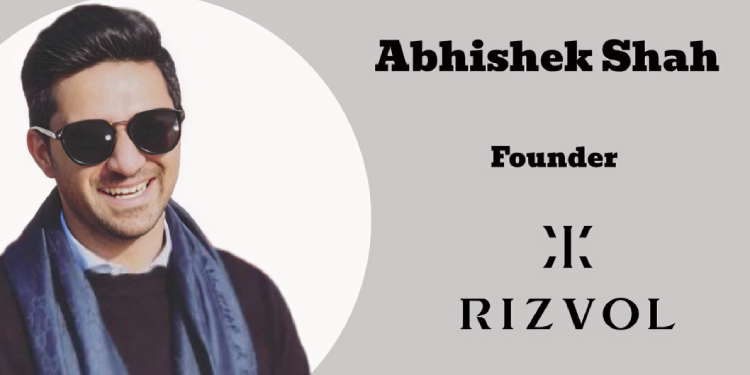
RIZVOL is a New York based global luxury label which was recently launched in India.
With a background spanning Columbia University, the ateliers of Milan, and the culture-rich streets of New York and Amsterdam, he brings a perspective to India’s growing luxury dialogue — one that blends global restraint with cultural richness.
Medianews4u.com caught up with RIZVOL founder Abhishek Shah.
Q. What trends are being seen when it comes to the rise of slow fashion and quiet luxury in India? What is the gameplan to leverage this?
Trends we have observed in the last 1-2 years in India
There is an emerging affluent mindset
– Young, urban Indians moving away from logo-driven consumption
– Consumers are opting for understated design, quality over quantity, and storytelling
– We see the growth of high-income professionals, NRI-returnees & second-gen business families fueling the shift
Influence of Global Travel and Digital Exposure
– There is a huge exposure to European luxury, niche minimalism due to increase in global travel and reach of digital
– Indian customers value fabric quality, cut & silhouette & brand philosophy
We see consumers opt for sustainability as sophistication
– Slow fashion in India is now associated with refinement, not just eco-consciousness
– In older times, for example handwoven khadi once defined sustainable fashion – now its mercerized linen, soft cashmere, fluid tailoring, with seasonal style
Retail Spaces are Evolving
– Spaces like Jio World Plaza, curated ateliers, and designer-run stores are primed for slow luxury
OUR GAMEPLAN:
– We want to build a narrative around why our fabrics (linen, cashmere, wool) is exceptional – sourcing, GSM, aging, finishing, long-lasting
– We want to create content infused with retail experiences (over time) around tactile discovery
– We want to educate or rather create awareness around how intentional we are and why some fabrics behave like they do (e.g., wrinkle in linen is a mark of luxury)
Q. RIZVOL positions itself as being a philosophy in motion and not just a fashion label. One that values restraint over excess, process over pace, and detail over drama. How is this reflected in its products and how does this give at edge over competition?
We don’t operate on the logic of seasonal drops or trend cycles. Our approach is intentionally rigorous — from design and fabric sourcing to sampling and production, every step is deliberate and deeply considered
We source only from fabric houses whose origins, processes, and standards we know intimately. These textiles undergo extensive testing for longevity, feel, and tone. In fact, we research colour directions in slow fashion 1–3 years in advance, so what we make is not only timeless — it’s thoughtfully timed
Each product is iterated over months. Our Spring/Summer 2025 shirt, for example, went through over 150 iterations before we arrived at the final form. We continue refining until it meets our internal standard — and we don’t release what we wouldn’t wear ourselves. That level of restraint defines our quality control.
This is what gives us our edge: we don’t chase market share — we build long-term trust.
Q. The aim is to build a fashion legacy rooted in meaning, not noise. What does this entail?
It’s about crafting pieces that stand the test of time — in construction, in aesthetic, and in relevance. At RIZVOL, we don’t follow trends; we follow principles. Every fabric, fit, and finish is chosen not just for how it looks today, but for how it will feel — and be remembered — years from now.
Meaning also lives in restraint. In a world of noise and overproduction, we choose discipline. We release fewer products, made better. We invest deeply in materials, in craft, and in process — not marketing gimmicks or fleeting hype.
The goal isn’t to create a moment. It’s to build a body of work — slow and steady.
Q. What are the key markets and TGs being targetted for growth? What goals have been set for the first three years?
Our key markets are India and the United States — both evolving rapidly in their appetite for quiet luxury.
India, in particular, is seeing the fastest growth in its affluent class. We anticipate a significant shift over the next two to four years from logo-driven consumption to more refined, understated luxury. Our goal is to be firmly positioned when that shift accelerates — not reacting to the change, but ready to lead it.
Three-Year Goals
– We recognise that building a true luxury brand today is a long game — especially when competing with houses that have a century-long head start. Our goal is not to sell more, but to grow slowly, intentionally, and sustainably.
– Establish the brand foundation with a tightly curated collection, strong storytelling, and an obsessive focus on quality and trust.
– Expand thoughtfully into new categories, including our upcoming Winter Collection — a limited release featuring two signature jackets made from 100% cashmere.
– With our D2C launch in the US and India complete, we plan to enter the European market by end of 2025, with a view to establishing a global footprint by 2026.
– We will explore selective pop-ups in New York, Delhi, and Mumbai in 2026 to offer a tactile brand experience.
– Our channel expansion includes entry into third-party D2C platforms:
o US: Platforms like Farfetch (targeted for 2026)
o India: Ajio Luxe in Q4 2025 / Q1 2026
Q. Is there a difference in how Gen Z perceives this category compared with older TGs?
Absolutely, there’s a clear shift in how Gen Z engages with the luxury and slow fashion category — and it’s not just about age, but mindset. Unlike older generations who often view luxury through the lens of legacy and status, Gen Z is driven by meaning, intent, and aesthetic alignment.
For us, Gen Z isn’t just a buyer — they’re a future loyalist. We don’t expect them to purchase immediately. We want them to aspire. To discover RIZVOL early, follow the story, and grow with the brand.
Just as today’s 30- and 40-year-olds once looked up to heritage houses, we want RIZVOL to become that quiet icon for the next generation — built not through mass exposure, but by consistent values and timeless design.
Q. Is the luxury clothing category relatively insulated from global geopolitical, economic pressures?
From what we see global luxury sales dipped by 1–2% over the past year, driven largely by softness in the US and Europe, where aspirational consumers pulled back on discretionary spending. But core luxury buyers — particularly in Asia and the Middle East — remained strong.
But typically, true luxury buyers tend to have higher discretionary income and are less sensitive to short-term market shifts.
Q. How is RIZVOL using AR and VR to create an immersive experience on its site, www.rizvol.in? Is the company tying up with e-commerce, Q-commerce sites and on the ground with retail outlets?
RIZVOL INDIA
Our vision is to build a future where every stitch, every seam, and every button tells a story—one that stretche…
We’re exploring ways to integrate AR-driven sizing tools to help our customers better visualise fit and fabric movement before they purchase. For us, helping the customer get the right piece the first time is key — and it also naturally reduces returns, which tend to be higher in luxury due to hesitation around fit and feel.
Q. In terms of marketing and promotional activities what innovations can one expect in the coming months? Will the focus rest on digital media or will traditional media also play a role?
For now, most of our focus is on digital. Think short films, product stories rooted in lifestyle, and collaborations with people who truly reflect the spirit of the brand. You won’t see us on billboards, but you might find us in a thoughtfully curated print journal or an immersive pop-up that feels more like a quiet experience than a retail push.
Q. How important will influencer marketing and positive word of mouth be?
We’ll be extremely selective when it comes to influencer or celebrity partnerships — the alignment has to feel natural and true to the brand.
Word of mouth has already been one of our strongest growth drivers, and we believe that will only deepen over time.
Q. Bollywood stars like Deepika Padukone are brand ambassadors for luxury brands like Gucci, Louis Vuitton, Cartier, Dior, Chanel. Would RIZVOL go down this route at some point?
Yes, it’s something we’re open to — but for us, it’s less about appointing a brand ambassador and more about finding the right strategic partner.
Someone who not only aligns with our values but brings meaningful contributions — whether that’s creative input on brand and design, investment, reach, or long-term vision. It has to be additive, not just associative.
Q. Could you talk about the R&D that goes into products like Japanese Mother of Pearl buttons, European linen? Is there a lot of trial and error?
We conducted rigorous fabric testing in labs across the US and India to determine whether these were truly the finest materials — a process that took many months, countless iterations, and extensive sourcing. The 34 linen we use is among the finest in the world, weighing barely 100 g/m² and made from the thinnest, longest fibers.
The same goes for our cashmere: the yarns are sourced from some of the best producers in Mongolia and then woven, dyed, and constructed in Italy under stringent chemical and environmental standards.
We are constantly engaging with fabric houses, sourcing samples, and assessing what fits not just our pieces, but our brand. We will not compromise — at any level — on the materials we use.
Even when it came to our buttons, we tested multiple types of mother-of-pearl from different countries, observed their degradation through washing, ironing, dry cleaning, and daily use, and eventually finalized the highest-quality option. Again, there are no compromises in the materials we select or the process our fabrics undergo.
Now, speaking about the process — take linen, for example. After sourcing, the fabric goes through a series of biodegradable washes, each done meticulously. We wash only 10 meters at a time to ensure even shrinkage by evenly distributing the wash agents. Once washed, the fabric is roll-ironed to ensure uniform pressure and finish, which helps us cut it precisely.
Even the stitching process is long and meticulous. Linen, by nature, needs to be ironed both before and after stitching to prevent it from spreading, loosening, or wrinkling. As a result, producing a single shirt takes us about 1.5 to two days. We spent over a year perfecting this process — which is why we delayed our launch.
We don’t care if we’re late to deliver or to market. We are obsessed with quality and with the rigor it takes to be a true luxury brand.
Q. How is RIZVOL leveraging AI in areas like product innovation, identifying market gaps?
My background is in Computer Science — both undergrad and master’s — so AI has always been core to how we think. At RIZVOL, we use both AI and Gen AI across product, research, and marketing in very intentional ways.
AI for Product Innovation
– We built our entire sizing and grading logic using Gen AI — analysing body types across regions and brands to create an extremely precise and globally relevant fit system.
– We also use AI to study historical fashion patterns and design languages, helping us explore ideas and silhouettes that feel timeless but still fresh.
AI for Research & Marketing
– We experimented with Gen AI for our product-model shoot — and while we didn’t use the final images due to resolution and post-editing limitations, it gave us a strong starting point. We’re confident the tech will catch up soon and become a viable tool for visual content.
– We’ve deployed Gen AI agents that run historical trend analyses to identify garments that are either inherently timeless or ripe for modern reinterpretation.
We also use AI for deep macro and micro fashion industry research — helping us model everything from financial forecasts to cultural signals that inform our decisions.