AI today is incredibly powerful. But what good is that power if it doesn’t connect with people in a way that feels natural, authentic, and emotionally intelligent? That’s exactly what Rian is focussed on solving!
Rian is looking to close the gap between advanced AI and real-world impact. While so many are focussed on creating deep tech, Rian says that it is focussed on what truly matters, building the human layer that helps AI reach the last mile with quality and meaning.
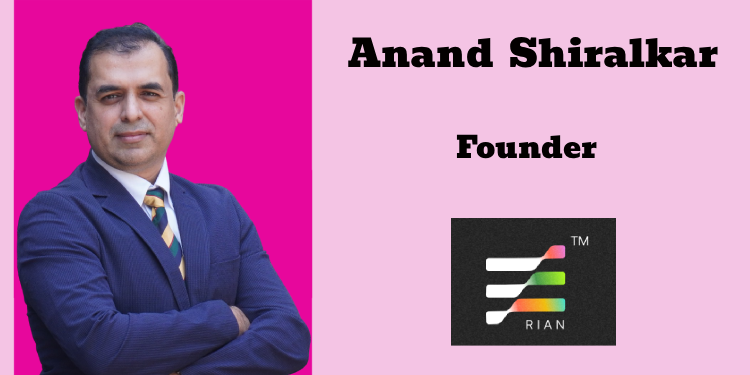
At the helm is Anand Shiralkar, a technologist driven by the belief that voice is the most powerful connector of human emotion. With a deep understanding of AI, product engineering, and the cultural fabric of India, Anand is building Rian to make technology feel more human. His focus isn’t just on scale, it’s on meaning, inclusion, and building tools that speak to the heart of a global audience.
Here’s what they say makes them a category-defining player:
· Voice AI that speaks with you, not just at you
Their emotion-driven neural voice system supports 60+ dubbing languages, using region-specific acoustic models to retain authenticity and sentiment.
· Built for scale, designed for accuracy
With 97% linguistic precision, Rian combines deep neural networks with a human-in-the-loop system ensuring both high throughput and editorial-grade quality.
· Enterprise-grade localisation at speed
Rian cuts 40% of the manual effort in translation workflows while processing millions of minutes of content
· A new generation of linguistic AI talent
Rian isn’t just advancing voice technology, it’s building the talent to power it. Through Rian Academy, it is shaping a new generation of AI linguists and voice-tech specialists, creating a strong foundation for the future of cultural AI in India.
Rian is focussing on creating the cultural and collaboration layer that helps AI go beyond capability and truly connect with people.
Medianews4u.com caught up with Rian founder Anand Shiralkar
Q. There is lots of activity happening in AI. This includes acquisitions by companies like Microsoft. How do you see the AI space evolving?
AI is moving from hype to real-world value. Companies like Microsoft are acquiring AI startups to strengthen their ecosystem. This shows the future isn’t about standalone tools. It’s about deeply integrated AI workflows across search, productivity, and enterprise.
We believe the next wave will make AI invisible, quietly working behind the scenes to enhance human output without replacing it.

Q. Could you talk about the value that Rian makes in the Voice AI space?
Rian makes voice AI useful and scalable. It’s not just about converting text to speech. It’s about making the voice sound culturally relevant, emotionally accurate, and linguistically precise.
Our AI helps global content speak to local hearts, whether it’s an anime from Japan or a compliance video from a manufacturing company in India.
Q. Voice AI is not being adopted yet at a mass level. When does it become mass in the country?
It becomes mass when it’s effortless. We think the tipping point will come when AI can work reliably in low-bandwidth areas, support local dialects, and be accessible to creators and companies without a tech team.
This could happen over the next 18 to 24 months, especially with vernacular internet users growing rapidly in India. (As per IAMAI-Kantar report, over 50% of rural users prefer local languages online.)
Q. Rian is focussing on closing the gap between advanced AI and real-world impact. What does this entail?
We’ve seen many great demos in AI. But in the real world, businesses need predictable turnaround, accountability, and cultural context.
At Rian, we built our platform to combine automation with human review layers so that the final output can be used in a real movie or a legal video without quality concerns. It’s about making AI dependable at scale.
Q. Could you talk about how building the human layer helps AI reach the last mile with quality and meaning?
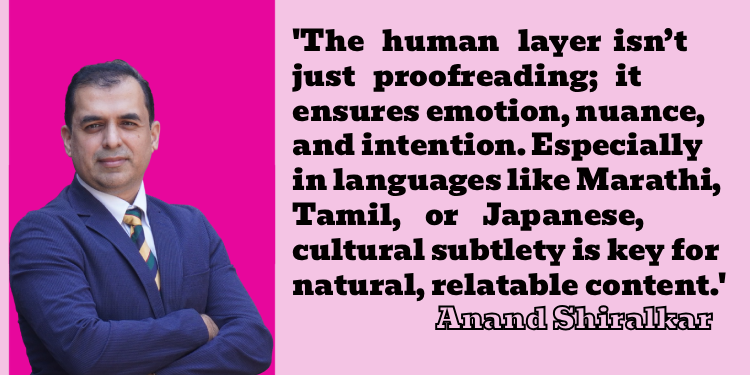
AI gets you 80% of the way. But the last 20% — the emotion, nuance, and intention — still needs a human touch. Our human layer isn’t just for proofreading. It helps shape the tone, correct the context, and ensure the content sounds natural.
This is especially important in languages like Marathi, Tamil, or Japanese, where cultural subtlety is key.
Q. What is Rian’s USP compared with other translation products?
We’re not just a tool. We’re a dubbing factory. While many products focus on translation, Rian focuses on production-quality dubbing using a mix of AI and expert review.
We don’t just localise. We recreate. And we offer this at scale, processing thousands of minutes with consistent quality and turnaround.
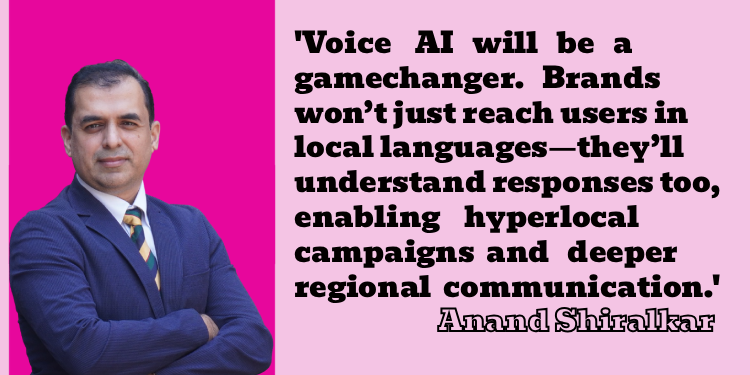
Q. Will Voice AI and Voice Search be a gamechanger for advertisers and marketers in the coming three years? Will it make regional communication easier?
Yes, massively. Think of a farmer in Maharashtra searching for crop prices through voice, or a homemaker in Tamil Nadu discovering products through voice ads.
As per Google, 28% of searches in India are already voice-based. With smart AI, this can become two-way. Brands won’t just reach users in local languages, they’ll understand responses too.
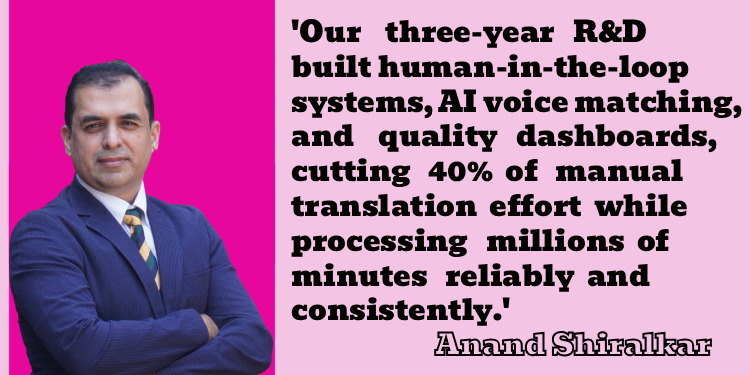
Q. Could you talk about the R&D that went into Rian that enables it to cut 40% of the manual effort in translation workflows while processing millions of minutes of content?
Our team has spent over three years refining a human-in-the-loop system. We created proprietary alignment models to sync subtitles with speech, used AI for automatic voice matching, and built quality dashboards for feedback loops.
The result? Fewer revisions, faster approvals, and more output with fewer people. That’s the 40% saving right there.
Q. Do voice AI services and innovations like Rian have major implications for the media and entertainment sector as well as FMCG, healthcare, BFSI?
Absolutely. For media and entertainment, we make global content local. For BFSI and healthcare, we help firms train their teams across India in regional languages.
FMCG brands can use voice AI to create hyperlocal campaigns at scale. The core idea is simple: speak your customer’s language.
Q. What progress has Rian made in terms of clients like Japanese anime? What is the business model?
We’ve already started work on Japanese IPs like Bonobono and are in active discussions with leading anime houses. The model is simple. We take the IP, localise it in Indian languages, and distribute it via YouTube, OTTs, and even schools.
We fund this upfront and earn through ad revenue, licensing, and merchandising. It’s a mix of risk and reward, but we’re confident in our execution.
Q. Could you talk about Rian Academy, which is looking to shape a new generation of AI linguists and voice-tech specialists?
Rian Academy is our skilling initiative to train the next generation of AI linguists. As AI takes over repetitive tasks, we need people who can supervise, fine-tune, and bring creative judgment.
Our courses cover language QA, voice matching, cultural sensitivity, and prompt engineering. This isn’t just training. It’s building a talent pipeline for the voice-tech economy.
Q. Now OpenAI is looking to challenge Google Chrome. How will AI platforms change the online Search game?
Search will become more conversational and contextual. Instead of typing keywords, people will ask full questions and expect full answers. AI will not just index the web. It will synthesise it.
Platforms like Rian can plug into this by making localised answers available in voice, creating an internet that truly speaks your language.