Dentsu Creative Public Relations is a full-service agency that unites the expertise of heritage brands—Haystac (consumer and brand), Cox Inall (behaviour change, corporate and agribusiness), and Cox Inall Ridgeway (First Nations)—under one integrated offering.
Vidya Dilip, Director of Public Relations at Dentsu Creative PR, was recently recognised among the ‘100 Most Influential PR Professionals of 2025’, a global peer-driven honour curated by the Symbol Creative Awards. This year, she features alongside international leaders from Netflix, Ogilvy, Publicis, and McCann.
With more than 25 years of experience in public relations and strategic marketing, Vidya has spearheaded communication strategies across diverse industries, mentored high-performing teams, and delivered campaigns that drive measurable business outcomes.
She also authored the article ‘PR in 2025: Navigating a Changing Media Environment in India’, which highlights how India’s communications landscape is evolving in response to a shifting media ecosystem.
Medianews4u.com caught up with Vidya Dilip, Director Public Relations Dentsu Creative PR, to discuss her journey, perspectives, and insights on the changing dynamics of the PR industry.
Q. To advance to a leadership position what qualities should a PR professional possess?
A strong strategic mindset, an ability to build trusted relationships, empathy, resilience, and excellent communication skills are critical.
A leader in PR must also inspire teams, manage crises calmly and keep learning to stay ahead of change.
Q. There is talk about how Gen Z is disrupting the traditional marketing funnel. Is PR also experiencing disruption due to both Gen Z and technology?
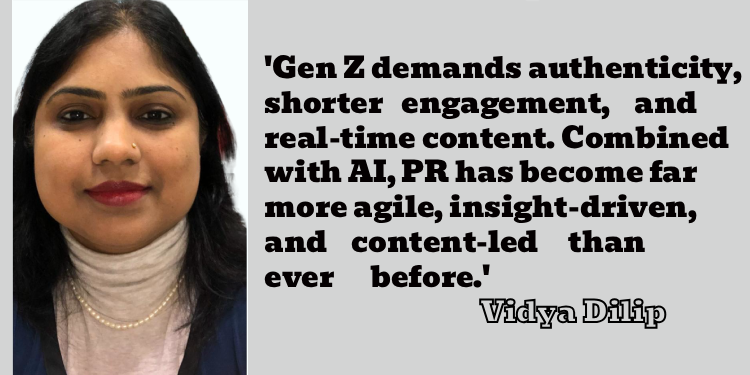
Absolutely. Gen Z consumes information differently — attention spans are shorter and authenticity matters more than ever.
Technology, AI and real-time insight tools are reshaping how and where we communicate. PR today is far more agile and content-led than before.
Q. In building and mentoring high-performing PR teams over 25 years what would you look for in someone? Is the ability to network important?
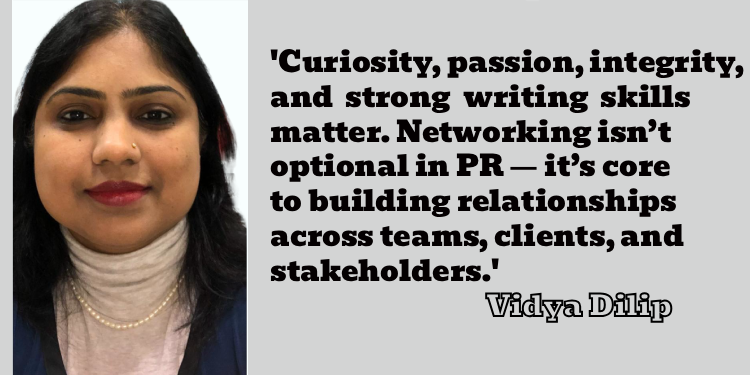
I look for curiosity, passion, strong writing skills, quick thinking and integrity. The ability to build genuine relationships — both within teams and across stakeholder groups — is crucial.
Networking is not optional, it’s core to our profession.
Q. Is fair remuneration from clients a challenge being faced by the PR industry?
Yes — while expectations from PR firms have grown, fee structures haven’t always kept pace.
Demonstrating measurable value is key to unlocking fair remuneration.
Q. Is it a challenge to balance creativity with measurable outcomes in PR campaigns?
It can be, that’s what makes great PR exciting. Creativity grabs attention, data proves impact.
The strongest campaigns today are those where art and science blend seamlessly.
Q. Which sector is the most challenging to deal with from a PR perspective in your experience?
Highly regulated sectors like BFSI and Pharma can be challenging due to compliance.
Tech, too, requires keeping pace with rapid evolution and simplifying complex narratives.
Q. The sector has more women than men. How has that helped bring in relatability to the message?
Women bring empathy, emotional intelligence and the ability to understand nuanced human behaviour — all of which enrich storytelling and make brand messages more authentic and relatable.
Q. At the same time are pay equity, unconscious bias issues that women in PR face?
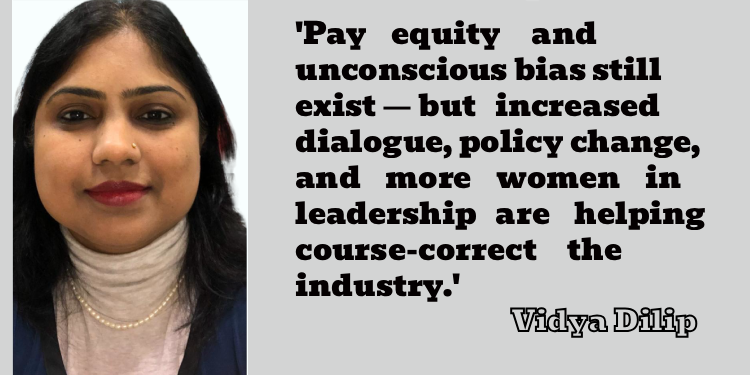
Yes, pay equity and unconscious bias still exist in pockets — though the industry has made progress. More dialogue, policy change and leadership representation are helping course correct.
Q. How important is it to anticipate change, think ahead and pivot quickly so that the brand message stays relevant?
It’s critical. Today’s environment moves fast — so reading trends, planning scenarios and being able to course-correct swiftly is essential to keeping a brand relevant.
Q. Do PR agencies that specialise in a vertical like tech or BFSI have an advantage?
Specialised agencies have deeper domain knowledge and media connects — which is a definite advantage.
However, integrated thinking and adaptive storytelling matter regardless of vertical.
Q. How is AI shaking up the PR industry? Are fewer people needed in a PR agency today?
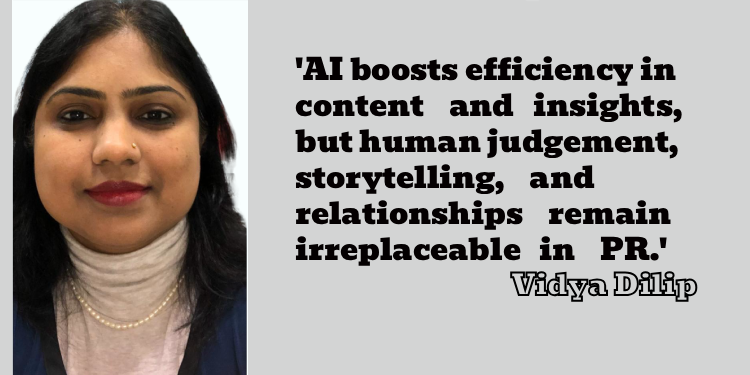
AI is transforming content creation, media monitoring and insights, improving efficiency.
While some roles will evolve, human storytelling, judgement and relationships will always remain vital in PR.
Q. Have you often worked with clients to ensure that no negative news come out at all at any point of time? Apparently, the focus of companies like Tata and Reliance is just that. No negative news should come out at all.
While prevention and robust reputation management are ideal, in reality the focus is on being prepared and responsive.
You cannot always control news, but you can control the narrative.
Q. Finally is CSR Impact becoming increasingly important for companies when they do PR?
Yes, stakeholders today expect brands to contribute meaningfully to society. CSR done authentically, communicated wisely, plays a significant role in building long-term reputation.