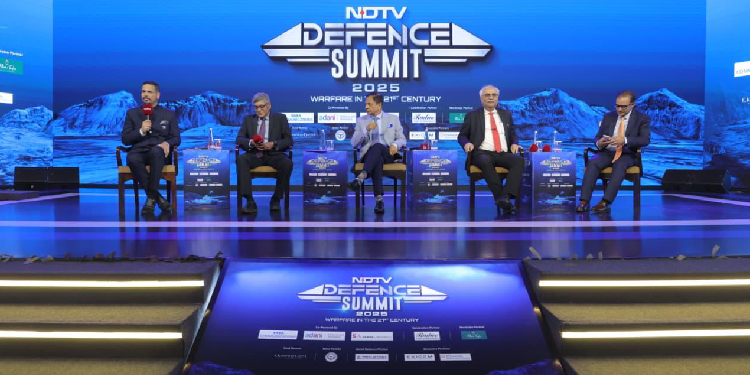
New Delhi: NDTV hosted its annual Defence Summit 2025 on August 30, bringing together India’s top political leadership, armed forces chiefs, veterans, policymakers, and industry leaders to deliberate on the theme ‘Warfare in the 21st Century’.
The summit opened with a powerful keynote address by Defence Minister Rajnath Singh on ‘Operation Sindoor: A Strategic and Operational Success.’ He underscored India’s decisive military response to the Pahalgam terror attack and reiterated that “atmanirbharta (self-reliance) is indispensable for India’s security and economy in today’s shifting geopolitics.” Emphasising that India’s foreign policy is guided by “permanent interests, not permanent friends or enemies,” he announced that all Indian warships will henceforth be built domestically, while highlighting the indigenous ‘Sudarshan Chakra’ project as a marker of India’s expanding strategic vision.
In the session ‘In Defence of Atmanirbhar Bharat’, Defence Secretary Rajesh Kumar Singh outlined policy reforms, indigenous innovation, and collaborations shaping India’s defence ecosystem. Sharing insights on Operation Sindoor, he noted the leadership’s confidence throughout the campaign, remarking that “he played tennis every morning during the operation to underscore its calm execution.” He also confirmed that the first two Tejas Mark 1A fighter aircraft with full weapons integration are likely to be delivered by the end of September.
The armed forces’ perspective was central to the discussions. Air Marshal Narmdeshwar Tiwari, Vice Chief of Air Staff, described Operation Sindoor as a watershed moment, reaffirming the IAF as “India’s sword arm.” He revealed that “fewer than 50 weapons were used to force Pakistan into a ceasefire,” showcasing India’s precision and restraint, and unveiled the IAF’s integrated air command map for the first time publicly.
Lieutenant General Pratik Sharma, Northern Army Commander, in his address ‘Indian Army: From Restraint to Response’, detailed rapid mobilisation, precision strikes on terror camps, and deployment of indigenous technologies during Operation Sindoor. He also reflected on the evolving face of terror operations, drawing lessons from both Operation Sindoor and Operation Mahadev.
The summit further explored the changing character of warfare. ‘Shakti in Uniform’ featured Vice Admiral Arti Sarin and Colonel Anshu Jamwal, who discussed women’s growing leadership roles in the armed forces. In ‘Drone Acharya: The Evolution of Drone Warfare’, innovators from Paras Defence, IdeaForge, NewSpace Research, and Exicom analysed the battlefield impact of drone technologies.
In the session ‘Lessons from the Past’, former armed forces chiefs General Manoj Pande, Air Chief Marshal Vivek Ram Chaudhari, and Admiral Arun Prakash reflected on the inter-services synergy demonstrated during Operation Sindoor and traced India’s technological progress since 1971.
Industry voices deepened the dialogue. Ashish Rajvanshi, CEO, Adani Defence & Aerospace, underlined the growing role of private players in R&D, exports, and global supply chains, while warning about AI-driven cognitive warfare, likening it to an “Avengers: Age of Ultron scenario.” Atul Dinkar Rane, former DG, BrahMos, in his session ‘The BrahMos Story’, described the missile as a hallmark of India’s foreign policy and operational strength.
In ‘Make in India, Build for the World’, Nikhil Joshi (Boeing Defence India), Ashish Saraf (Pratt & Whitney), and Ashok Wadhawan (Adani Defence & Aerospace) discussed India’s potential to emerge as a trusted global defence export hub. Amur Lakshminarayanan, CEO, Tata Communications, in ‘Reimagining Defence: A Digital Fabric for a Secure and Connected India’, emphasised the role of telecom, cloud, and data infrastructure in national security. Puneet Kaura, Samtel Avionics, showcased advances in avionics and aerospace electronics aimed at reducing import dependence.
The NDTV Defence Summit 2025 reaffirmed NDTV’s role at the heart of India’s national dialogue on security and strategy. By drawing critical lessons from Operation Sindoor and anticipating future challenges, the Summit reflected India’s strategic priorities and aspirations. It also underscored the commitment of a new NDTV for a New India – to tell India’s story with honesty, purpose, and clarity.