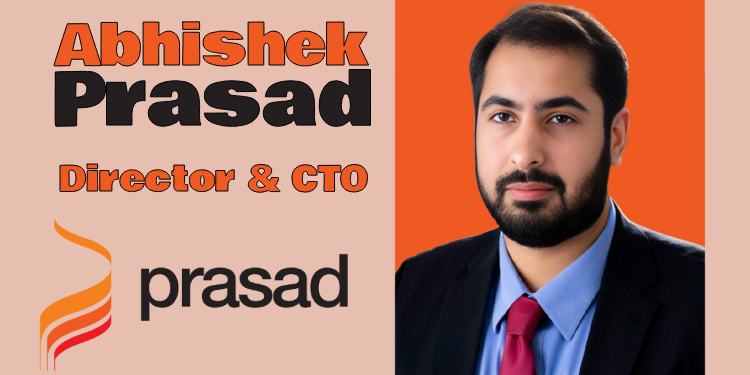
Founded by the legendary filmmaker L. V. Prasad, the fourth-generation Prasad Group has shaped Indian and global cinema for over six decades—from preserving timeless classics to powering today’s digital-first storytelling. As the company evolves into a media-tech powerhouse with expertise spanning 8K restoration, HDR grading, Dolby Atmos, digitisation, VFX, and AI-driven workflows, its next chapter is being driven by Abhishek Prasad, Director & CTO and fourth-generation custodian of the Prasad legacy. With global engineering experience, deep technical acumen, and a vision to future-proof film heritage, Abhishek shares insights on the Group’s transformation, innovations, and strategic direction.
In this conversation with MediaNews4U, he reflects on the future of cinematic preservation and technology.
Q) Prasad Group has been synonymous with Indian cinema for over six decades. How do you view the legacy you’re inheriting as a fourth-generation leader?
Abhishek Prasad: As a fourth-generation member of the Prasad family, inheriting this legacy is both an honour and a responsibility. The scale and reputation built over six decades certainly make the journey smoother—there is already strong awareness and trust in the Prasad brand, which helps us introduce new ideas and innovations into the market more effectively.
At the same time, it carries the weight of expectations. There is a deeply rooted way of working, a philosophy shaped by the generations before me, that I feel personally accountable to uphold. Our family has always operated with certain principles and values, and those guidelines continue to shape my decision-making even today.
What grounds me most is our origin story. My grandfather (legendary filmmaker L. V. Prasad) came from extremely humble beginnings, and everything the Group stands for has been built through hard work, perseverance, and an unwavering commitment to the craft of cinema. I was raised with that history, so whether I’m exploring new projects or steering the company’s technological direction, those roots guide every step.
So yes, it’s both a gift and a responsibility. I have the freedom to innovate and explore new avenues, but always within the framework of values and vision that my great-grandfather, grandfather, and father laid down. That balance is what defines my leadership approach today.
Q) How has Prasad Group evolved from a traditional film studio into a global media-tech powerhouse, and what would you identify as the most defining milestone in this transformation journey?
Abhishek Prasad: Our journey has been anchored in creativity from the very beginning. My great-grandfather entered the film industry as a deeply creative individual—acting and directing were his core passions, and that early involvement behind (and occasionally in front of) the camera laid the foundation for what would become Prasad Group. As his films found success, we naturally transitioned into full-fledged production.
The real turning point came from an operational challenge. During one of our early productions, my grandfather, who was assisting with post-production, faced significant hurdles in getting the negatives processed and the release prints ready. That experience exposed a critical gap in the industry’s post-production ecosystem—particularly in reliability and customer service. Recognising this need, he established Prasad Film Laboratories, which went on to become one of India’s largest and most trusted film processing networks. That era defined our analogue identity, and it became the Group’s core business for many decades.
The next major evolution came with my father’s entry into the business. He brought a strong technical and digital mindset, complementing the analogue expertise of the previous generation. This synergy enabled us to anticipate the coming digital wave far ahead of the market.
The most defining milestone in our transformation was our strategic pivot in the 1990s, when we consciously embraced digital technologies and began expanding into digital post-production. This decision—to not just adapt but lead the transition—fundamentally reshaped Prasad Group. It allowed us to broaden our service portfolio, remain relevant through the industry’s most disruptive phase, and ultimately evolve into a global media-tech organisation with capabilities spanning restoration, VFX, DI, scanning, mastering, and cutting-edge post-production technologies.
That foresight ensured the longevity of the business, and it remains the cornerstone of our identity today.
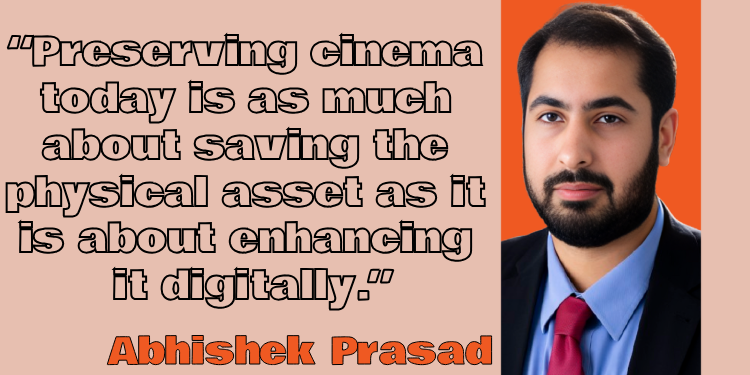
Q) Prasad Group has restored and processed over 30,000 films. What are the biggest challenges in preserving cinematic heritage in today’s digital era?
Abhishek Prasad: While we have restored and processed well over 30,000 films, restoration was not the first digital capability we built. We began with telecine transfers, followed by ad film production and visual effects. Over time, as content became more accessible globally, it became clear—especially through conversations with international studios—that film restoration would be a critical requirement for the future. We decided to invest early in this space, even though it was a high-risk move at a time when almost no one else in India was doing it. That decision has since proven pivotal for our long-term growth.
When it comes to the challenges of preserving cinematic heritage today, the core issue has fundamentally shifted. In the early years of restoration, the technology and scanning systems evolved steadily, so the process itself improved naturally over time. The real challenge was not the tools—it was the condition of the source material.
In those early days, most of the work we handled came from global studios. Their archives were well maintained, stored in controlled environments with proper temperature and humidity. As a result, the film negatives were in comparatively good condition, making the initial digitisation more straightforward—even though restoration itself is never simple.
The scenario is very different today, especially with Indian content. Decades ago, no one anticipated the rise of OTT platforms or digital ecosystems like YouTube, where archived content suddenly regained immense commercial value. Many rights holders didn’t know what to do with their film reels, and a significant portion of Indian film heritage was left in inadequate storage facilities—godowns, sheds, or private collections without climate control.
As a result, many of the negatives we now receive are severely deteriorated. The chemical integrity of the film—essentially the data itself—is often damaged or partially lost. This makes the input material our biggest challenge. Even with advancements in AI and digital tools, no technology can compensate for a poor-quality source.
Before any restoration can begin, we often need to put the negative through extensive chemical treatment to stabilise it, recover as much of its original information as possible, and restore its physical and chemical properties. Only then can we digitise it at the required high quality. The digitisation stage is crucial—if the scan isn’t strong, the restoration downstream will never reach its true potential.
Q) Are you working with organisations like Film Heritage Foundation?
Abhishek Prasad: Yes, we work very closely with the Film Heritage Foundation, and our relationship with them goes back many years. They have been strong collaborators and partners in several major restoration initiatives. Their core focus is to engage with content owners, identify archival assets, and guide them on how best to prepare these materials for digitisation and restoration.
Once the assets are identified, our team at Prasad takes over the technical pipeline—digitising, restoring, and preparing the content for preservation or re-release. Many of the titles we have jointly restored have gone on to premiere at global platforms, including prestigious festivals such as Cannes. It’s a partnership built on a shared vision: safeguarding and celebrating cinematic heritage at an international scale.
Q) How do you see AI reshaping film restoration, VFX, and post-production workflows?
Abhishek Prasad: AI is undoubtedly one of the most discussed technologies today, sometimes even overused as a buzzword. But in our industry—whether in restoration, VFX, or post-production—AI is proving to be a highly effective assistive tool, not a replacement for human expertise.
In film restoration, where we often deal with severely damaged negatives, AI models are becoming invaluable. Traditional challenges like dust removal, scratch correction, and frame clean-up—tasks that previously required extensive manual effort—are now being accelerated significantly through AI-driven processes. This not only improves efficiency but also allows our artists to focus on the more nuanced aspects of restoration.
More advanced use cases are emerging as well. When certain frames are missing or irreparably damaged, AI can now interpolate data by analysing the preceding and following frames, helping recreate sequences that would earlier have required laborious manual VFX work. However, despite these advancements, restoration—especially for archival and studio-grade projects—cannot be fully automated. The goal is to preserve the authenticity of the original negative, and that still demands skilled manual supervision and judgment.
In VFX and post-production, the role of AI is similar. It enables teams to work faster and optimise productivity, allowing more output within the same time frame. But these processes, too, remain heavily supervised. AI may reduce the amount of QC required in the future, but today, human oversight is essential to ensure creative and technical accuracy.
Q) How is Prasad integrating advanced tech like AI/ML, HDR mastering, and Dolby Atmos to stay ahead of global demand?
Abhishek Prasad: At Prasad, our approach is to lead with technology while remaining deeply committed to preserving creative intent and the authenticity of the original material. Innovation, for us, is meaningful only when it enhances the filmmaker’s vision without altering it.
Digitisation is a core area where we’ve invested heavily. We engineered our own 14K film scanners—far beyond today’s display capabilities of 4K or emerging 8K. The logic is simple: capturing at 14K allows us to preserve maximum detail and create a future-proof digital master. Even if the delivery format is 4K or 8K, downsampling from a 14K source yields significantly richer detail. And a decade from now, when higher-resolution displays are commonplace, the preserved 14K data will be ready to meet that demand. We’ve already completed multiple 8K and 12K projects for the Indian market using this technology.
On the AI/ML front, we have an internal software engineering team that builds proprietary tools for our restoration, post-production, and workflow automation needs. We’re now transitioning these capabilities into customer-facing solutions. A key example is Honeycomb, our media asset management platform that integrates several of our advanced AI-driven tools, enabling studios and content owners to optimise their own pipelines.
HDR is another major innovation area. While HDR is widely available on mobile and consumer displays, delivering true HDR in theatrical projection is exceptionally complex. To bridge this gap, we recently partnered with Barco—the only projection company offering HDR-compliant theatrical systems. Together, we’ve built India’s first and Asia’s largest HDR-compliant DI suite. This allows filmmakers, studios, and grading teams to accurately view and master HDR content on a large screen, as it is meant to be seen. This new HDR-for-cinema workflow also seamlessly informs HDR deliverables for OTT and mobile formats.
On the audio side, we were early adopters of Dolby Atmos when the format first emerged. Since then, we’ve expanded significantly, setting up multiple Atmos mixing theatres across the country. Atmos, with its multi-dimensional sound architecture, has transformed the theatrical audio experience, and we continue to support creators in mastering high-end immersive soundscapes.
Q) How do you assess the competitive landscape globally—particularly with international studios increasingly outsourcing restoration and VFX work to India?
Abhishek Prasad: The global landscape is intensely competitive, and the rapid proliferation of AI tools has, in many ways, levelled the playing field. With advanced software becoming more accessible and affordable, differentiation based solely on tools is no longer sustainable.
Our competitive edge comes from something far more foundational: our proprietary workflows, in-house software, and the massive dataset we’ve accumulated over decades. Having restored and processed tens of thousands of films, we possess a deep understanding of film behaviour, damage patterns, and archival complexities. This historical data gives us a unique advantage—it enables us to build customised AI models, develop specialised solutions, and optimise workflows in ways that generic off-the-shelf tools simply cannot match.
As a result, we compete not just on cost, but on speed, precision, and the ability to deliver technically demanding outputs consistently. This blend of proprietary tech and legacy expertise is what positions Prasad strongly in the global ecosystem, even as competition intensifies.
Q) With streaming platforms prioritising remasters and high-resolution libraries, how is Prasad preparing for the next wave of demand?
Abhishek Prasad: Streaming platforms have become one of the biggest drivers of restoration and remastering projects, simply because that’s where audiences consume the most archival content today. This shift has fundamentally broadened the types of material we work with.
Traditionally, restoration begins with film negatives—but many rights holders today don’t have the original films at all. Instead, they may only have a broadcast tape, a standard-definition digital file, an LTO archive, or scattered assets from different eras of distribution. To meet this reality, we’ve expanded our capabilities significantly.
Beyond film scanning, we now handle tape digitisation, file-based ingestion, and advanced content enhancement workflows. We can upscale SD material all the way to 4K, applying AI-assisted upres and enhancement techniques that align with platform requirements. This allows streaming services to monetise large libraries—even when the physical film elements are no longer usable or available.
Scaling technology and teams is the easy part. What truly matters is continuous R&D. The tools evolve, AI models improve, and platform specifications become more demanding. We’ve built an iterative development approach—constantly refining our pipelines to deliver better output quality with each project.
Q) Your career path spans engineering, global automation systems, gaming, VR, and media-tech. How have these diverse experiences shaped your leadership style?
Abhishek Prasad: I’ve always approached my work from a deeply technical and engineering-driven perspective. Unlike other members of my family who naturally gravitated toward the creative side of filmmaking, I inherited more of the analytical mindset. That background has shaped both how I solve problems and how I lead teams.
For me, everything begins with understanding the creator’s vision with absolute clarity. Every director and cinematographer brings their own interpretation and flavour, so my first priority is to ensure that nothing is left open to assumption. Once we understand exactly what they have in mind, I focus on designing the most efficient, optimised workflow to bring that vision to life.
This approach extends across the production chain. For example, during the scripting stage, we often collaborate with directors to run AI-driven previsualisation. That allows us to map out camera angles, lighting, moves, pans, zooms—virtually every detail—before anyone steps onto a set. By the time shooting begins, the technical roadmap is fully defined, and once the footage comes in, the workflow is already structured for efficient execution.
My leadership style is therefore heavily tech-centric and systems-oriented. But it’s also collaborative. I rely on the creative specialists—our colorists, VFX supervisors, and other artistic experts—to bring in their aesthetic judgment. I complement their strengths with technical precision, and together we deliver the final output in a way that aligns with the director’s original intent.
Q) Do you foresee any strategic tie-ups with international media giants or technology-related partnerships or investments?
Abhishek Prasad: At this stage, we are not actively pursuing equity investments or large-scale capital partnerships with international media or technology companies. That is not part of our immediate roadmap. However, what is very much on the horizon is a renewed focus on returning to film production, which is where the Prasad legacy originally began.
There is a strong aspiration within the family to revive Prasad Productions, and we are exploring pathways to bring it back in a meaningful way. The intention is to combine our production heritage with the advanced technologies and capabilities we have built over the years—creating a modern, tech-empowered production entity that honours our roots.
In terms of market focus, this revival will be centred on Indian cinema, which has always been our core. The approach will be measured and strategic. Rather than immediately scaling up or making aggressive expansions, we envision forming collaborative partnerships with other production houses. These alliances will allow us to complement each other’s strengths and re-establish Prasad Productions in a way that is both creatively and commercially sustainable.