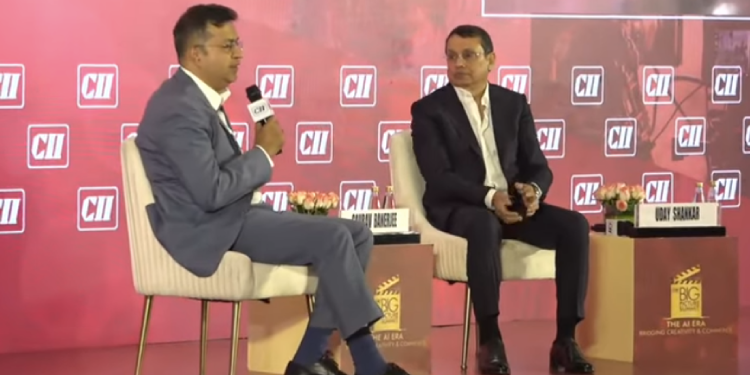
In one of the most anticipated dialogues at the CII Big Picture Summit 2025, Gaurav Banerjee, Chair, CII National Council on Media & Entertainment, and MD & CEO, Sony Pictures Networks India, sat down with Uday Shankar, Vice-Chairman, JioStar—one of India’s most influential media visionaries.
What followed was a rare, candid, deeply reflective power talk spanning the evolution of Indian media, the art of leadership, talent, risk-taking, disruptive thinking, and the limitless opportunities ahead as AI, mobile, and content consumption reshape the ecosystem.
The Media Opportunity: “People Are Consuming More Content Than Ever”
Opening the conversation, Banerjee asked Shankar where he sees hope and opportunity at a time when linear TV faces pressure, advertising is slowing, and streaming economics remain challenging.
Shankar’s answer was characteristically sharp and optimistic:
“People are consuming content everywhere, all the time. The industry is not broken—our imagination is.”
He argued that the sector’s challenges stem not from consumer behaviour but from how media companies continue to constrain themselves with outdated definitions of “TV”, formats, and distribution.
“We are creators of exciting content. Everything else—distribution, screen size, formats—is temporary.”
Shankar called out the industry’s reliance on legacy tropes such as 30- and 60-minute formats, prime-time slots, fixed screens, and narrow definitions of “premium content,” stressing that these artificial boundaries restrict growth in a world where consumption is continuous and device-independent.
“Skills Don’t Matter. The Skill to Learn Skills Does.”
Banerjee shifted the conversation to leadership and the challenges of preparing teams for a future with no precedents—whether it was building Hotstar before global streaming took off or launching India’s first 24×7 live Hindi news channel.
Shankar’s response distilled his leadership philosophy:
“Skills have a finite lifespan. But if you have the ability to pick up new skills, you will always stay relevant.”
He emphasized adaptability over expertise, noting that the media industry—ironically—often fails to introspect or adapt despite telling the world to do so.
“The world will keep changing. You have to be ready to run at the same speed.”
On Building Winning Teams: “Give Me 100% in One Subject, Not 85% in Ten.”
One of the most applauded segments of the conversation was Shankar’s breakdown of how he identifies and hires talent—something widely admired across the industry given the number of CEOs who’ve emerged from his teams.
He dismissed the default “IIT–IIM filter,” calling it a lazy HR instinct.
“Know what you don’t have. Then find the one person who is exceptional in that vertical—even if they’ve failed everywhere else.”
Like a cricket coach picking opening batsmen for specific skill sets, Shankar said leadership teams must be built with precision, not generalisation.
“A team of specialists is far more valuable than a team of all-rounders.”
He reinforced the importance of surrounding oneself with people better than oneself, not fearing it.
Risk-Taking and Failure: “If You Aren’t Failing, You Aren’t Innovating”
Banerjee recounted two audacious proposals from his own career—from broadcasting live atop Everest Base Camp to greenlighting the mammoth Marathi show Raja Shiv Chhatrapati—both approved by Shankar in minutes.
Shankar laughed off the “quick decision-maker” praise with his trademark humility but delivered a powerful insight:
“Life is about experiments. If your experiments aren’t failing, you are not innovating.”
He narrated the inside story of Panchvi Paas—an expensive failure—and how Rupert Murdoch told him to move on and keep experimenting.
“The world remembers only the successes. So why fear failure?”
Reinventing Entertainment: The Story Behind Satyamev Jayate
The room erupted when Banerjee brought up Satyamev Jayate—a show he named but credits Shankar for ideating since the days of Star News.
Shankar shared the deeper motivation behind the show:
“Star Plus was at the peak of its success. That is the right time to disrupt yourself.”
He described how the team broke every rule of entertainment television—format, tone, scheduling, marketing—and created something that redefined Sunday mornings in India.
“I didn’t know whether it would succeed. But I knew it had to be different.”
For Shankar, discomfort is the birthplace of innovation.
Leadership Restlessness: “If Everything Is Fine, I Start Getting Uncomfortable”
Reflecting on why he exited Star in 2020, Shankar said he no longer felt the restlessness that had fuelled every leap in his career.
“Restlessness is a state of being. If I’m not restless, something is wrong.”
Today, that restlessness is focused on one thing:
the transformative potential of AI.
The Future: “AI Will Free Us From Limitations—Why Shouldn’t We Be Excited?”
Shankar’s eyes lit up when Banerjee asked what excites him today.
“AI can liberate us from the constraints of budgets, talent availability, and production capacity.”
He believes AI could:
-
enable creation of limitless characters and worlds
-
democratise high-quality production
-
make talent infinitely scalable
-
unlock new storytelling forms never imagined before
“If actors are worried—why? They can now do ten shows at once with multiple avatars.”
He sees in AI the same excitement he felt when mobile streaming first emerged:
“This is the biggest creative opportunity of our lifetime.”
A Conversation That Became a Tribute
The session closed with Banerjee inviting several leaders who once worked closely with Shankar—Gunjan, Rahul, Avinash, Carol—to join the stage in an emotional moment for the “Uday Shankar school” of leadership.
Shankar, visibly moved, thanked the CII and the industry he continues to inspire.