AnyMind Group, a BPaaS company for marketing, e-commerce and digital transformation had earlier this year launched its ‘India Digital Landscape 2025’ report, offering a dive into the digital journeys and behaviors shaping India’s rapidly evolving consumer ecosystem.
Key findings from the report included:
- Social media and in-game ads now drive the highest consumer awareness, with in-game ads noticed by 43% of surveyed users.
- Influencer-led short videos stand out for brand recall and storytelling, achieving 53% effectiveness for awareness creation.
- Video ads lead conversion effectiveness, preferred by 31% of surveyed consumers at the point of purchase.
- Rich media interstitials deliver the highest clickthrough rate (CTR) at 8%, outperforming classic banner ads which trail below 2% CTR.
- In influencer marketing, entertainment is the top vertical, followed by lifestyle/home living and beauty as the leading categories in consumer engagement.
Medianews4u.com caught up with Aditya Aima, Managing Director, Growth Markets; Co-MD, India and MENA, AnyMind Group
Q. How are digital journeys and behaviours shaping India’s rapidly evolving consumer ecosystem in the festive season?
India’s growing fast, and as it does, the consumer base is scaling and splintering simultaneously. Take Gen Z, for instance, they already account for about 40% of e-commerce spending. They’ve effectively weaponised the “fear of missing out” into a business model and you can see similar fragmentation across every age group. Brands must learn to stop treating these signals as mere trends or risk bleeding margins in the short term.
It is at this very intersection that conventional reasoning betrays its limitations. Tier-2 cities are no longer ‘emerging markets.’ On a per-capita basis, they’re matching metro spending. What’s changed is trust and convenience. Payment options like UPI and even cash-on-delivery are the infrastructure of digital inclusion. Our India Digital Landscape 2025 report found that influencer videos now drive 53% higher recall in brand storytelling. That really tells you how the festive consumer journey has evolved, people discover through creators, validate through peers, check out in seconds, and then share it back into the social loop.
So, the festive shopper today doesn’t move in a straight line from awareness to purchase. She goes through at least 10 touch points before making the purchase. They bounce between social feeds, reviews, and comparison sites, and then buy on impulse triggers. Digital journeys aren’t just shaping India’s retail ecosystem anymore; they are the ecosystem.
Q. When you look at where brands advertise during the festive season is retail media like Flipkart, Amazon becoming a bigger threat to Meta, Google the main difference compared with last year?
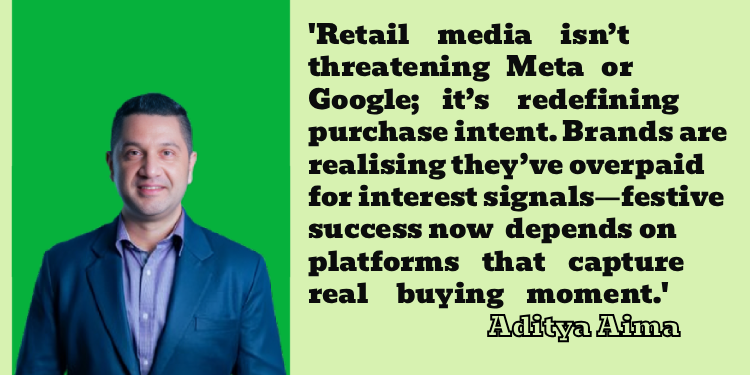
I would actually respond to the question a little differently. It’s not about whether retail media platforms are somehow encroaching upon the territory of Meta or Google, because, quite frankly, they are, well as far as the consumer buying journeys are concerned.
However, Meta and Google, still own consumer attention. They’re the interruption between you wanting something and actually buying it. Retail media like Flipkart and Amazon, especially on double days and other marquee opportunities have augmented this buying experience for consumers.
What is notable compared to last year is that brands are finally coming to terms with the truth that perhaps should have been obvious all along: they have been overpaying for interest signals, when what truly matters, particularly during the festive season, are purchase signals. Paid social moves perception; retail media moves revenue. And during this high-stakes, transaction-heavy period, GMV is precisely what you need.
This isn’t a threat to Meta and Google. This is what happens when the stack inverts. Retail media isn’t even competing for attention anymore. They’re competing on knowing exactly when you’re about to spend. They know your wallet and are successfully managing to keep the consumer in the centre.
Q. Is striking a balance between the short-term goal of performance marketing versus brand building the biggest challenge facing marketers today?
Consider the extremes: if you chase only performance, you are buying clicks with no foundation and CAC (customer acquisition cost) never drops. If you chase only brands, you look impressive, but your revenue engine sputters. The elegant solution here is integration. I call it, “the dance of synchronicity”. Brand lives in your website, content, and email, and performance captures it. Only when these work in concert does the system harmonize.
Now, let’s take the festive season as an example; the stakes are exponentially higher. You don’t have six months for brand effects, perhaps 45 days, maybe fewer. Every touchpoint must perform double duty: ads should inspire but also convert, landing pages alike, and copy should feel premium but also drive urgency.
The brands that succeed are not “balancing” anything. They have architects of an ecosystem where brand and performance operate as a seamless whole. That, in essence, is the game, subtle, precise, and uncompromising.
Q. In the past year Anymind Group has undergone leadership changes. What prompted this move and how has the going been since?
When Siddharth and I stepped into the co-managing director responsibilities for India and MENA, we weren’t solving a problem but rather we were positioning the business for what was coming.
We’d both spent years within the organisation, having come through POKKT (which was acquired by AnyMind Group in 2020), with an intimate understanding of the teams, the product architecture, and the operational rhythms that sustain growth. But institutional knowledge, however deep, doesn’t automatically translate into the capacity to scale regional operations at the pace these markets now demand. The absence of territorial friction, rare in co-leadership structures, has allowed us to focus entirely on the substantive work: staying ahead of accelerating market dynamics and evolving client expectations.
The real challenge isn’t managing the transition; it’s ensuring our leadership remains generative rather than reactive. That’s where we direct our energy daily, and that’s why this structure continues to prove effective.
Q. How is AI helping the company strengthen its verticals AnyTag (influencer marketing), AnyDigital (digital marketing), POKKT (mobile marketing) and AnyX (e-commerce)?
Most marketing platforms are drowning in data but starving for insight. Teams spend 80% of their time on execution and 20% on strategy. That ratio should be inverted. That’s where AI becomes foundational. We built AnyAI as the architecture running across all of what we do.
In AnyTag, AI handles influencer discovery and campaign planning through conversational agents. What used to take hours now happens in minutes. POKKT uses AI for real-time mobile ad optimization, dynamic pricing, personalized placements, and adapting while campaigns run. AnyDigital drives contextual targeting, understanding intent through context, not tracking. AnyX leverages AI across e-commerce, particularly customer service.
As an AI native company, the real power is cross-platform and cross-domain intelligence. Because AI is embedded across every vertical, brands get unified insights across the entire customer journey, from influencer awareness through mobile engagement to commerce conversion offering a smarter ecosystem. That’s what we’re building toward, AI handling the execution layer so teams can actually focus on the work that matters.
Q. How does Anymind Group help D2C brands balance speed with insight?
Most D2C brands think they have to choose between moving fast and making informed decisions. That’s a false trade-off created by bad infrastructure.
When your systems are actually integrated, manufacturing, commerce, customer data, and marketing, you don’t wait for insight. It’s already there. Data flows in real-time, so speed and intelligence happen together, not sequentially.
That’s the infrastructure we’ve built. The tension doesn’t get balanced. It gets eliminated.
Q. At a time when everybody is shouting, how important is it for brands to focus on authenticity and a data-driven strategy? Should vanity metrics be ditched altogether?
Authenticity isn’t a marketing tactic. It’s the natural consequence of an honest data strategy. You cease optimizing for metrics that placate stakeholders and begin optimising for what genuinely moves customers. Conversion rates, retention, lifetime value, these are unforgiving measures. They don’t permit you to hide behind vague notions of “brand awareness” when your product isn’t selling.
So should vanity metrics be abandoned entirely? They serve one limited purpose: confirming you’ve purchased attention. But if that attention fails to convert to intent, you’ve simply funded noise. The ultimate goal should be that your signal penetrates the noise because it’s anchored in what customers actually do, not what brands wish they would do.
Q. An AI actor Tilly Norwood is creating a furore in Hollywood. Could AI innovations like her turn marketing upside down?
Let’s take influencer marketing for instance, it works because there’s a real, parasocial trust between the audience and the influencer. AI can simulate that, but simulation isn’t the same as genuine human connection. And that’s where we risk accelerating the AI fatigue we’re already starting to see.
So the way forward isn’t replacing people; it’s using AI to amplify human creativity while preserving what only humans can bring. For functional use cases, product demos, localized adaptations, or scale-driven campaigns, AI talent makes absolute sense. Ambassadors who don’t age, don’t have off-days or controversies, and work around the clock, it would be foolish not to explore that. But for storytelling that needs emotion, authenticity, and trust, humans still lead the way.
Q. How much R&D went into creating a new product AnyLive for creators?
R&D is a way of everyday martech life. Running iterative testing and cross-market feedback loops, trying to understand how creators actually behave on live platforms, what tools slow them down, and what data they actually care about.
We ran prototypes across multiple countries before locking the final build. So by the time AnyLive launched, it wasn’t just another live commerce tool, it was something creators had in a way co-designed with us.