Raintree Foundation is a systems-first foundation. It restore forests that recharge water, empower women-led farming, and strengthen livelihoods through clean energy, proving that balance creates lasting change.
At a time when technology dominates every aspect of life, the Raintree Foundation earlier this year had launched a campaign, “I Am Not a Robot,” to remind people that saving the planet needs heart — not just machines.
The campaign urges individuals and communities to reconnect with nature and act consciously for the planet. It turns the familiar CAPTCHA phrase into a statement of purpose — “I am human. I act for the planet.”
Raintree Foundation explains that it has been working across Maharashtra’s Western Ghats — in regions like Velhe and the Shastri River Basin — where it focusses on water conservation, biodiversity, and rural livelihoods. The new campaign draws from this work, emphasizing that while technology can help, it is human empathy and action that truly drive change.
‘I Am Not a Robot’ unfolded across digital platforms, universities, and public spaces:
- Digital Launch: Interactive posts on social media will invite people to “Prove you’re human — act for the planet.”
- On-ground Engagement: Installations and booths at youth festivals like Mood Indigo and Frames will encourage participants to share personal pledges for the environment.
- Public Dialogue: Articles, podcasts, and panels will explore how compassion and responsibility can strengthen India’s climate movement.
The campaign aims to connect with young people, urban citizens, and the Indian diaspora — inviting them to reflect, participate, and take small, meaningful actions for a healthier planet.
Through ‘I Am Not a Robot’, Raintree Foundation hopes to inspire a movement that goes beyond awareness — one that puts empathy at the heart of climate action.
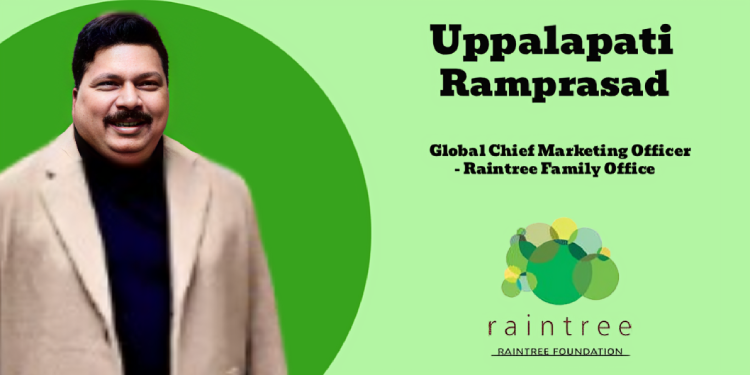
Medianews4u.com caught up with Uppalapati Ramprasad, Global Chief Marketing Officer, Raintree Family Office, Raintree Foundation
Q. Bill Gates recently said that climate action should focus on human welfare. Your views?
From a marketing and development lens, I believe his point is valid. Climate action gains traction only when people feel its direct connection to their lives — their wellbeing, dignity, economic security and sense of agency. If we frame climate change only as an environmental challenge, we miss the opportunity to mobilise people at scale. A human-first narrative brings climate change closer to the ground and allows communities to see themselves as partners, not spectators.
What’s important — and often overlooked — is that human-centric narratives create emotional permission for people to act. Behavioural change rarely emerges from scientific charts; it emerges from identity, pride and belonging. When climate action is framed as improving your family’s wellbeing, your community’s future and your children’s prospects, participation becomes instinctive. That shift in storytelling is what will mainstream climate action in India and globally.
Q. Has he said the quiet part out loud, or is he missing a point?
I think he has voiced a truth that people in the ecosystem feel but often don’t articulate publicly — that climate solutions must show real value to real people. When climate discourse is dominated by technical jargon, it alienates audiences. His point is that a human-first climate agenda is not a distraction from science; it is an enabler of better science outcomes because it builds public will.
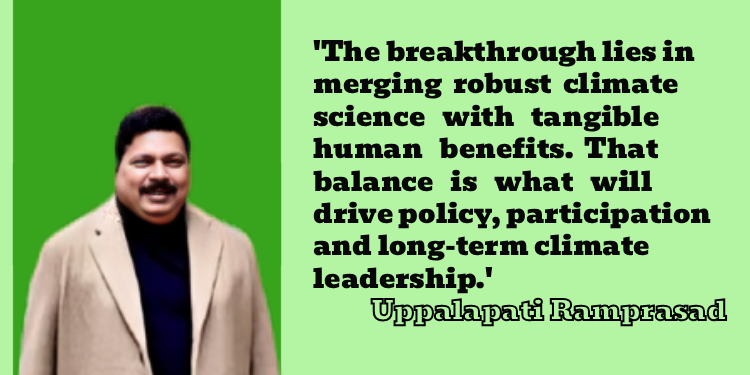
Where I feel the nuance lies is in the risk of binary framing. Climate communication often swings between extremes: either hyper-technical or hyper-humanitarian. The real breakthrough lies in merging the two — using robust science to create human benefit, and using human benefit to build societal demand for stronger climate policy. That equilibrium is difficult but necessary, and the brands and organisations that get it right will shape the next decade of climate leadership.
Q. Raintree Foundation’s integrated approach across climate, community and biodiversity
Our approach is anchored in the idea that ecological and human systems are inseparable. We design programmes where watershed restoration strengthens agriculture, where biodiversity revival leads to healthier soils, and where community participation ensures long-term stewardship. This interconnected approach ensures that climate resilience is not a theoretical construct but a lived experience for the people in our landscapes.
What differentiates this model is that it creates circular impact loops, not linear interventions. Most projects treat climate, biodiversity or community as single-issue problems. But resilience is only achieved when improvements reinforce each other — when better water security increases incomes, when stronger incomes reduce pressure on forests, and when healthier forests further stabilise the climate. This is where impact compounds, and it’s the direction modern climate programming must shift toward.
Q. Is it a challenge that many view climate, community and biodiversity as a box-ticking exercise?
Yes, and it remains one of the most entrenched behavioural challenges. Too many corporate or policy-led interventions are still built around compliance or visibility rather than transformation. This reduces climate action to symbolic acts with limited longevity. Our work has been to move away from “token conservation” toward long-term, measurable change that builds community ownership and institutional strength.
The deeper insight is that box-ticking persists because it’s easier to report activity than impact. Impact requires time, science, rigorous monitoring and uncomfortable transparency. But as climate risks intensify, stakeholders — from regulators to consumers — are demanding authenticity. The organisations that shift from box-ticking to long-term stewardship will be the ones that shape public trust in the sustainability space. The ones that don’t will get filtered out by accountability, not competition.
Q. How did the idea for the I Am Not a Robot campaign come about?
The campaign began with a simple insight: caring for the environment is a deeply human instinct. We wanted to remind people that, like us, every other life form is alive, sentient and deserving of the right to thrive. Yet when it comes to philanthropy, climate change as a category still sits low in priority, far behind causes that feel more immediate or emotional. One of the core motivations for this campaign was to shift that equation, bring climate giving into sharper focus and make it impossible to ignore.
What excites us most is that the campaign uses the familiar language of the internet to challenge apathy. By turning a CAPTCHA-style prompt into a climate prompt, we are positioning climate action as the most human thing left to do. It creates a narrative space where technology and humanity aren’t in conflict but in conversation and that’s the sweet spot for modern impact storytelling.
Q. Does the goal of marketing revolve around encouraging community-driven conservation?
Yes. For us, marketing isn’t only about awareness; it’s also about mobilisation. Every narrative we build is designed to shift people from passive observers to active stewards. Conservation succeeds only when communities feel that environmental protection is part of their identity, not an external responsibility imposed upon them.
The strategic insight here is that community-driven conservation builds social capital, and social capital is the strongest predictor of long-term climate resilience. When people feel connected to each other and to their landscapes, they protect both. Marketing that strengthens this social fabric is more powerful than any campaign that focuses only on facts or fear. That’s the transformation we are working toward.
Q. What is the social-media strategy to participate in the conversation?
In today’s digital environment, people face an overwhelming volume of content and extremely limited attention spans. For a campaign to break through that clutter, it needs a device that is instantly recognisable, native to the internet, and able to make people pause. That is why the campaign uses the CAPTCHA — a digital-native verification tool that every user instinctively understands.
By adopting a device intrinsic to the online ecosystem, we created an immediate ‘penny‑drop’ moment: something familiar enough to stop the scroll, yet surprising enough to provoke reflection. This creative choice allows us to humanise complex climate issues and invite audiences to participate through a format they encounter daily. The CAPTCHA becomes both the message and the mechanism — a perfect match for a campaign built around the idea of proving one’s humanity through action.
Q. Could you talk about on-ground initiatives through university partnerships?
We are partnering with leading colleges and universities at their major tech and cultural festivals to engage youth who are increasingly conscious about their environmental future. These on-ground activations use interactive formats to spark agency, encouraging students to see themselves as future leaders capable of driving meaningful climate action.
Q. What are the key markets for 2026 — pan-India or targetted?
Our approach for 2026 is targetted rather than pan-India. We are focusing on markets that influence climate policy and have strong philanthropic ecosystems. This includes Delhi, where key policymakers are based, as well as major metro cities connected to the Western Ghats — regions where people inherently understand the ecological importance of this landscape.
These priority cities include Mumbai and Pune, along with southern metros such as Bengaluru, Chennai and Kochi, which are closely linked to the Western Ghats and home to influential philanthropists. By concentrating on these centres of policy influence, environmental awareness and high-impact giving, we aim to mobilise stronger support for climate action in one of India’s most critical ecological regions.
Q. Do organisations need to track outcomes rather than just reach?
Yes, absolutely. What matters today is demonstrable, scientifically validated ecological and social impact — healthier water systems, revived biodiversity, stronger community institutions and improved livelihoods. Outcomes are the only credible currency in climate communication.
The deeper insight is that measurement is becoming a competitive advantage. Companies that can quantify impact with rigour will earn stakeholder trust, attract better partnerships and differentiate themselves in a crowded CSR ecosystem. Transparent, outcome-based storytelling will become the backbone of climate reputation in the next decade.