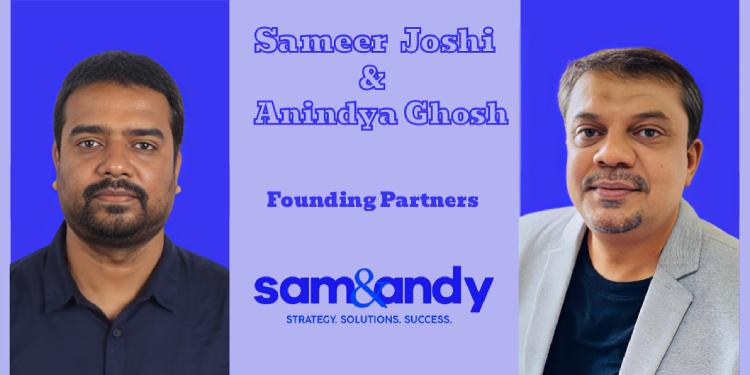
Sam & Andy is a Mumbai-based strategic brand marketing company.
Led by Sameer Joshi and Anindya Ghosh, with 38+ years of cumulative experience across strategic marketing, brand management, digital solutions, and mainline advertising (India & global markets), Sam & Andy partners with brands and communication agencies as their strategic brand and marketing planning arm.
The firm says that it strongly believes that brand and business are two sides of the same coin—called growth.
Medianews4u.com caught up with Sameer Joshi, Anindya Ghosh, Founding Partners Sam & Andy Brand Consultancy
Q. In 2025, did advertisers struggle to balance brand building versus performance marketing? Is AI making this balance easier?
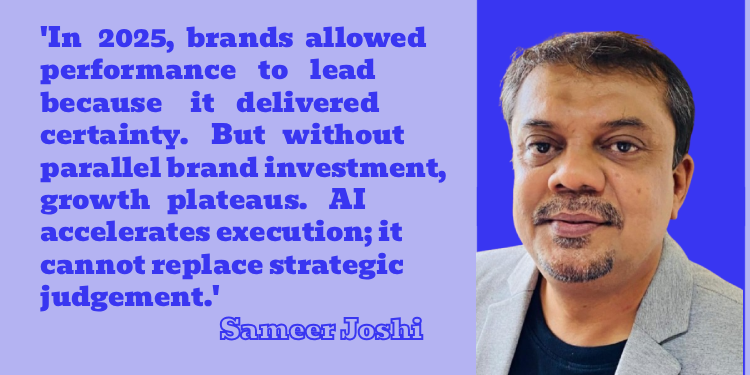
I wouldn’t call it a struggle as much as a conscious choice. In 2025, most brands, especially startups, deliberately prioritised performance marketing over brand building. Sales became the immediate objective and performance delivered measurable returns, so brand campaigns naturally took a backseat. You can see it clearly: even large, established brands ran fewer pure brand-led campaigns this year. It wasn’t confusion; it was intent. Performance was allowed to lead, with the belief that visibility and sales would follow.
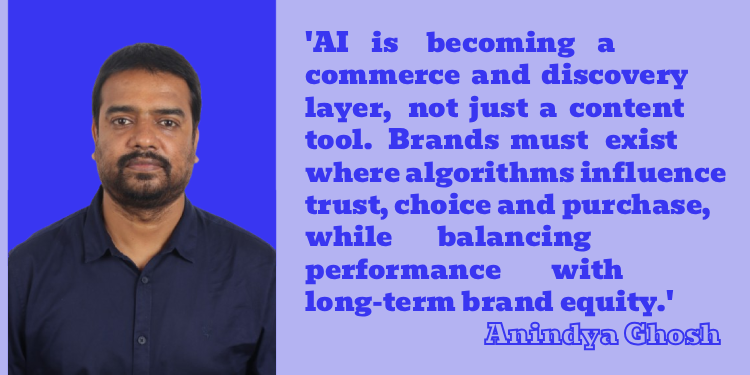
On AI, the conversation is still evolving. Most people see AI purely as a content-creation tool and yes, it has disrupted how content is produced. But the real shift is bigger. Earlier, brand discovery was about websites and search engines; today, brands also need to exist within AI-led discovery and recommendation systems.
AI is quickly becoming a commerce layer in itself. Just as consumers once searched on Google and bought products, AI platforms are now influencing what people discover, trust and eventually purchase. That’s a significant change and one that brands are only beginning to understand.
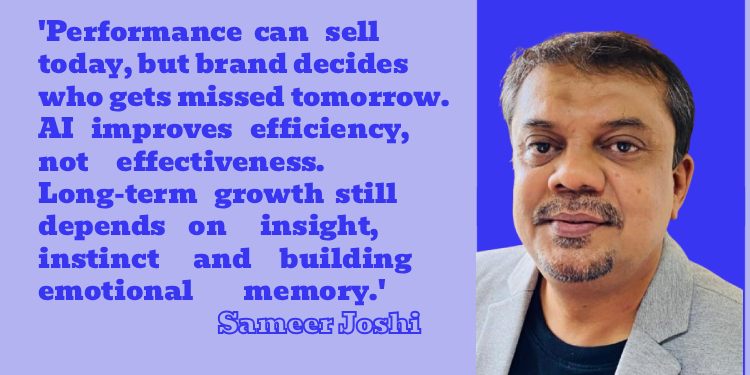
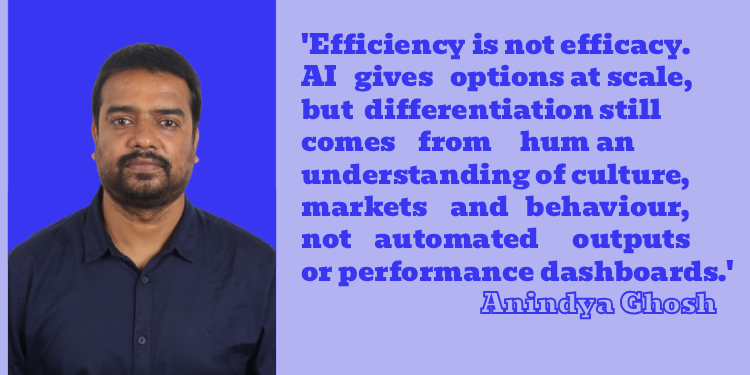
To build on that, AI has unquestionably improved efficiency, speed, volume and agility. Performance teams can do more, faster. But efficiency is not the same as efficacy. I use AI daily, across creativity and communications and while it gives me multiple options in minutes, the outputs rarely work on their own. Real impact still comes from market understanding, instinct and experience.
On the larger question of brand versus performance, the balance is non-negotiable. Performance can drive transactions, but brand creates memory, meaning and loyalty. A brand that relies only on performance may sell well today, but if it disappears tomorrow, very few people will truly miss it. Compare that to something like Maggi, when it left the market, consumers felt a genuine absence. That emotional gap is brand power.
The strongest businesses today are those building both simultaneously. Performance creates demand; brand sustains it. We’ve seen cycles where brands chased short-term sales and later struggled when performance alone couldn’t carry growth. The lesson from 2025 is clear: performance may lead in the short term, but without brand, there is no long-term resilience.
Q. Did an obsessive focus on short-term metrics erode long-term brand growth in 2025? Will this continue in 2026?
This is, in many ways, an outdated framing of the problem. Today, no brand, not even the largest FMCG players, has the luxury of saying, “Let’s build the brand for 18–24 months and results will follow.” Businesses are living quarter to quarter, and that reality isn’t going away.
At the same time, most marketers have realised that pure short-termism doesn’t work either. Yes, quarterly numbers matter because that’s how organisations operate, build confidence internally, and justify continued investment. But long-term equity is equally non-negotiable. The real question is no longer short term versus long term; it’s how you build equity and relevance simultaneously.
We look at this through what we call the 3-6- 365 model. The first three months are about getting the business sales-ready: putting demand generation, funnels and conversion systems in place so the cash register starts ringing. Without that, marketing cannot sustain itself.
The next six months are about structure and clarity: understanding segments, price points, micro-markets, purchase behaviour and defining brand tonality and templates. You’re not “building the brand” fully yet, but you’re creating consistency and direction.
Only after that does the full brand-building phase come in: positioning, architecture, portfolio thinking, research and long-term equity creation. Importantly, brands have clear exit points at three months, six months or post-365 days, so they can assess impact and decide how aggressively they want to invest.
So the debate isn’t brand versus performance anymore. It’s equity versus relevance, acquisition versus retention and top-line versus bottom-line. Short-term growth builds confidence and momentum; long-term equity strengthens profitability and resilience. The brands that will win are the ones that stop treating these as opposing forces and start designing systems where they reinforce each other.
Q. Did marketing plans that were not aligned with P&L struggle in 2025? In 2026, will every successful campaign begin with a clear business objective?
It’s not a trend for the future, it has always been the rule, and in 2025 it became non-negotiable. Marketing cannot exist in isolation from the business anymore. If it does, it will simply not survive.
The core issue is mindset. CMO is no longer just a designation; it’s a way of thinking. Marketing cannot be treated as a once-a-year planning exercise. It has to be broken down month-wise, quarter-wise, half-yearly and tied clearly to revenue outcomes. If marketing is not building a pipeline, not influencing demand and not contributing to growth, then it’s failing its fundamental role.
What we saw in 2025 was a clear shift at the leadership level. CEOs are now asking very direct questions: What is the accountability? Where is the ROI? Activities that could not justify their impact, no matter how fashionable or long-standing, were questioned or shut down. Not because they were “wrong,” but because they couldn’t prove business value.
The takeaway is simple. If marketing is reduced to advertising, it’s gone. If it’s only about likes, shares or subscriptions, it’s gone. Marketing today must be deeply integrated with the P&L, driving measurable outcomes and commercial relevance. Every successful campaign will start with a business objective, not as an afterthought, but as its foundation.
Q. How did AI and automation expose weak thinking rather than replace strategists in 2025?
AI did not replace strategists in 2025, if anything, it exposed weak strategic thinking. At best, AI can generate quick frameworks, options or directions, but they are largely generic. Strategy, by its very nature, cannot be generic.
When we evaluate AI in our own work, especially while defining brand positioning, we often use it as a reference point. If AI throws up certain positioning spaces, we consciously avoid them. Why? Because those spaces are accessible to everyone. If you and I feed the same prompt into the system, we will get similar answers. That immediately tells you where differentiation dies.
Strategy is not output; it is thinking. It is lived experience, human insight, market understanding and judgement. AI operates at a surface level. It can inform, evolve or even educate someone on what strategy is. It can generate decks, structures and language. But relevance comes from interpretation, not generation.
Another reality became very clear in 2025: clients also know how to prompt. If they can ask the same questions and receive the same answers, the value of a strategist disappears. That’s when the real question arises, why hire an agency at all if everything looks the same?
The brands that stand out are differentiated and distinct, and that distinction only comes from human intelligence. AI can support the process, but strategy demands intuition, context and originality. In 2025, AI didn’t replace strategists, it revealed who was actually thinking and who was simply assembling information.
Q. Are successful advertisers now focussing more on an always-on brand ecosystem rather than only big-bang festive or IPL-led campaigns?
IPL and Diwali have never been substitutes for brand building, they are amplification moments. Traditionally, brands communicated at two points in the year: at launch and during Diwali.
Over time, IPL emerged as the third big cultural moment in India. Naturally, a large share of media budgets flows into these occasions, just as brands in the US reserve budgets for the Super Bowl or Christmas.
But the role of these moments is very different. IPL is fundamentally a brand-led platform. Its strength lies in reach, awareness and storytelling. Over the years, it has evolved into India’s equivalent of the Super Bowl, complete with its own creative templates, characters and narratives that audiences actually wait for. IPL is appointment viewing.
For three months, it removes the clutter and decision fatigue of television and OTT. People watch with leisure, attention and openness to stories. That’s why narrative-driven brand communication works so well here.
Diwali, on the other hand, is largely transactional. It’s about shopping, bonuses, offers and discounts. The consumer mindset is not about storytelling; it’s about value and immediacy. So naturally, Diwali communication leans more towards sales activation than long-term brand narratives.
What has changed is how brands think beyond these moments. Smart advertisers no longer wait for IPL or Diwali to define their brand. Product launches may or may not align with IPL and sometimes budgets are better deployed elsewhere if the scale doesn’t justify the spend. The real shift is towards building a continuous brand ecosystem, with IPL and Diwali acting as powerful accelerators, not the foundation.
Q. While many clients focussed on purpose-led advertising, has it become generic? What is the way forward to truly stand out?
Purpose didn’t fail, performative purpose did. Somewhere along the way, purpose became showbiz. Beautiful films, strong storytelling, big social statements… and then nothing changed on the ground. Consumers have seen enough of that. Today, they are far more discerning. If a brand claims purpose, people want to see commitment, action and sacrifice; not just communication.
The uncomfortable truth is this: purpose cannot exist in isolation from profit. If it doesn’t sit inside the business model, it collapses. We’ve seen countless campaigns around women empowerment or social good that looked impressive but had no real impact. People eventually figure that out. When that happens, trust erodes faster than it was built.
Real purpose is when a brand is willing to put money where its mouth is, when ownership is prepared to redirect profit to solve the problem it claims to care about. In those cases, purpose becomes integral to the brand’s DNA, not a seasonal narrative. That’s when consumers lean in, support the brand and invest emotionally.
Another mistake brands make is confusing CSR with purpose. CSR is mandatory. Purpose is voluntary and strategic. It has to be deeply connected to the category, the product and the brand’s ability to deliver. If the linkage isn’t natural, it becomes hollow. A cause that has no relevance to what you sell or how you operate is not purpose, it’s noise.
Most importantly, purpose cannot be a campaign. Campaigns come and go. Purpose has to be a long-term strategy. When viewed strategically, it automatically forces the right questions: relevance, credibility, profitability and impact. That’s the way forward. Not louder purpose-led advertising, but fewer, more honest brands willing to live their purpose every day.
Q. In 2026, will brands focus more on culture, behaviour and values instead of age and income buckets?
One hundred percent, and this shift has already begun. At Sam & Andy, we’ve moved well beyond viewing audiences purely through demographic lenses. Age, income and SEC may still offer a broad frame, but they no longer explain decision-making.
What truly matters today is mindset. And mindset is shaped by culture, behaviour and values. You can take three people of the same age, income bracket and social class, yet each will respond very differently to a brand. That difference comes from who they are, how they think and what they believe, not what bucket they fall into.
Digital has accelerated this change. When you can reach individuals directly, personas become far more powerful than population segments. Culture and behaviour define the persona and the persona defines relevance.
In the future, brands that win will be those that understand people as individuals with distinct mindsets not as averages defined by age or income.
Q. While brands are increasingly data-driven, does data interpretation still remain a challenge across categories? Are AI and analytics easing this?
The problem today isn’t lack of data; it’s clarity. We have an abundance of information, but very little direction on how to use it. Data is like crude oil, we have plenty of it, but we don’t always know how to refine it or where to deploy it for real business impact.
The bigger issue is application. Which data matters? How should it be linked to behaviour, purchase intent, creativity and outcomes? All of these are connected, but when data is treated in silos, it loses relevance. Instead of driving decisions, it becomes a polished boardroom artefact, something that looks impressive in presentations but doesn’t translate into action.
AI and analytics can help, but only to a point. AI will give you data dumps; it won’t tell you what to do with them. Data only becomes powerful when you know why you’re collecting it, what questions you’re trying to answer and which metrics truly matter. Without that intent, even AI-led interpretation ends up being generic and superficial.
The real value still lies in human judgement, defining the problem, identifying the right inputs and connecting the dots. AI can accelerate analysis, but insight comes from knowing what to look for and how to use it.
Q. With digital-first strategies becoming the norm, is understanding the unique USP of each platform (Reels, YouTube, etc.) the real differentiator?
Every platform has its own way of working. Google, Meta, YouTube; each operates on a different logic, behaviour pattern and consumption mindset. The real differentiator isn’t obsessing over platform “USPs” as buzzwords, but knowing which platform to use, when and for what role.
This is no different from how traditional media was planned. You never treated TV, radio or print the same way. You chose the medium based on what the brand needed to achieve. Digital works the same way. Google, Meta and YouTube are not interchangeable; they are part of a larger media mix, each serving a distinct purpose in the consumer journey.
Success comes from understanding the role each platform plays and integrating them intelligently, rather than forcing one idea across all platforms. It’s about orchestration, not platform heroics.
Q. Will micro-dramas gain traction in 2026? Is there a risk of brands adopting the format without understanding its unique skill set?
Microdramas will gain traction, but they need to be understood for what they truly are: a format, not a strategy. Just like Reels, influencer videos or short-form films before them, microdramas are simply another way to package content for digital consumption.
We’ve seen this cycle before. There was a time when 30-second TVCs dominated. Then came longer-format brand films. Today, attention spans and platforms have pushed storytelling into shorter, episodic formats. Microdramas sit squarely in that evolution. They’re not the equivalent of “vertical TV,” and they’re certainly not a long-term replacement for brand thinking.
The risk is when brands mistake the format for the idea. Microdramas require a very specific storytelling skill: tight narratives, strong hooks and emotional payoff in seconds. When brands jump in just because the format is trending, without understanding how to use it meaningfully, the content quickly becomes forgettable.
Microdramas are best seen as one more tool in the content ecosystem. They serve engagement, not brand strategy. Something else will eventually replace them, just as formats before them evolved. The brands that succeed are the ones that use microdramas thoughtfully, as a way to serve content, not as the content itself.
Q. During pitches, why are brands increasingly seeking strategic growth partners rather than only execution agencies?
Because execution without direction doesn’t work anymore. Brands are under pressure to sell, scale and move fast; but many have realised that speed without a plan only creates noise. That’s why there’s a clear return to fundamentals. Strategy is coming back to the centre of the conversation.
Execution is essential, but if it’s directionless, it leads to sameness. Today, everyone is using the same influencers, the same formats, the same digital playbooks. Once one execution works, ten brands copy it. In that environment, differentiation doesn’t come from how you execute, it comes from what you’re saying and why you’re saying it. And that only comes from strategic thinking.
Brands are now asking sharper questions during pitches: What is the positioning? What is the message? How does this create distinction? Even if the format is similar, strategy ensures the communication stands apart.
You can see this clearly with large organisations and PSUs as well. They’re no longer satisfied with celebrity-led campaigns without a clear reason. The question now is: Why this person? What equity do they bring? How does it align with the brand and how does it drive long-term differentiation?
That’s why agencies are being evaluated as growth partners, not just executors. Brands want someone who can define the direction first and then execute with purpose.
Q. Could you share your perspective on the rise of the strategic generalist over narrow specialists?
At the core, a strategist is someone who can bring clarity out of chaos. That’s the defining skill. In complex businesses, information is everywhere. What matters is the ability to cut through it, set priorities and distinguish what is truly important from what is merely urgent.
This is where strategic generalists stand out. They understand the entire business, not just one function. They can see how marketing connects to sales, how brand links to revenue and how strategy translates into execution. Their strength lies in breaking big, complex problems into clear, actionable steps.
Specialists are valuable, no doubt. But without a unifying point of view, specialisation can lead to fragmentation. A strong strategist provides direction. With clarity and focus in place, execution becomes sharper and more effective. That ability to lead with perspective, not just expertise, is why strategic generalists are increasingly in demand.