Primus Partners is a leading advisory firm delivering strategic insights across policy, technology, and economic sectors. Last year, the firm had unveiled its latest report, ‘Empowering Small Businesses through Digital Advertising’. It was a study based on a survey of over 1,000 MSMEs and startups across India. The report underscores that digital advertising has become one of the most potent accelerators of small business growth, driving visibility, efficiency, and measurable returns at a scale previously inaccessible to smaller enterprises.
The study shows that India’s SMB sector is undergoing a decisive shift embracing data-driven marketing, diversifying across platforms and formats, and increasingly adopting AI to optimise campaigns and reduce inefficiencies.
Yet, even with this momentum, many small businesses continue to struggle with cost pressures, skill gaps, and the challenge of navigating an increasingly complex advertising ecosystem.
Medianews4u.com caught up with Sunita Mohanty, Managing Director, Primus Partners
Q. How much did SMBs spend on advertising in 2025? What growth is expected in 2026?
When we worked on the report, we were unable to get the exact numbers for advertising in in the initial stages itself. Small businesses do not plan advertising with fixed annual budgets. Their spending is closely tied to cash flows and business cycles.
Therefore, we focussed on behaviour and dependence. At the macro level, India’s total advertising market is estimated at $ 11.4 billion, with roughly 46 to 49 % now digital.
At the SMB level, our survey shows that 76.7 % of businesses already use online advertising, and 89.5 % said their teams find online advertising easier to manage than traditional media. That ease of management is critical. It explains why digital advertising has shifted from being discretionary to a core operating expense.
Looking ahead, India’s digital advertising market is projected to grow at nearly 19 % annually, reaching around $7 billion by 2026. Translating this for SMBs, this growth will be factored by smarter use of digital tools driven by sharper targetting, AI-led optimisation, and broader participation across regions.
Q. What is the media mix split for SMBs between digital and traditional media? Is this changing in 2026?
Every small business we spoke to have a different media mix. However, almost all of them told us the same thing: digital is increasingly where the action is. Some still use traditional media for credibility or local visibility.
However, for others, there is a clear shift from traditional mode to usage of digital tools and traditional advertising is only working as a supplementary power to online advertising.
This change is seen in the data: 76.7 % of SMBs find online advertising more effective than traditional media, especially for customer acquisition, revenue growth, precise targetting, and geographic expansion. As a result, digital’s share in SMB marketing budgets keeps increasing. By 2026, it will likely be the focal point of marketing strategies with traditional media playing a supporting role.
Q. Are agencies doing enough for SMBs amid cost pressures and ecosystem complexity? What should improve by 2026?
Agencies play an important role for small businesses, and most SMBs recognise this. Many of the respondents shared during the course of the survey that agencies helped them get started, understand platforms, and interpret performance data.
In fact, 73 % of SMBs work with external agencies, and over 90 % say agencies have made it easier to adopt tools and access analytics. However, the ecosystem still feels complex from an SMB’s perspective.
Skill gaps, tight budgets, and the increasing number of platforms and formats often lead to confusion. As one business owner said, “Support exists, but it is not always simple.” In 2026, SMBs will need clearer guidance, common benchmarks, and more standardized frameworks. This should be supported by closer collaboration between platforms, agencies, and public-private initiatives, rather than fragmented advice.
Q. Will AI significantly reduce digital advertising costs for SMBs in 2026 while helping grow revenue?
When we talked to small business owners regarding AI, their enthusiasm was evident, but so was their pragmatism. Many of the respondents viewed AI is a tool to minimise errors and enhance their decision-making powers however AI leading to reduction of advertising expenditures was a much-welcomed surprise.
The statistics support this perspective. More than 92.5 % of SMBs think that AI boosts efficiency, creativity, and return on investment. One business owner encapsulated this idea: “AI did not decrease our spending however it enabled us to spend more intelligently.”
In 2026, AI is poised to assist SMBs in maximising their current budgets through improved targeting, optimisation, and timing. Any potential savings will rely less on the technology itself and more on how effectively and confidently businesses can implement it.
Q. Are there examples of AI helping SMBs optimise campaigns and reduce inefficiencies?
Yes, and this was most evident in discussions with business owners. Many of the respondents simply notice improvements in functionality.
Some mentioned that automated bidding helped them manage their spending effectively. Others highlighted how fraud detection tools safeguarded their limited budgets. Several described how chatbots managed customer inquiries, allowing their teams to concentrate on sales.
The report illustrates this through examples of AI applications in ad serving, bidding optimization, predictive analytics, fraud prevention, and customer interaction. The shared element in these accounts is straightforward: AI minimises inefficiencies and uncertainty, which often holds more significance for a small to medium-sized business than mere cost reductions.
Q. Is the creation of responsible AI frameworks a major challenge?
Very much so, and SMBs themselves are saying this. Over 90 % recognise the need for responsible AI, especially to avoid deceptive content, misinformation, and loss of consumer trust. What stood out was the maturity of this concern. Small businesses do not want unchecked automation.
They want AI that is transparent, fair, and easy to understand. As AI starts to affect visibility and outcomes, clear and balanced governance frameworks will be essential for maintaining trust in digital advertising systems.
Q. Are platforms like Amazon Ads and LinkedIn customising solutions for SMBs, and is this helping overseas expansion?
In our conversations during the survey, one question was on how often small businesses talked about unexpected reach. Many began advertising online for local visibility and soon found customers coming in from other states and even overseas. Platforms like Google, Meta, Amazon, and others were mentioned often because they allow for scale and measurement.
This is shown in the data: over 70 % of small and medium-sized businesses say digital advertising helps them reach beyond their home state, and 44 % have already expanded both domestically and internationally. In short, platform-led advertising is helping small businesses think beyond local markets.
Q. Will data-driven marketing become non-negotiable for SMBs in 2026?
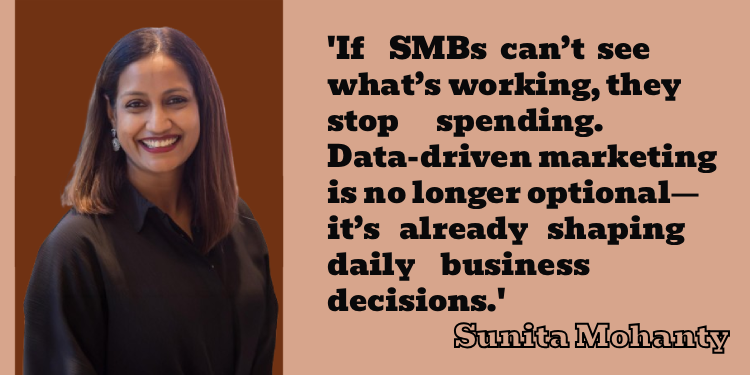
For most small businesses today, this shift is already underway. More than 90 % reported that they actively track campaign performance and ROI. Almost all now use digital measurement tools as part of their daily decisions.
One founder expressed it well: “If we cannot see what is working, we stop spending.” This mindset represents a significant change. By 2026, data-driven marketing will influence the way SMBs operate.
Q. What technology advances are helping SMBs better measure ROI?
What really changed the game for many SMBs was how quickly they could see what worked. Instead of waiting for a campaign to end, business owners told us they now adjust spending, creative, and targetting almost in real time.
Digital dashboards and analytics tools have made this possible. SMBs increasingly track simple, actionable metrics like clicks, conversions, reach, and frequency. They use these metrics to make quick adjustments. For SMBs, measuring success has moved from reporting to everyday decision-making.
Q. Has digital made the concept of primetime advertising irrelevant for SMBs?
Digital advertising has not eliminated primetime but has it has changed how we think about it. Many respondents mentioned they no longer schedule campaigns around set hours.
They focus on behaviour and react to customer intent. One retailer explained, “We do not think in terms of evening or weekend anymore. If the customer is searching or scrolling, that’s our primetime.”
The data backs this change, as many small and medium-sized businesses now run campaigns weekly, daily, or even continuously, adjusting their spending in real time. For SMBs today, primetime is no longer about the clock. It is about being relevant at the right moment.
Q. Will new formats like meme marketing be aggressively adopted in 2026?
There is a clear openness to newer, informal formats, but with a practical view. Respondents often mentioned experimenting when formats feel low-cost, low-risk, and culturally relatable.
One D2C brand shared that short, funny content on social platforms helped them “blend into conversations rather than interrupt them.” This attitude shows why formats like memes are becoming more popular. Adoption in 2026 will likely rely less on trends and more on whether these formats are easy to create and deliver quick results.
Q. Will SMBs use microdramas in 2026? Does this require a separate skill set?
Narrative-led formats like microdramas sparked both curiosity and caution. Several respondents noted that while video consumption is growing, storytelling formats require a different level of planning and creative confidence.
One case study in the report described a regional brand using short episodic videos to explain product use over time. This helped improve engagement, but it took multiple iterations to get right. This reinforces a recurring theme in the report: new formats do not just need access; they need skills, guidance, and the confidence to experiment effectively.