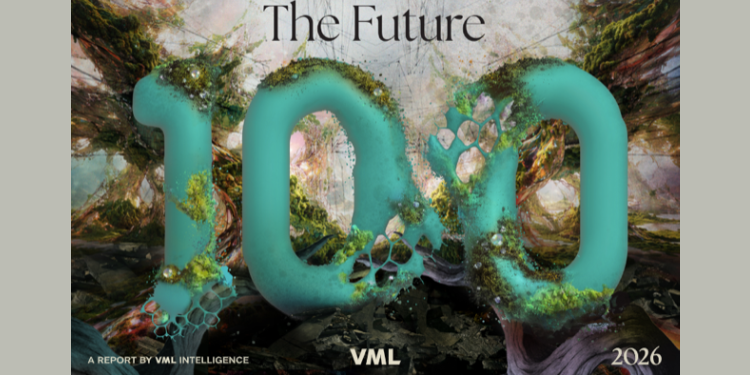
Mumba: As 2026 unfolds against a backdrop of geopolitical uncertainty, economic flux and rapid technological change, VML has introduced a new cultural lens to decode the moment. Its 12th annual Future 100 report identifies “dystoptimism”—a mindset that accepts systemic breakdowns without giving in to despair, and actively looks for renewal—as the defining ethos shaping consumer behaviour in the year ahead.
Based on a global survey of 15,639 adults across 16 markets, The Future 100: 2026 maps 100 trends influencing business, culture and consumer decision-making. The report suggests that people are no longer simply enduring disruption; they are reframing it as a catalyst to rethink how they live, spend, work and connect.
“Dystoptimism reflects a collective understanding that while old systems are failing, new, more human-centred alternatives are being built,” said Emma Chiu and Marie Stafford, Global Directors at VML Intelligence and co-authors of the report. “It’s about designing a better future rather than longing for the past.”
Seeking enlightenment, not escape
One of the report’s central findings is a growing desire for meaning, joy and perspective amid ongoing adversity. Exhausted by cycles of bad news and uncertainty, consumers are gravitating towards experiences that promise emotional uplift and personal growth.
According to the study, 86% of respondents are drawn to encounters that inspire awe or reshape their worldview. This has fuelled trends such as transformative travel, immersive wellness retreats and resilience-focused wellbeing programmes that blend emotional, physical and spiritual tools. Short, high-impact “nano trips” are emerging as affordable ways to reset, while “treatonomics” points to the rise of small, frequent indulgences as a coping mechanism even as consumers cut back elsewhere.
AI evolves from utility to partner
Artificial intelligence is another major force reshaping the consumer landscape—no longer viewed solely as a productivity tool, but increasingly as a collaborator. The report highlights how AI is enabling real-time, adaptive environments through generative realities and AI-driven storyworlds, blurring boundaries between entertainment, commerce and experience design.
More strikingly, AI is becoming emotionally embedded in daily life. Nearly half (49%) of Gen Z respondents say they have already formed a meaningful relationship with AI, reflecting the rise of synthetic companions and automated co-workers. At the same time, the report flags growing pressure on governments, platforms and brands to rebuild trust through transparency, accountability and ethical design, with trends such as truth literacy and coded empathy gaining prominence.
Human connection still matters most
Despite the rapid blending of digital and physical worlds, The Future 100: 2026 finds that human connection remains non-negotiable. In a hyperreal culture where memes turn into products and online language seeps into everyday speech, consumers still prefer human interaction when making important decisions.
Community-led spaces are seeing renewed interest—from social wellness clubs and sober raves to neighbourhood “third places” designed around belonging rather than transactions. These trends signal a pushback against isolation and algorithmic living, reinforcing the value of shared, real-world experiences.

“The brands set to lead in 2026 will be those that can confidently operate in blended realities while recognising the emotional complexity of today’s consumers,” said Naomi Troni, Global Chief Marketing Officer at VML. “We need to design for both the ambition and the anxiety people are feeling.”
A brief for brands in 2026
Spanning 100 trends, The Future 100: 2026 offers marketers and business leaders a strategic blueprint for navigating a world defined by uncertainty, technological acceleration and a renewed focus on humanity. The full report, including detailed trend analysis and expert insights, is available for download on VML’s website.
Methodology:
The study was conducted by SONAR™, VML’s research practice, between September and November 2025. It surveyed 15,639 adults across 16 global markets, with samples representative by age, gender and income, and incorporates perspectives from over 60 global industry experts.