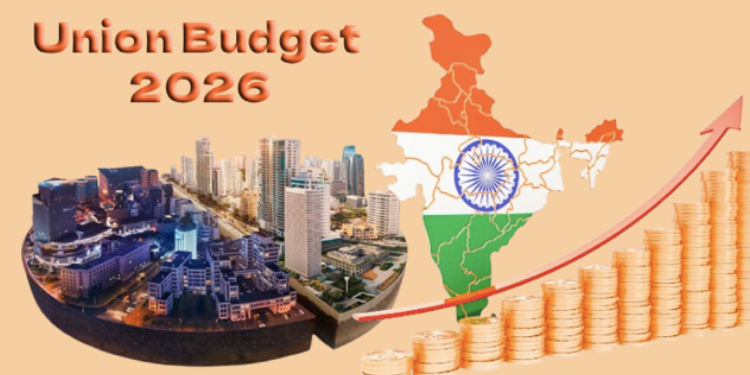
New Delhi: As the Union Budget 2026 approaches, India’s real estate sector—spanning homebuyers, developers, investors and allied industries—is entering a decisive phase. Backed by steady end-user demand, improving market confidence and the government’s sustained focus on infrastructure-led growth, industry leaders believe the upcoming Budget offers a crucial opportunity to revive housing affordability, ease tax burdens and lay the foundation for long-term, sustainable urban development.
With real estate contributing nearly 7% to India’s GDP, supporting over 200 allied industries, and playing a key role in employment generation, stakeholders see Budget 2026 as a lever to accelerate growth while aligning with the broader vision of Viksit Bharat by 2047.
Affordable Housing and Homebuyer Relief Take Centre Stage
A key expectation from the sector is renewed focus on housing affordability and demand stimulation. Pradeep Aggarwal, Founder & Chairman of Signature Global (India) Ltd, says continued policy support through fiscal incentives, financing mechanisms and demand-led measures will be critical to sustaining momentum.
He reiterates the industry’s long-standing demand for granting industry status to real estate, which would improve access to institutional funding, lower borrowing costs and enhance transparency. Aggarwal also calls for the extension or reintroduction of the Credit Linked Subsidy Scheme (CLSS) to support first-time homebuyers and stimulate demand across housing segments. Industry estimates suggest real estate’s GDP contribution could rise to 15% by 2047 with the right policy backing.
Echoing this, Ashok Kapur, Chairman of Krishna Group and Krisumi Corporation, expects the government to continue its strong focus on infrastructure development, given its multiplier effect on connectivity, liveability and urban efficiency. He stresses that policy stability and regulatory clarity remain essential to reinforce buyer confidence and encourage quality-led development.
Tax Reforms and Disposable Income Boost
From the homebuyer’s perspective, industry participants are seeking enhanced tax incentives to offset rising property prices and high interest rates. Expectations include:
- Raising the home loan interest deduction under Section 24(b) from ₹2 lakh to ₹4–5 lakh
- Redefining the affordable housing cap, especially in metro cities, where current thresholds no longer reflect market realities
- Increasing the standard deduction for salaried individuals to improve disposable income
- Rationalisation of income tax slabs under the new tax regime to boost purchasing power
Developers believe these measures could unlock pent-up demand, particularly among first-time and middle-income buyers.
Infrastructure, Sustainability and Urban Planning
For new-age developers, Budget 2026 is expected to strengthen the link between infrastructure investment and real estate demand. Ajitesh Korupolu, Founder & CEO of ASBL, highlights the importance of continued investment in city-level infrastructure—roads, metro corridors, civic assets and water management—to support integrated township development.
He also advocates incentives for green building certifications, stamp duty relief in smart city zones and policies that promote transit-oriented development. According to Korupolu, such measures can unlock private investment in live-work-play ecosystems while driving sustainable urbanisation.
Similarly, Karteesh Reddy, CEO of GHR Infra, expects Budget 2026 to reinforce investments in transport connectivity, social infrastructure and sustainability standards. He points to tax benefits for energy-efficient buildings, viability gap funding for metro extensions and incentives for low-carbon construction as catalysts for next-generation urban development.
Commercial Real Estate, Capital Markets and AIFs
On the commercial real estate front, Sudarshan Lodha, Co-founder & CEO of Strata, says the next phase of growth should focus on easing project-level financing and enabling structured private credit. Clearer tax and regulatory frameworks for alternative investment platforms could unlock long-term capital and support office expansion beyond core metros.
Industry stakeholders have also flagged the need for tax rationalisation for Real Estate AIFs, particularly to address double taxation at the SPV and investor level. A single-layer tax structure, they argue, would significantly improve investor returns and attract institutional capital.
New Asset Classes: Rental Housing and Tokenisation
A growing section of the industry is also pushing for the creation of new asset classes. Proposals include a National Rental Housing Scheme to incentivise build-to-rent models through tax holidays on rental income and GST waivers for rental-only projects. Such a framework could create stable assets for pension funds while addressing housing needs of India’s mobile workforce.
Another emerging theme is asset tokenisation, which aims to democratise access to high-value real estate through blockchain-based fractional ownership. Industry leaders believe a clear policy framework could unlock liquidity, broaden investor participation and modernise capital raising in real estate.
Infrastructure Capex and the Viksit Bharat Vision
Linking real estate growth with infrastructure momentum, Sunil S. Nair, CEO of Ramky Infrastructure Ltd, notes that last year’s infrastructure push delivered tangible results across highways, railways, metros and water projects. For Budget 2026, he expects sustained capex of ₹12–13 lakh crore, with sharper focus on water infrastructure, PPP models and sustainable urban transformation aligned with Viksit Bharat@2047.
Taken together, the expectations from the real estate sector point to a common theme: policy continuity, affordability-led reforms, infrastructure integration and access to long-term capital. Industry leaders believe that a balanced Budget—combining tax relief for homebuyers, incentives for sustainable development, and support for emerging asset classes—can reinforce real estate’s role as a key engine of economic growth.
As India charts its path toward becoming a developed economy by 2047, stakeholders see Union Budget 2026 as a pivotal moment to ensure that housing, infrastructure and urban development grow in tandem—driving jobs, investment and inclusive prosperity across the country.