Hashtag Orange, is an integrated marketing agency demonstrating how end-to-end execution outperforms fragmented specialist models across India’s competitive landscape. Hashtag Orange’s Mumbai operations have emerged as a growth powerhouse, securing marquee mandates and delivering category-defining campaigns that showcase the agency’s unique single-team model spanning strategy, creative, production, media buying, and performance marketing.
Recent Accomplishments Driving Mumbai Success:
· Conceptualised and executed Zuno General Insurance’s viral “Smart Drive” campaign featuring aliens, genies, and ghosts across digital, social, print, OOH, and cinema
· Expanded ROCA India’s digital footprint with integrated brand communication
· Achieved 40% YoY growth through Mumbai hub while maintaining pan-India execution capability
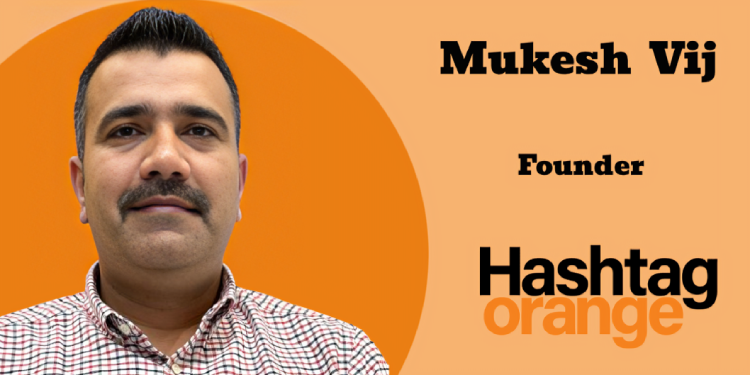
Leadership in the region, led by Gaurang Menon, Regional & Creative Head – West backed by Founder – Mukesh Vij can offer unique perspectives on scaling an integrated agency model in India’s evolving marketing ecosystem. Their leadership has positioned Hashtag Orange to consistently win against specialist agencies by eliminating execution silos and delivering measurable client outcomes.
Medianews4u.com caught up with Mukesh Vij founder Hashtag Orange
Q. The agency space is seeing consolidation. What are the implications of this for independent agencies like Hashtag Orange?
Consolidation is inevitable, but it doesn’t replace the need for agility and ownership. At Hashtag Orange, we bring integrated capabilities across Creative, Social Media, SEO, Media, and Technology, powered by teams with strong global agency experience.
What differentiates us is how deeply we’re involved with our clients. Leadership and teams work closely together to drive success. Independence gives us speed, flexibility, and the ability to truly partner with brands in ways large networks often can’t.
Q. How is consolidation going to change relationship dynamics between clients and agencies, especially around the point of contact within an agency?
One of the biggest challenges emerging from consolidation is turnaround time. As global agencies merge, processes, systems, and teams take time to align. During this transition phase, decision-making can slow down, and TAT often gets impacted.
Consolidation brings scale and structure, but it also introduces complexity, multiple approvals, shared service models, and cross-market coordination. It typically takes years for large organisations to fully stabilise these processes and restore speed and efficiency.
The real test for global agencies is not just integrating capabilities, but doing so without compromising responsiveness. Clients today operate in real time, and any lag in execution directly affects outcomes. Agencies that can streamline workflows, empower local teams, and shorten approval cycles will be the ones that successfully navigate consolidation in the long term.
Q. Hashtag Orange focuses on demonstrating how end-to-end execution outperforms fragmented specialist models across India’s competitive landscape. What would this entail in 2026?
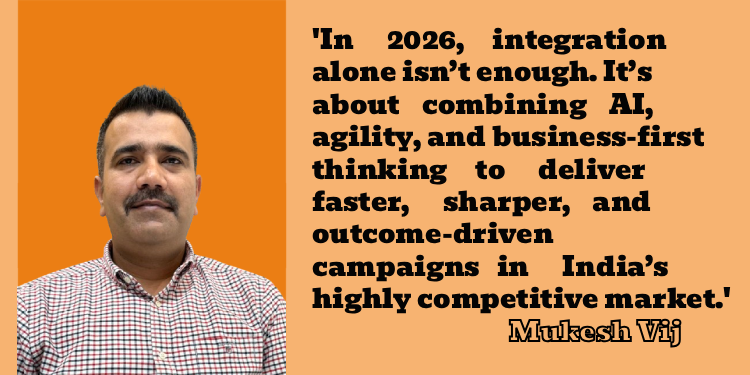
In 2026, end-to-end execution goes beyond integration across Creative, Social, SEO, Media, and Technology. It’s about leveraging AI to deliver speed, cost efficiency, and smarter campaigns. At Hashtag Orange, we have always kept clients’ business goals at the centre.
That focus drove impactful outcomes through 2025, and today we combine the same agility with AI and technology to ensure every campaign is faster, sharper, and aligned with client objectives in India’s competitive market.
Q. Does the agency’s unique single-team model spanning strategy, creative, production, media buying, and performance marketing make the task of liaising with the client’s CMO and the marketing department much easier?
Absolutely. A single-team model spanning strategy, creative, production, media buying, and performance marketing simplifies client engagement.
For CMOs and marketing teams, this means one point of accountability, faster decisions, and seamless alignment across all campaign elements. More than convenience, it enables stronger ownership of business outcomes.
Instead of managing multiple specialists or silos, clients get a unified team focused on driving measurable impact.
Q. In 2026, are we in a situation where no client starts a campaign without a clear line of sight to business outcomes?
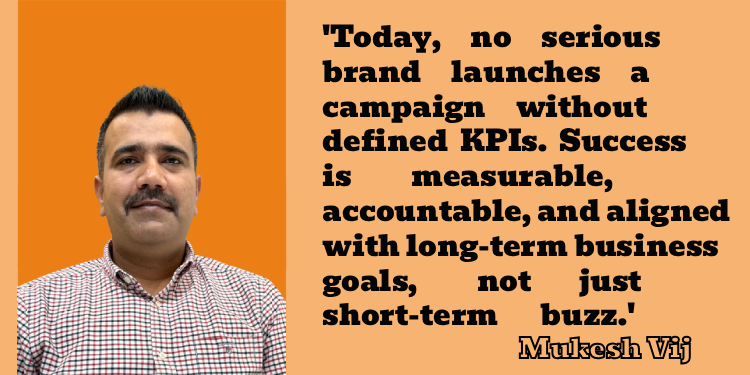
By 2026, very few clients will start a campaign without a clear line of sight to business outcomes. A strong umbrella thought and a clear campaign objective are critical. It’s no longer about jumping on trends that dilute the core business proposition.
Clients now expect every initiative to be measurable, accountable, and aligned with broader business goals. Agencies and clients work together from day one to define success metrics and KPIs, ensuring campaigns drive real impact, not just short-term buzz.
Q. When you talk to clients today, is their biggest concern the declining attention span of consumers, especially Gen Z and Gen Alpha?
Declining attention spans, especially among Gen Z and Gen Alpha, are a major concern for clients today. Campaigns need to be concise, relevant, and engaging from the first moment.
When creative ideas are merged with ongoing trends that align with the brand’s core proposition, it adds real value, driving both attention and business impact. Technology and data also play a key role in reaching the right audience at the right time. Ultimately, the campaigns that succeed are the ones that capture attention without losing sight of business goals.
Q. In 2025, the agency achieved 40% YoY growth through the Mumbai hub while maintaining pan-India execution capability. What goals have been set for 2026?
In 2025, we delivered around 89% overall growth, with our Mumbai hub, now just two years old, contributing 40% YoY growth while maintaining strong pan-India execution capabilities.
For 2026, we’ve kicked off with major campaigns, including Signify’s #FansReimagined and another big campaign for Monte Carlo in February, along with several significant pitches in December and January.
With this momentum, we’re aiming to sustain healthy double-digit growth across the year, while continuing to strengthen our integrated, end-to-end capabilities and deliver measurable business outcomes for our clients.
Q. Is the big challenge going to be commanding fair remuneration from clients? Do measurable outcomes help in securing fair remuneration? Are there any examples or learnings you can share?
Fortunately, we have several long-term clients with whom we work closely as business partners, and they are fair in terms of remuneration. In some cases, fees are linked to business outcomes, which works well, we believe a ‘skin in the game’ model ensures accountability and alignment beyond standard costs.
At the same time, there are clients who may not offer fair terms. In those cases, we often choose not to engage, because running an agency is also about attracting and retaining the best talent. If we compromise on remuneration, we risk compromising on quality, which is unfair both to the client and to long-term relationships.
The key learning is that fair remuneration and business alignment go hand in hand with delivering consistent impact and sustaining growth.
Q. In 2025, the agency conceptualised and executed Zuno General Insurance’s ‘Smart Drive’ campaign across digital, social, print, OOH, and cinema. In 2026, will ensuring message consistency across platforms be a challenge for client campaigns? Will AI help in this regard?
For campaigns like Zuno General Insurance’s ‘Smart Drive’ in 2025, we conceptualised and executed the creative across platforms, while the media was managed by a separate partner. Even so, ensuring message consistency across platforms is always a key challenge.
In 2026, AI is playing a growing role in platform planning, optimisation, and performance monitoring, helping creative stay aligned and relevant.
By combining strong creative strategy with AI-driven insights, agencies can maintain consistent messaging across channels, even when media execution is handled by different partners.
Q. How are AI and tech advances helping to speed up the delivery of work? At the same time, will the overuse of AI be a challenge in 2026, potentially resulting in the sameness of work?
AI and technology are transforming agency work by speeding up delivery, from generating insights to automating routine tasks and enabling quick iterations. This allows teams to focus on high-value creative and strategic thinking.
However, unique ideas still require human intervention. A concept must be clear, relevant, and instantly understood by consumers, something AI alone cannot fully guarantee. While AI helps with insights and efficiency, originality, context, and true creativity come from humans, ensuring campaigns remain distinctive and impactful rather than uniform.
Q. Microdramas are competing with short-form videos in terms of consumption. Will Hashtag Orange be working on microdramas, or is this a separate and more difficult skill set?
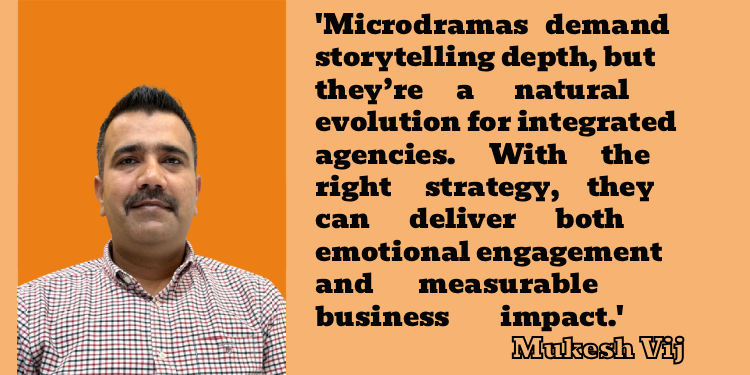
Microdramas are gaining traction alongside short-form video, as audiences increasingly seek story-driven, bite-sized content. While microdramas require a specialised skill set, including storytelling, character development, scripting, and production, Hashtag Orange already has in-house producers and directors.
We haven’t formally entered the microdrama space yet, but the capability exists internally, and we’re ready to explore it anytime. With the right planning and alignment with brand objectives, it is a natural extension of our integrated approach, allowing us to deliver both creative depth and measurable business impact.
Q. A post on LinkedIn about the success of microdramas mentioned that today, brands in their communication have to give consumers a dopamine hit in 60 seconds. If they don’t, the brand may not have an audience in 2027. Do you agree?
Audiences, especially Gen Z and Gen Alpha, have very short attention spans, so brands need to capture attention quickly. It’s not just about a dopamine hit; the idea has to be clear, engaging, and meaningful.
In 2027, success will come from balancing speed with creativity, delivering content that grabs attention while staying true to the brand’s purpose.
Q. TV had a poor 2025 in terms of ad revenue. Is it still relevant as a platform to showcase creative work, or will digital take an even larger share in 2026?
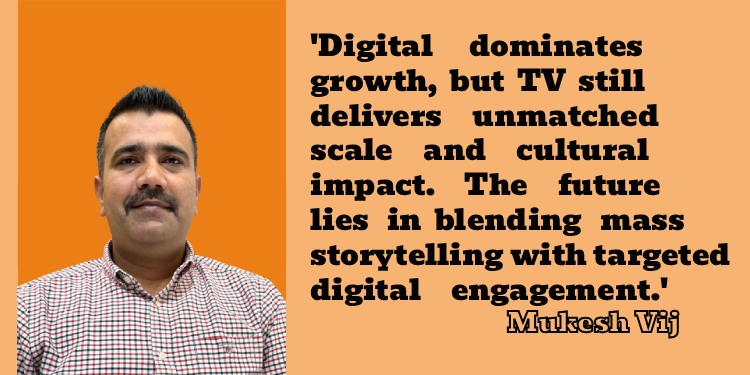
TV ad revenues dipped in 2025, while digital is growing fast, now making up around 60% of total ad spend in India. Yet, TV still reaches over 680 million viewers, especially in Tier 3 and 4 markets, and remains unmatched for emotional storytelling at scale.
In 2026, TV won’t be irrelevant. It builds mass reach and cultural impact. The most effective campaigns will blend TV with digital, using TV for scale and storytelling, and digital for targetting and engagement.