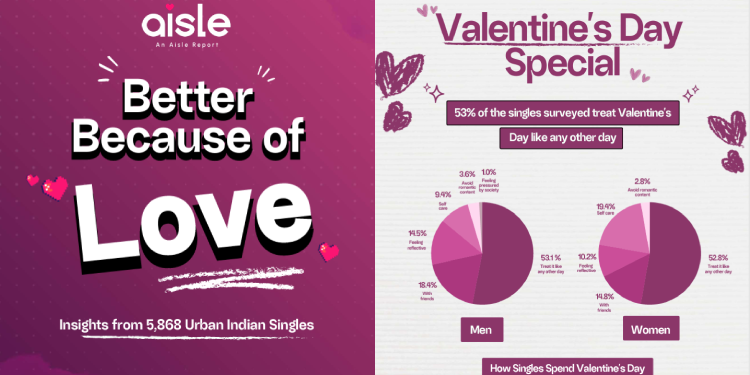
Mumbai: Aisle has released its Valentine’s Day industry report titled “Better Because of Love,” highlighting evolving attitudes toward love, communication and emotional growth among Indian singles. Based on insights from 5,868 respondents across Gen Z (43%), Millennials (54%) and Gen X (3%), the study reflects a cultural shift from performative romance to intentional, growth-oriented relationships.
The survey, which includes participants from Metro and Tier 1 cities (87%), NRIs (9%), and Tier 2 and 3 markets (4%), reveals that 84% of Indians believe love has made them better people. Respondents associate relationships with becoming more patient (63.6%), better communicators (49.1%), more confident (44.2%) and more self-aware (40.1%). Additionally, 40.7% reported becoming more adjusting due to love, while women were found to prioritise practical compatibility 73% more than men.
“At Aisle, we have always believed that the right kind of love helps you grow and become the best version of yourself. What this report shows is a clear evolution in how the approach towards love changes and redefines different generations. Singles today aren’t running after big, dramatic gestures or seeking approval from others; they’re leaning toward relationships that feel safe, steady, and help them grow as individuals. Love is no longer the finish line; it is the force that shapes who we become,” said Chandni Gaglani, Head of Aisle Network
Valentine’s Day Pressure Eases
The report indicates that 53% of singles now treat Valentine’s Day like any other day, suggesting declining social pressure around the occasion. Men were found to be 42% more likely than women to feel reflective about wanting a relationship (14.5% vs 10.2%), while only 1% of men reported feeling pressured on the day, compared to zero among women.
Care Over Grand Gestures
Romantic expectations are also shifting. While 54% of women reject grand gestures in favour of acts of service and everyday consistency, men most commonly express love through quality time (41.1%), and women through acts of service (39.8%). Millennials lead in prioritising quality time at 43.1%, compared to 38.4% of Gen Z respondents. Interestingly, both men and women expressed a desire to receive more acts of service than they currently give.
Self-care also emerged as a strong trend, with women being twice as likely as men to pamper themselves on Valentine’s Day (19.4% vs 9.4%).
Emojis vs Words
In romantic communication, the data suggests a gradual shift toward clarity. Half of all women respondents (50%) said they do not use emojis to flirt. The See-No-Evil Monkey and red heart emojis were used more by men (21.6% and 21.3%) compared to women (17.6% and 11.1%). While 73.2% of Gen Z favour emoji-led communication, 32.1% of Millennials prefer language-based clarity, indicating maturation in romantic expression.
Mother Tongue Carries Emotional Truth
A key insight from the report reveals a linguistic paradox: 78% of respondents feel more emotionally expressive in their mother tongue, yet 89.3% use English to communicate emotions. Among men, 78.9% feel more comfortable expressing love in their mother tongue, compared to 69.4% of women. Gen Z appear slightly more open than Millennials to expressing love in their native language (79.3% vs 77.1%).
Regional Differences in Romance
The report also highlights regional nuances. North Indian respondents (25.9%) are more likely to have a Bollywood-influenced view of love than those in the South (18.4%). In contrast, respondents from South India (34.1%) prefer expressing love through acts of service compared to 25.5% in the North. Additionally, 29.4% of respondents in the South rely on a mix of logic and emotion in relationship decisions, compared to 21.9% in the North.
Aisle’s relationship expert Arouba Kabir said, “What may sometimes look like indifference in today’s singles is emotional growth and the newer generations are atleast trying not treating love as something that completes them, but as something that adds to an already meaningful life. They’re trying not to wait around for a date, a gift, or a relationship status to feel fulfilled; and they’re investing in friendships, passions, careers, and self-discovery. The inner dialogue is shifting from ‘Will love happen to me?’ to ‘Who will I become when it does?’ It’s a more confident, grounded outlook where love is not a rescue, but a shared journey, chosen with clarity, entered with intention, and experienced with emotional readiness.”
The report also explored pop-culture character preferences, finding that emotionally expressive and sincere characters resonate strongly with respondents. Among women, Geet (31.5%) emerged as the most relatable figure, while men identified most with Bunny (17.7%), Raj (14.8%) and Surinder (14.4%)—characters known for choosing vulnerability and emotional connection over detachment.
Overall, Aisle’s ‘Better Because of Love’ report captures a broader cultural transformation in Indian dating, where relationships are increasingly viewed as spaces for growth, emotional regulation and self-awareness rather than performance and spectacle.