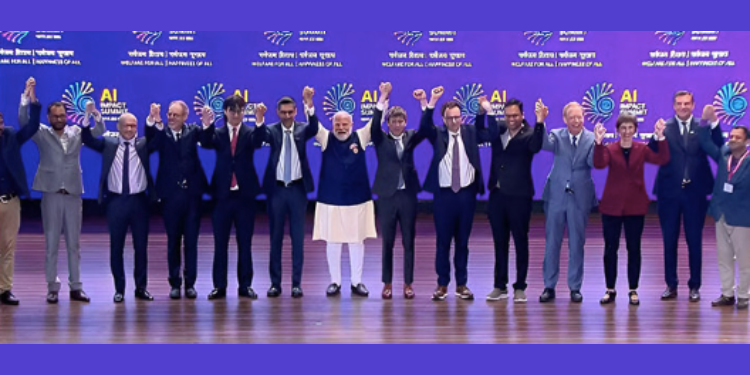
New Delhi: Prime Minister Narendra Modi on Thursday unveiled India’s global artificial intelligence governance vision — “NAAIV” (Human-Vision for Artificial Intelligence) — at the India AI Impact Summit in New Delhi, positioning the framework as India’s blueprint for responsible, inclusive and sovereign AI development worldwide.
Announcing the initiative before leaders from more than 100 countries, Modi described NAAIV as India’s contribution to shaping the global AI order, anchored in ethics, accountability and equitable access.
“Today, I present NAAIV — the Human-Vision for AI,” the Prime Minister said, outlining a five-pillar architecture intended to guide policy, innovation and international cooperation.
Five pillars of India’s AI doctrine
Explaining the acronym, Modi defined the core principles underpinning India’s AI strategy:
- M — Meaningful ethical growth
- A — Accountable governance
- N — National sovereignty
- A — Accessible and inclusive systems
- V — Valid and legitimate frameworks
He emphasised that artificial intelligence must remain fair, trustworthy and accessible to all societies rather than concentrated among a few nations or corporations.
“AI should serve the entire global community,” Modi said, stressing inclusive access and sustainable governance.
India stakes claim in global AI leadership
Opening what he called the world’s largest AI Impact Summit, Modi framed India as central to emerging global AI consensus, citing the country’s demographic scale, digital public infrastructure, startup ecosystem and talent base.
“Welcome to the world’s largest AI Impact Summit. This summit represents India’s one-sixth of humanity,” he said.
He added that the gathering reflected the rising influence of the Global South in shaping future technology norms and governance frameworks.
Modi highlighted India’s expanding AI foundations across research labs, startups and digital infrastructure, and underscored the role of youth innovators in deploying AI across agriculture, public services, security and multilingual communication.
AI as civilisation-scale turning point
Positioning AI alongside past technological inflection points in human history, Modi said its full societal impact is only beginning to unfold.
“In human history, certain turning points mark the direction of development,” he said. “The impact we see today is only the beginning. This time the good is faster and the scale is unprecedented.”
He stressed that while AI increases machine intelligence, its deeper significance lies in expanding human capability.
“The real question is not what artificial intelligence can do in the future. The question is what we choose to do with artificial intelligence,” he said.
Human-centric guardrails against techno-nationalism
Warning that transformative technologies bring both opportunity and risk, Modi drew parallels with nuclear technology — capable of both destruction and societal benefit.
“We have seen nuclear technology’s destruction and its contribution to humanity. AI also has transformative power,” he said.
He cautioned against techno-nationalism and machine-centric development that sidelines human values, arguing that AI governance must remain rooted in human dignity and agency.
“A person should not become just a data point or an asset,” Modi said, calling for democratised access and empowerment-focused AI systems.
Using a simple analogy, he added: “Life gives us the gift, but we choose the direction.”
India’s long-term AI governance ambition
Modi said India’s MANAV (human-centric) vision could form a foundational framework for global AI governance in the coming century, signalling the country’s ambition to play a leading role in shaping international AI norms.
“India’s MANAV Vision will become a vital foundation for AI in the next century,” he said.
The NAAIV framework places ethical growth, sovereignty and inclusivity at the centre of India’s AI strategy, reinforcing the country’s push to balance rapid technological advancement with human-centric governance as AI adoption accelerates worldwide.