PRandit is a public relations and communications firm built on the belief that powerful, purposeful storytelling can transform businesses. We partner with startups, high-growth companies, and established brands to design PR strategies that drive media visibility, industry authority, and long-term brand recall. By operating at the intersection of strategy, creativity, and data, we help brands cut through cluttered markets and build credibility with the right audiences.
It is backed by IIM Bangalore, Google for Startups, and AWS, reflecting its strong foundation in the startup ecosystem and the commitment to building scalable, future-ready communication solutions. This backing reinforces its credibility and enables us to work closely with innovation-led companies across different stages of growth.
Over the years, it has worked across a wide range of sectors, supporting brands through launches, growth milestones, reputation building, and category leadership. Its domain expertise spans technology and Web3, sustainability and clean energy, healthcare and wellness, lifestyle and luxury, education, and innovation-driven institutions, allowing it to bring nuanced insights and adaptable communication strategies to every engagement.
What sets it apart is its strong and trusted network across mainstream, digital, regional, and niche media platforms, combined with our ability to blend data-driven insights with creative storytelling. It brings a deep experience in managing both corporate reputation and consumer-focussed PR, with a proven track record of delivering visibility, engagement, and measurable outcomes. As a women-led agency, it is committed to building credible narratives and driving impact across traditionally male-dominated industries.
The vision is to become India’s most trusted, innovative, and impactful PR partner, enabling brands to achieve cultural relevance and long-term reputation. Our mission is to craft creative, insight-led, and trend-driven PR campaigns that help brands break through cluttered markets and connect meaningfully with their audiences.
At its core, it is guided by integrity, creativity, collaboration, ownership, and excellence. It focusses on fostering a collaborative, flexible, and performance-driven work culture where respect for time and ideas, continuous learning, teamwork, and approachable leadership shape how it works every day.
Medianews4u.com caught up with Shalu Jha co-founder PRandit
Q. Will the main goal of a PR agency in 2026 be to build trust in a brand/client? Will this trust have to be shared, earned?
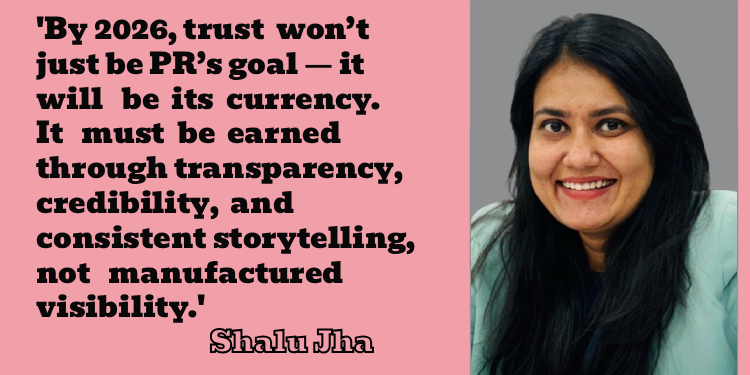
In 2026, trust will not just be the main goal of PR; it will be the currency of PR. Brands will be evaluated not only on visibility but on credibility, consistency, and values.
Trust cannot be manufactured or borrowed; it has to be earned through transparent storytelling, credible third-party validation, and long-term narrative building. PR agencies will increasingly act as trust architects helping brands show up honestly across media, platforms, and stakeholders.
Q. Establishing a PR agency’s credibility needs an out-of-the-box approach. What tactics have worked to establish PRandit Solution?
At PRandit, credibility was built by doing the work before talking about it. We focused on strong outcomes, impactful coverage, founder positioning, and category creation, especially in complex sectors like climate tech, healthcare, EV, and Web3.
Another differentiator has been thought leadership for our clients, not just announcements. Being a women-led agency in traditionally male-dominated sectors also helped us challenge stereotypes and stand out with substance, not noise.
Q. Wat are the challenges of scaling a PR firm in a rapidly changing media ecosystem? Is commanding fair remuneration a key challenge?
Scaling a PR firm today means constantly adapting to shrinking newsrooms, faster cycles, and platform-first journalism. Talent retention, training for new-age storytelling, and managing client expectations are real challenges.
Fair remuneration is definitely a concern because PR outcomes are often intangible yet high-impact. Educating clients on the strategic value of PR, not just coverage, remains an ongoing effort.
Q. Could you shed light on success stories that have shaped PRandit’s growth?
Our growth has been shaped by working with mission-driven startups and scale-ups and helping them move from unknown to unavoidable.
From positioning climate-tech and sustainability founders as national voices to helping healthcare and wellness brands earn consumer trust, each success reinforced our belief in narrative-led PR. Being backed by platforms like IIM Bangalore, Google for Startups, and AWS also validated our approach.
Q. Does PRandit Solution work closely with startups to help them navigate the media maze?
Yes, startups are core to PRandit’s DNA. Many founders have strong products but struggle with articulation and timing.
We help them understand what is media-worthy, how to align business milestones with storytelling, and how to build credibility early. For startups, PR is not about headlines—it’s about momentum.
Q. How is PRandit using tech advances to enhance storytelling? Is being data-driven essential today?
Being data-driven is no longer optional. We use insights from media analytics, audience behaviour, and platform performance to refine narratives and measure impact.
Technology helps us identify story angles, track sentiment, and optimise spokesperson visibility. Data doesn’t replace creativity, it sharpens it.
Q. How important are relationships between PRandit and CMOs? Will this be crucial in 2026?
Absolutely. Strong CMO–PR partnerships allow for strategic alignment rather than transactional execution.
When trust exists, PR becomes proactive, not reactive. In 2026, these relationships will be critical for integrated storytelling across media, social, and leadership platforms.
Q. How will AI reshape PR in 2026, especially Search and automation? How will PRandit leverage it?
AI will fundamentally reshape PR in 2026 by transforming how we research, present, track, and optimise communication strategies. In Search, PR will play a much larger role in building reputation and authority signals, as search engines increasingly reward credible media coverage, expert commentary, and consistent narratives across platforms. PR will therefore directly influence how brands are discovered and trusted online.
AI will significantly improve efficiency across everyday PR workflows. From helping teams quickly create sharper presentations and pitch decks, to automating PR tracking, coverage analysis, and sentiment mapping, AI will reduce time spent on manual tasks. It will also enable deeper analysis of what kind of stories, spokespersons, and publications are delivering real impact for brands.
At PRandit, we see AI as an enabler that strengthens decision-making rather than replacing human thinking. We are leveraging AI to support PPT creation, real-time media monitoring, performance analysis, and reporting, allowing our teams to focus more on strategy, journalist relationships, and high-quality storytelling.
While AI will make PR faster and more data-driven, credibility, creativity, and context will remain human-led. The future of PR lies in combining intelligent automation with strong narrative thinking, and that is how PRandit is approaching 2026.
Q. Will predictive analytics play a bigger role in 2026?
Yes. Predictive analytics will help agencies anticipate media trends, audience responses, and potential reputation risks. This will shift PR from reactive storytelling to foresight-led communication something brands will increasingly expect.
Q. PR is dominated by women, often in leadership roles. How does this contribute to creativity and resilience?
Women bring empathy, adaptability, and collaborative leadership qualities essential in PR. This diversity of thinking enhances creativity and resilience, especially in high-pressure environments.
At PRandit, women-led leadership has helped us build a culture that values both intuition and insight.
Q. How do you build a PR culture that balances strategy, speed, and storytelling?
By being clear on the why before the what. Strategy provides direction, speed ensures relevance, and storytelling creates impact.
We invest heavily in training teams to think like consultants and storytellers, not just executors.
Q. Are platforms like LinkedIn emerging as alternatives to press releases?
LinkedIn has become a powerful first-point platform for leadership communication. It offers authenticity and immediacy. However, it complements rather than replaces traditional media.
A strong announcement today often starts on LinkedIn and is amplified through credible media coverage.
Q. How has the role of the press release changed?
Press releases are no longer just announcements; they are narrative tools. They need sharper angles, data, and context.
A release today should spark conversations across media, social platforms, and search.
Q. Social media tracking is a 24×7 task. Will technology make it easier in 2026?
Technology will make tracking more efficient, but interpretation will remain human-led.
Tools can flag trends and sentiment, but judgment, response strategy, and tone will continue to need experienced communicators.
Q. Any advice for aspiring communication professionals and early-stage founders?
For professionals: build curiosity, understand business, and never stop learning. PR is as much about strategy as storytelling.
For founders: invest early in communication. Tell your story consistently, honestly, and with purpose. Visibility without credibility doesn’t last.