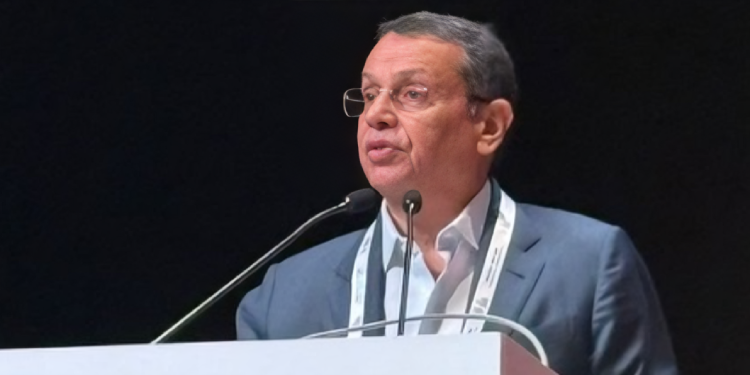
New Delhi: Artificial intelligence can help India overcome long-standing structural constraints and emerge as the world’s leading creative economy, Uday Shankar, Vice-Chairman of JioStar, said in his keynote address at the India AI Impact Summit 2026.
Reflecting on the rapid evolution of the country’s media sector, Shankar said India has grown from a few-billion-dollar industry into the world’s fifth-largest media market with more than 900 channels, over 210 million TV households and 800 million video consumers. Yet scale has not translated into global cultural influence.
“Despite our remarkable domestic progress, India has not yet broken through as a global content powerhouse,” he said, noting that countries with far smaller populations have captured global audiences more effectively.
He attributed the gap to structural constraints in capital, talent economics and market orientation. “The average Hollywood studio production commands a budget of $65 million to $100 million… The average Indian film? Three to five million dollars,” he said, describing the “order-of-magnitude chasm” that has historically limited global competitiveness.
Artificial intelligence, Shankar argued, represents a turning point that could fundamentally rewire the industry’s core pillars of content, consumer and commerce. AI-driven production is already collapsing cost and infrastructure barriers and enabling large-scale storytelling at unprecedented speed.
“AI provides India a once-in-a-generation opportunity to become the creative capital of the world. Not the back office for the world’s content. The leader. The standard-setter,” he said.
Beyond production, AI will reshape audience engagement through interactive storytelling, conversational discovery and localisation that captures the texture of India’s diverse markets. It will also transform monetisation by enabling granular segmentation and dynamic pricing, moving media beyond its historic reliance on advertising and subscriptions, he said.
Shankar placed the transformation in a global economic context, noting that the media and entertainment market is projected to reach about $3.5 trillion by 2029 while India’s share remains below 2 percent. Even a modest increase could create tens of billions of dollars in new value.
He urged industry leaders and policymakers to act quickly, warning that incumbents often resist disruption until competitive advantage is lost. “Disrupt ourselves, or be disrupted,” he said, adding that Western markets are approaching AI defensively, creating a window for India to define global standards in AI-driven entertainment.
The country should prioritise building a new generation of hybrid creators who combine storytelling and AI skills, and ensure policy frameworks accelerate rather than constrain experimentation. India has a structural advantage, he argued, as AI shifts media competitiveness away from capital-intensive production hubs toward countries with deep cultural reservoirs and large audiences.
“The question before us today is not whether India can become the global media powerhouse of the AI age. It is whether we will move fast enough to claim that position,” Shankar said.
He concluded that the convergence of India’s storytelling heritage, market scale and AI capability has created a historic opportunity for global leadership. “The stories have always been here. Now, the scale of our market and the power of our technology have finally aligned,” he said.