Thought Blurb Communications, an independent advertising and design agency based in Mumbai, was founded in 2007 by Vinod and Razia Kunj. The agency provides a comprehensive approach to brand strategy, identity design, packaging, marketing, and advertising, focusing on design and digitalization.
As the marketing and advertising landscape continues to evolve at breakneck speed, Thought Blurb Communications reflects on a year of meaningful progress while laying out a clear-eyed vision for the future. From expanding into purpose-led communication and crafting culturally rooted regional storytelling for legacy brands, to embracing AI-driven intelligence and redefining how brands connect with audiences across platforms, the agency’s leadership shares its perspective on 2025 learnings, 2026 ambitions, and the shifts reshaping creativity, media, and impact in a rapidly changing digital-first world.
Medianews4u.com caught up with Vinod Kunj, Founder & CCO, Thought Blurb Communications
1. How would you describe the progress that Thought Blurb Communications made in 2025?
Thought Blurb has made a few significant leaps in 2025. One remarkable point of note is Keystone Foundation, a key organization involved in the health, welfare and economic advancement of indigenous communities in India. Their work is concentrated in the Nilgiris, but have expanded to other parts of the country. This is Thought Blurb’s thrust into social marketing in ecological and environmental communication.
Over this year, we have created a number of regional and local language based films for Parle-G that mainly center around local festivals. With a legacy brand as deeply rooted as Parle-G, it is necessary to speak to the customer in their own language and in their own community’s idiom. Thought Blurb has internalised this strategy and created various digital films that went viral in spectacular fashion.
2. In 2026 what goals have been set and what is the game plan to get there?
Technical innovation cannot be side-stepped. What data-linked targeting has done for advertising in the past is just a beginning. The next step in intelligence. And by this, we mean both human and artificial. Thought Blurb is readying itself for this new evolution. We have set down a roadmap to achieve excellence in this regard.
3. What key trends do you think we will see in 2026 in the marketing and advertising world?
There is a sea change coming. AI will change the face of creativity as well as strategy going forward. Data assimilation and analysis will be in overdrive. There are already systems falling in place for this. Of course, there will be trial and error for a while, but standard operating procedures (SOP) will gradually change.
4. Will campaigns have to drive business results in 2026? Will vanity metrics become unimportant?
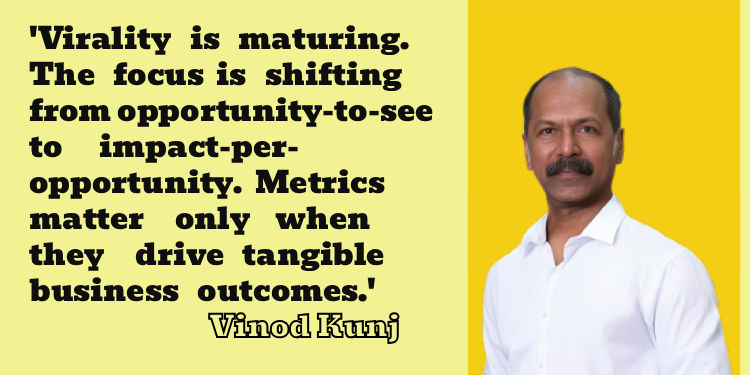
Advertising is always going to be a prime driver of business. But the age of virality may be coming into maturity. It is no longer a game of opportunity to see (OTS). It is impact per opportunity (IPO) that will become key. Metrics will take on a whole new meaning. Numbers eventually mean nothing if it doesn’t drive business.
5. How will Thought Blurb Communications leverage hybrid ad formats to reach consumers wherever they are?
The old adage holds. Communication will always follow strategy. The individual formats don’t matter. Today, in the digital space, formats tend to overlap. A social media post is not disconnected from proximity advertising on mobile phones. Experiential marketing, content and influencer marketing will all be layered over conventional advertising to promote brands and products. These will all come from the single fount of intelligence-based strategy.
6. Has digital made the concept of primetime irrelevant for advertisers? Or has it redefined the concept of primetime?
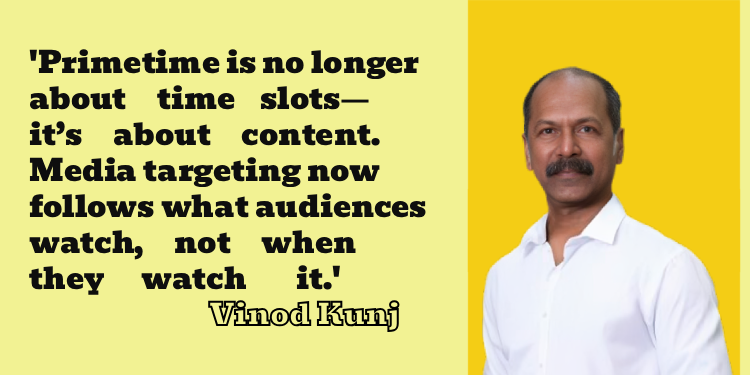
This has been happening for a long time. Direct-to-home broadcast has changed the face of that, along with digital video recording (DVR). Customers are already used to watching their programs at their pleasure, when they want. They can watch a program. re-watch it, play, pause or rewind at will. There is no concept of primetime is an anachronistic concept in this day and age. And that is not a bad thing. It throws up more opportunities than issues. This means that advertisers can target more meaningfully without resorting to peak-time traffic dynamics.
OTT has muddled the waters further. Now it is a matter of placing advertising in the content that our audience watches, rather than the time-slot at which they watch. This is the next evolution of media targeting. It is no longer about prime-time. It’s prime-content.
7. How will AI enable Thought Blurb Communications to ensure that the message lands in an era where attention spans are rapidly declining?
I wouldn’t say attention-span is a myth, but it may have been overstated. While our audience is no longer willing to passively absorb content, they are also willing to binge- watch a complete TV series for hours on end. Advertising will do well to learn a trick here. The customer will always prioritise content and entertainment over advertising messaging. Advertising has to morph into the content that they want rather than a one-directional message.
AI can do a lot more than landing the message in the right spot. It can analyse in granular detail the reach, demographic work-up, and the cultural context, global and ambient flavour of content. It helps us mirror the space the content viewer’s mind inhabits. Which is invaluable for advertising creatives.
8. Different ad formats and platforms serve different need states. How challenging is it for Thought Blurb communications and for the industry to understand the various formats like memes and platforms like Reels and how they are evolving?
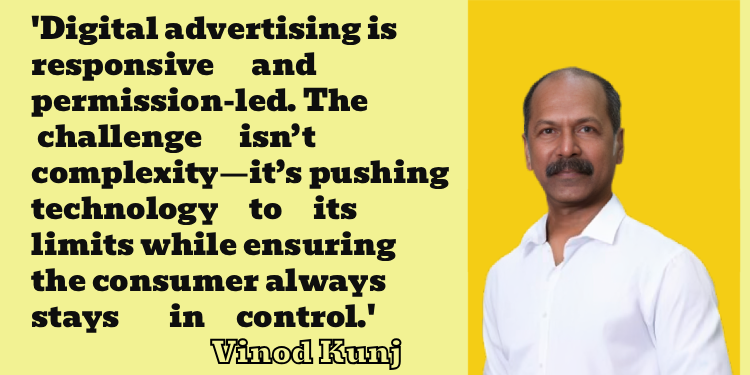
Unlike conventional advertising with its shape, geography and time limitations, digital can be extremely flexible. The audience can be served as they receive. The viewer can be at a desk, on the road, on a variety of devices from a small handheld smartphone to a wall-sized CTV. Like websites, advertising can be made responsive to sizing and projection opportunities.
The important thing is, the message goes to the consumer at their choosing, not the other way around. Permission marketing is still at the base of this. We can knock on the door, but the customer has to let us in.
New ad formats keep coming along. But as technology advances, the execution becomes less complex than the last one. That is the good news. For Thought Blurb, the challenge is to push the technology to its limits and wring every drop of advantage out of it.
9. For brands who are savvy when they do a campaign does each platform serve as a chapter in the larger brand narrative?
It is always about the brand narrative. In the conventional advertising past, it was extremely expensive to maintain a constant brand presence. Here, however behavioral tracking and retargeting can maintain a steady pace of messaging at a level that is as subtle or as strident as required.
10. People might see an ad on social media before seeing it on traditional media like TV, print. Is this completely disrupting brand storytelling by making it non-linear?
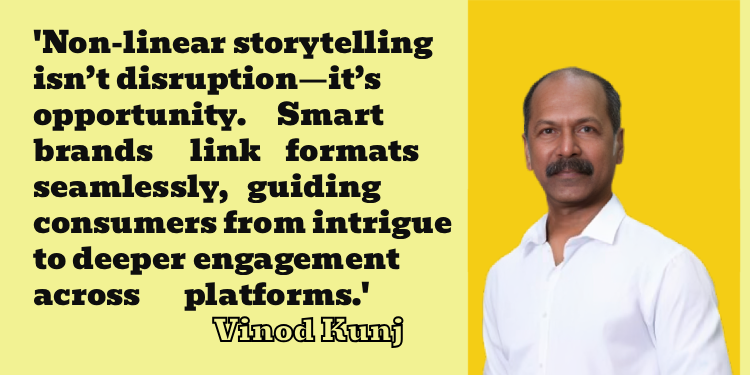
This begs the question, would the first piece of communication in any medium or format begin the process of wearying you out? This is the creative challenge. An advertiser could either intrigue the consumer or confuse him. However small the format, it has to keep the customer interested.
Look at the other side of the conundrum. If the consumer sees an ad on social media, it makes sense to link it to a YouTube video, a website for more information, a WhatsApp link to the brand for an AI chatbot, demonstration videos, substacks, or whatever the brand requires. To reach the digital-native consumer, circumventing broadcast and print media may just be the astute choice.
11. WhatsApp has in the recent past introduced new tools for businesses. Has the role of this platform grown a lot as a result in the digital media mix?
WhatsApp has grown far beyond its role as a receptacle of OTPs and notifications. It is a very capable platform for product catalogues, e-com, customer service, AI-backed query systems and so on. Being part of the Meta landscape also allows it to link up with Facebook, Instagram and their subsidiary platforms.
With its Business Suite, WhatsApp could very well become a consequential player in the digital mix.
12. Since they are different from millennials are Gen Z and Gen Alpha forcing brands like Parle G to rethink marketing and communication?
Parle-G is a visionary brand with deep roots in the Indian firmament. However, they realize that every new customer has to be befriended. Any brand can endure as long as it re-invents itself for the next generation. It should be easier for all legacy brands to do this.
Going back to my point. The medium carries the message and the message alone. The message comes from the brand and the marketing strategy behind it. Technologies can change, platforms may come and go, but the basic human traits that the brand embodies remain unchanged.
13. Could you talk about work that Thought Blurb Communications has done with legacy brands to reinvent themselves using digital as a tool like Parle-G?
Parle-G is the best example of Thought Blurb’s work with legacy brands. But it is a testbed and a schoolroom for us to learn from and expand our understanding of digital propagation of branding.
14. In a changing landscape TV ad revenue struggled badly in 2025. Is this platform still going to be very important for categories like FMCG, BFSI in 2026?
I wouldn’t write off TV yet. But then, as you see, TV has itself changed. Appointment-watching is long dead. Linear timelines are a thing of the past. As stated, there is no primetime any more. CTV may be the latest iteration of the format, with OTT interwoven into it. DTH penetration had reached a peak in 2015, but has steadily lost ground to CTV/OTT.
Traditional TV ad revenue may struggle for a bit. But it is simply a matter of porting the business model into subscriptions, pay-for-play, and targeted advertising. As far as sectors are concerned, media managers may just have to re-think their calculus.
![Beyond Ello, you can expect [x]cubeLABS to lead the transition from generic “chatbots” to Vertical AI Agents: Sridhar Muppidi](https://www.medianews4u.com/wp-content/uploads/2026/03/Sridhar-Muppidi-Ello-350x250.png)