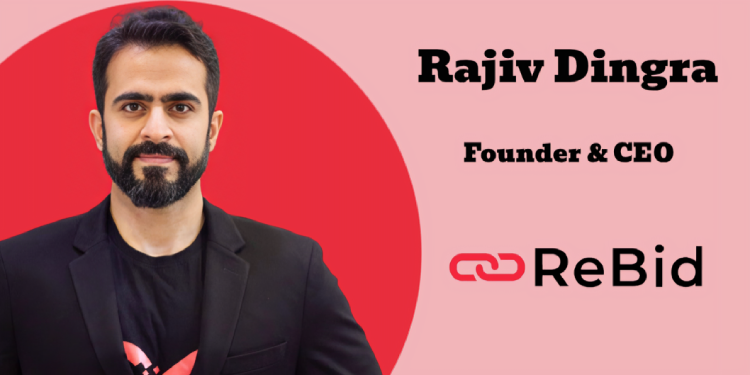
ReBid is India’s first Agentic AI Full Funnel Agency. Started by serial entrepreneur Rajiv Dingra, ReBid is a Digital Agent-cy that merges Platform + People + Agentic AI to transform how brands plan, activate, and measure advertising. ReBid is powered by an Advertisers CDP with 250+ data and advertising connectors, unifying ad-to-transaction journeys across Google, Meta, DV360, LinkedIn, programmatic platforms, CRM, and MMPs.
This foundation enables ReBid’s army of 20+ AI Agents to not just analyse and recommend, but autonomously plan, optimise and activate campaigns — ensuring higher ROAS, lower CAC, and measurable business growth.
Medianews4u.com caught up with Rajiv Dingra Founder, CEO ReBid
Q. While people talk about the growing use and benefits of AI, will we see consumers also start to push back against Agentic AI and the algorithm in 2026?
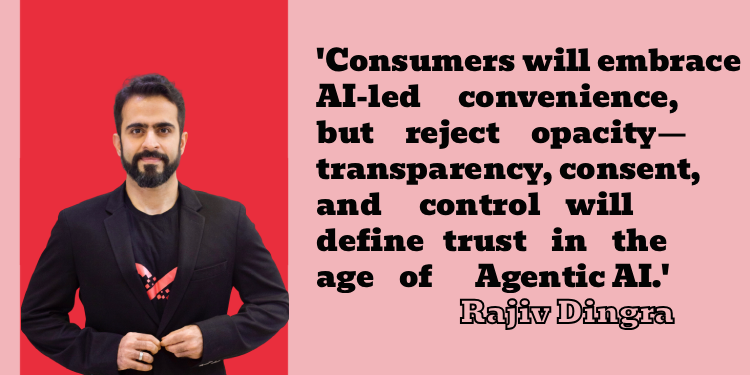
Consumers won’t push back against convenience. They will push back against the lack of transparency, manipulation, and data misuse. They will not push back against AI itself, but against opaque AI.
In 2026, the winning brands will be the ones that:
● Clearly disclose AI interactions
● Offer explainability in recommendations
● Give consumers control over data permissions
Agentic AI must shift from “invisible automation” to “responsible augmentation.” The trust layer will become as important as the intelligence layer.
Q. There is talk that while AI is boosting marketing efficiency, you need the human touch. What are ReBid’s views on this? Will the campaigns that succeed in 2026 be the ones who strike the right balance?
AI without human judgment becomes optimisation without imagination. At ReBid, we believe the future is Platform + People + Agentic AI. AI can analyse, detect patterns, optimise bids, and generate variations, but humans define narrative, emotion, brand codes, and cultural nuance.
The most successful campaigns in 2026 will:
● Use AI for speed and scale
● Use humans for strategy and storytelling
● Use unified data to connect both
It’s not AI vs Human. It’s AI + Human, orchestrated intelligently.
Q. There is talk that Indians consume AI but don’t innovate in core LLMs. Do you see this changing?
India may not yet lead in foundational LLM creation at the scale of American tech giants, but it is rapidly emerging as a leader in applied AI.
The shift happening now is seen through vernacular AI applications, AI productisation for India-specific use cases, and AI integrated into commerce, BFSI, health and retail ecosystems. India’s strength lies in building scalable, cost-efficient AI layers on top of global foundation models. Over time, with policy support and compute infrastructure investment, we will see more foundational innovation as well.
Q. What trends did we see in agentic AI usage over the last year? Expectations for 2026?
Over the last year, we saw AI move from dashboards to decision-support. Brands experimented with AI reports and anomaly detection. Creative intelligence tools saw strong adoption, and early pilots of action-based automation began.
In 2026, we will see a shift from insight agents to action agents. There will be autonomous budgets, bid and creative optimisation within guardrails, along with cross-channel orchestration instead of platform silos. There will be agentic workflows embedded inside marketing teams, and Agentic AI will move from “assistant” to “co-pilot with accountability.”
Q. In terms of the Perplexity AI and Amazon lawsuit — will the battle for control of the consumer intensify in 2026?
Yes. The battle is no longer for traffic. It’s for interface control. Who owns the consumer’s decision layer? Is it search engines, marketplaces, AI agents or Super apps?
As AI agents become intermediaries between consumers and platforms, platform economics will be challenged. Expect more legal friction as ecosystems attempt to protect distribution dominance.
Q. Are digital legal frameworks going to be challenged in 2026 as tech evolves rapidly?
Absolutely. Agentic AI blurs lines around Identity disclosure, consent, attribution of action and liability. If an AI agent acts on behalf of a consumer but does not declare itself, who is accountable?
Legal frameworks will need agent identity protocols, AI action traceability and clear compliance disclosures. 2026 will see regulation move from data privacy to agent governance.
Q. What are the plans of ReBid now to merge Platform + People + Agentic AI?
Our focus is towards building a unified ecosystem where:
● The Platform becomes the source of truth (connected ad-to-transaction data).
● People define strategy, guardrails and creative direction.
● Agentic AI handles insights, alerts and optimisation actions.
We are a Full funnel Digital Agent-cy, which is the next evolution of the digital agency, wherein we are evolving from insight agents to action agents, where AI doesn’t just recommend but executes within approved thresholds.
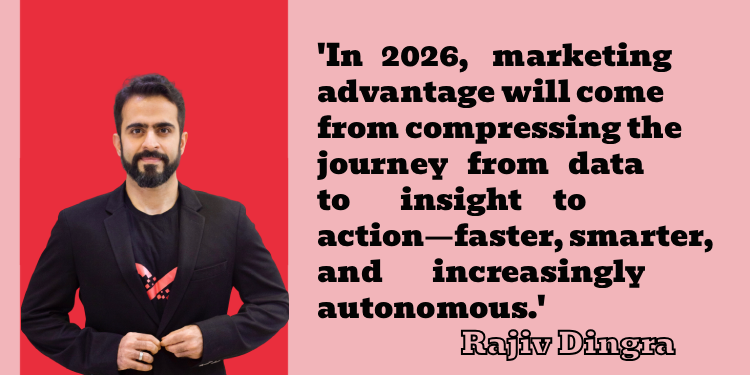
The objective is simple: compress the time between data → insight → action → business outcome.
Q. The agent-cy entered India after testing in advanced global markets. What was the advantage?
Testing in mature markets allowed us to understand where the market of the future was headed. It also allowed us to validate agentic workflows in complex ecosystems, refine AI guardrails and automation layers and build scalable frameworks before mass rollout. By the time we scaled in India, the model was de-risked and performance validated.
Q. What is the business model of ReBid and how will it be fine-tuned in 2026?
ReBid operates on a trifecta model of Platform + People + Agentic Ai providing full funnel creative, brand and performance marketing services.
Our offering includes:
● Platform access (Advertisers CDP and Agentic AI layers)
● Agentic AI-led brand and performance marketing services
● Agentic AI-led creative services
● Outcome-driven engagements
In 2026, we are fine-tuning towards more automation-driven cost efficiencies, bandformance that links branding to performance, and AI-augmented managed services across creative, brand and performance across the full funnel.
The goal is to align brand and performance campaigns across the funnel tightly with business outcomes.
Q. Which categories will grow Agentic AI usage most in 2026?
Agentic AI will play a diverse role in 2026 across categories. In BFSI – Creative intelligence, anomaly detection, bid optimisation, compliance-aware automation.
In Consumer Tech – SKU-level performance mapping, dynamic budget allocation; in Retail – Geo-personalised targeting, lead-to-store mapping.
Categories expected to accelerate Agentic AI adoption in 2026 will include BFSI, Retail & Commerce, Auto, D2C and Travel. Any category with high media spends and measurable outcomes will move fastest.
Q. To what extent is AI reducing costs in creative production?
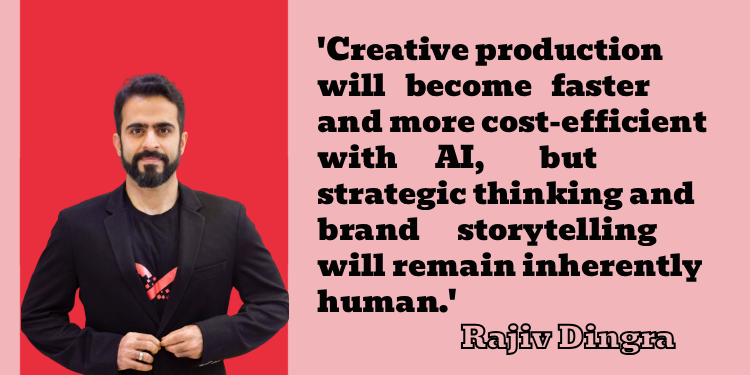
AI is significantly reducing Iteration costs, creative testing cycles, catalogue visual production and localisation expenses.
However, AI does not eliminate brand thinking costs. It reduces execution friction, not strategic investment. Brands are seeing 30–50% faster turnaround times and meaningful savings in production-heavy categories.
With our launch of the ReBid AI Creative Studio, we are now able to create on brand full-fledged digital video commercials at a fraction of the cost of the offline shoot films. It also lends itself to hyper personalization across languages and regions with AI voice-overs and experimentation for brand and performance results, with the option of using multiple variations of the same film.
Q. Will first-party data collection grow in importance in 2026? How does ReBid facilitate this?
First-party data will become the backbone of competitive advantage. With tightening privacy norms and signal loss, brands must:
● Own their customer data
● Unify offline + online touchpoints
● Activate consented data intelligently
ReBid facilitates this via a unified Advertisers CDP that connects ad data to transaction data, enabling measurement, segmentation and compliant activation.
Q. How is Agentic AI going to drive hyper-personalisation at scale in 2026?
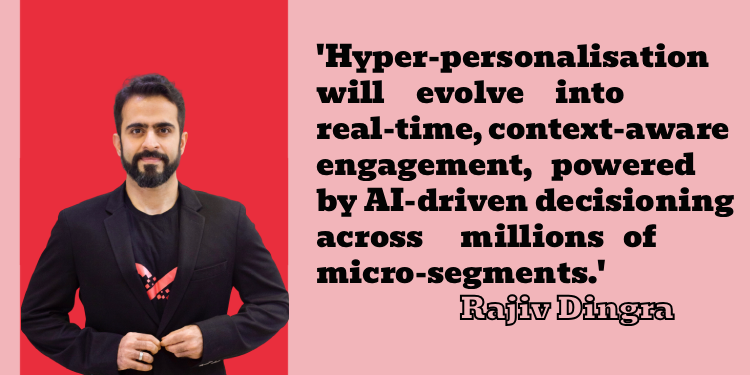
Hyper-personalisation in 2026 will not be about inserting a name in an email. It will involve: Context-aware messaging, behaviour-based creative sequencing, budget shifts based on lifecycle stage and Real-time predictive intent scoring.
Agentic AI enables dynamic decisioning across millions of micro-segments simultaneously, something impossible through manual marketing.
The brands that master this will shift from campaign-based marketing to continuous intelligence-based marketing.


![Beyond Ello, you can expect [x]cubeLABS to lead the transition from generic “chatbots” to Vertical AI Agents: Sridhar Muppidi](https://www.medianews4u.com/wp-content/uploads/2026/03/Sridhar-Muppidi-Ello-350x250.png)