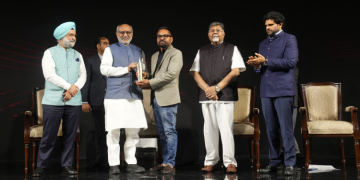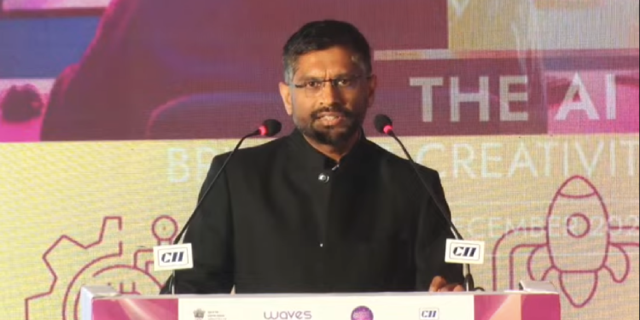
At the CII Big Picture Summit 2025, Ravi Rajamani, Managing Director and Global Head of AI Blackbelts at Google, delivered a wide-ranging Special Address that urged India’s enterprises—particularly in media and entertainment—to move decisively on AI adoption. Speaking from the vantage point of a decade-long career at Google, Rajamani reminded the audience that CEO Sundar Pichai had declared Google an “AI-first company” as early as 2015, long before AI became a global buzzword. “It took the world almost ten years to catch up to that vision,” he noted, adding that AI is now deeply embedded in everyday Google products like Gmail’s Smart Compose and YouTube’s closed captions. The time, he emphasised, is right for India to seize its own AI opportunity.
The Rise of Multimodal AI and the Launch of Gemini 3.0
Rajamani spotlighted Gemini 3.0, Google’s latest multimodal AI model, which he described as the most advanced system available today across text, audio, image and video capabilities. Drawing a parallel with how children learn through multiple senses, he explained how modern AI is evolving to understand the world in a similarly holistic manner. The same AI foundations that power consumer-facing Google products are now available to Indian businesses through Google Cloud, backed by enterprise-grade privacy and security. Addressing a common concern, he clarified that customer data does not get embedded into Google’s foundation models, reiterating that “your data stays in your environment.”
India’s Moment: Compute, Data and Talent
Turning to the global landscape, Rajamani pointed to China’s rapid progress and said India is equally capable of achieving a “DeepSeek-like moment” of AI acceleration. But success hinges on three critical pillars: compute, data, and talent. He highlighted Google’s recent announcement of a $15-billion data centre investment in India, calling it one of the company’s largest global bets and essential to powering compute-hungry AI models. India’s linguistic and cultural diversity provides an unparalleled data advantage, while its vast engineering and developer pool forms a natural talent base. “The question is not whether India can do it,” he said. “It’s who gets there faster.”
Rapidly Evolving Models Demand a Long-Term Foundation Strategy
Rajamani cautioned businesses against evaluating AI models as if they were static products. In just months, Google has moved from Gemini 2.0 to 2.5 to 3.0, and another leap is inevitable. “It’s not about which model is best today,” he said. “It’s about which foundation model you choose to build your skills, capabilities and future use cases on.” He urged organisations to be vigilant about legal and compliance risks when adopting open-source models, especially around data provenance, likeness rights and indemnification. Google’s own AI Principles, published in 2018, continue to guide responsible, fair and equitable model development, he added.
AI Is Reinventing Visual Storytelling and Democratizing Creativity
Speaking directly to the media and entertainment community, Rajamani showcased one of Google’s most technically ambitious AI projects: the transformation of a 1939 technicolour classic for The Sphere in Las Vegas—a four-football-field-sized spherical screen. The project required reconstructing extremely grainy footage, generating missing performances, and using AI-driven outpainting and facial detail recreation to maintain pixel-perfect fidelity. “It was almost like AI becoming the director,” he said, calling it a breakthrough for archival restoration and immersive filmmaking.
He argued that AI now fully democratizes cinematic creation: no high-end VFX infrastructure is required—only strong storytelling. “Creativity is the only limitation today,” Rajamani concluded. “AI gives every creator the ability to produce full-length, high-quality films and release them in multiple languages.”
With this message, Rajamani left the audience with a clear call for India’s industry leaders: embrace AI boldly, build on a strong foundational model, and unlock the country’s full creative and technological potential in the decade ahead.