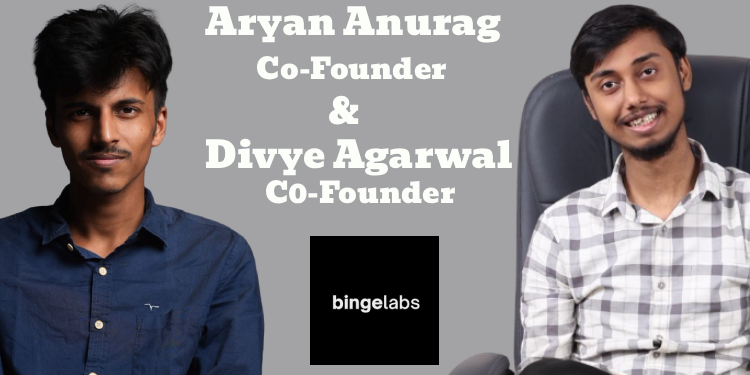
Bingelabs is a social media company working with the top Entrepreneurs in India with the most amount of growth case studies.
Bingelabs, who is on a mission to turn founders and entrepreneurs into brands organically, is able to achieving results by using a unique approach that combines pattern recognition and first-principles thinking.
The company is working with founders like Dr. Ritesh Malik (Innov8), Arjun Vaidya (V3 Ventures) , Mukul Rustagi (ClassPlus), Shradha Sharma (Yourstory), Neel Gogia (Iplix) , Mohit Sadani (Sold Moms&Co), Manish Chowdhary (Wow Skin Science) to name a few. Besides founders, the agency also works with VC Funds like Lightspeed Venture Partners, Z47 (Matrix Partners), Arkam Ventures, All In Capital as well as popular brands such as Masters Union, YourStory, Lenskart, KukuFM, Classplus, ICICI, Amazon Home, 1% Club, 360 ONE.
Co-founder Aryan Anurag’s expertise as a social media growth strategist in India has earned him a notable distinction of being one of the very few Indians followed by the world’s biggest YouTuber, Mr. Beast (Jimmy Donaldson), on X (formerly Twitter). This testament to his thought leadership in the field solidifies his position as one of India’s leading minds in social media strategy.
Impact created by Bingelabs:
1. Reactivated Shradha Sharma, Founder of Yourstory Instagram presence, achieving 7M+ views on the debut reel and growing followers from 5000 to 1,40,000 in seven months.
2. Spearheaded Prashant Desai’s (MD, Everstone Group) social media growth, growing his followers from 50,000 to 1 million+ in a remarkable 5-month span.
3. Grew Arjun Vaidya’s Instagram from 15k followers to 200k followers in five months.
4. Increased Dr. Ritesh Malik’s Instagram from 50k followers to 250k followers in four months.
Medianews4u.com caught up with Aryan Anurag, Co-founder, Bingelabs, Divye Agarwal, Co-founder, Bingelabs
Q. What was the gap seen in the market that led to the formation of Bingelabs in 2023?
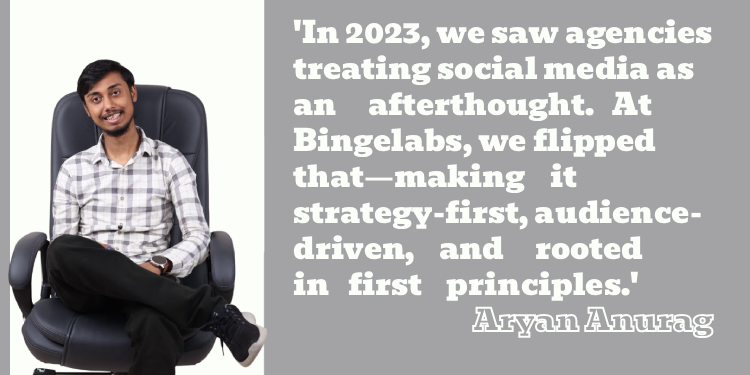
When we started Bingelabs in 2023, we noticed a recurring issue in how most agencies approached social media, treating it as an afterthought that followed advertising or influencer marketing rather than being a core function on its own. Social platforms were often seen as mere extensions, not standalone ecosystems with their own logic and pace. On top of that, many agencies handling social media were either primarily production or post-production houses. Strategy often took a backseat.
We felt there was a missing layer of real thinking—one that could guide production meaningfully. At Bingelabs, we built ourselves as a strategy-first company, allowing every piece of content to be driven by clear thought before execution. Lastly, we also observed how much of the social media world had become clouded with jargon in the name of “algorithm hacks.” Instead, our lens has always been audience-first, driven by pattern recognition and first principles. That shift changed everything for us and for our clients.
Q. Bingelabs aims to turn founders and entrepreneurs into brands organically. What does this entail?
We work with a wide range of clients, but when it comes to founders specifically, our approach is shaped by a few key realities. First, most founders are short on time. Shooting a reel every other day just isn’t feasible for them. Second, many are not naturally comfortable in front of the camera, nor should they be expected to be, given where their priorities lie. Third, founders typically have a wealth of insights and unique perspectives.
What they need is a way to express that knowledge authentically, not by reading off a teleprompter or repeating a scripted line. That’s why at Bingelabs, we’ve developed a scriptless model. We don’t hand over pre-written lines; instead, we create a structure where their natural thoughts and expertise drive the content. This method allows us to build strong personal brands while requiring just a few focussed hours every couple of months from the founder.
Q. What have been the learnings from working with founders like Dr. Ritesh Malik (Innov8), Arjun Vaidya (V3 Ventures) , Mukul Rustagi (ClassPlus), Shradha Sharma (Yourstory), Neel Gogia (Iplix)?
Working closely with such founders has been one of the most rewarding aspects of what we do. The relationship often evolves beyond work, we’ve built friendships that allow for conversations at any time, whether it’s about a campaign or a broader business insight. What we’ve learned from them goes far beyond content; it’s about how they think, how they build, and how they navigate challenges.
Being close to such minds gives us access to perspectives we wouldn’t have encountered otherwise. These interactions constantly push us to improve, not just in our work, but in how we think about leadership, growth, and clarity of purpose. More than anything, we value the long-term nature of these partnerships and the mutual trust they’re built on.
Q. Mohit Sadani who you worked with sold Moms&Co. Does social media marketing play a role in successful exits and securing funding in a difficult environment
In Mohit’s case, we started working with him after his exit, so our work didn’t contribute to that specific milestone. But generally speaking, social media can absolutely play a role in a founder’s journey toward a successful exit or fundraise. A strong personal brand helps build trust, it attracts not just customers but also potential investors and acquirers.
When a founder is visible, credible, and actively engaging with their audience, it sends a signal that they understand their space and have built something meaningful. Whether it’s an IPO or an exit, visibility matters. In today’s attention economy, people need to know you before they buy into your product or your story. And in many ways, no one represents a brand better than the founder.
Q. Social media platforms and algorithms are constantly changing, evolving requiring entrepreneurs to adapt their strategies frequently. How challenging is this for entrepreneurs and do they need to upskill themselves to better understand the nuances of platforms?
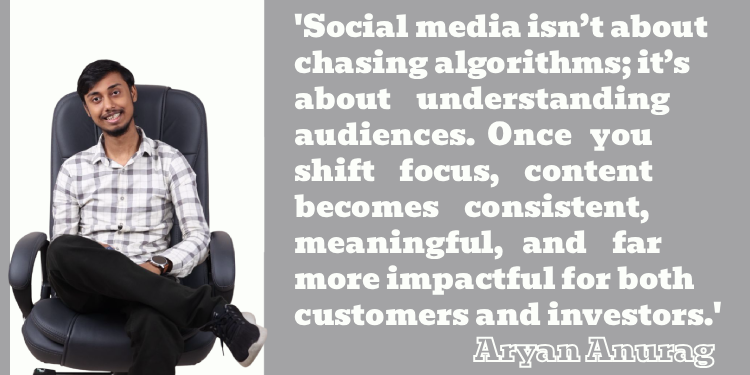
It’s definitely challenging, but not because the platforms keep changing; that’s expected. The real challenge is in how entrepreneurs respond. At Bingelabs, we always tell our clients to shift the focus from chasing algorithms to understanding their audience better.
The moment you do that, your content decisions become clearer and more consistent. We believe in first principles thinking, which means we avoid blaming the algorithm and instead ask, did the audience connect with this? That mindset keeps us grounded. It’s also essential for entrepreneurs to keep learning. Not to become social media experts themselves, but to gather new ideas, stay relevant, and bring in fresh insights.
We’re clear about this: while we can handle execution and scaling, we can only do half the job. The other half depends on how much the entrepreneur is willing to evolve, learn, and stay curious.
Q. In using social media what are the do’s and dont’s for entrepreneurs?
One of the biggest don’ts we’ve seen is jumping onto social media just because others are doing it. FOMO is a terrible reason to start building a personal brand. The most effective founders we’ve worked with are the ones who come in with a strong sense of purpose, who know why they’re doing it and what they want to say.
Another mistake is expecting overnight success. Social media rewards consistency and honesty, not quick wins. On the flip side, what you should do is stay patient, focus on long-term value, and commit to a process that may not give you immediate returns but builds real credibility over time.
Q. What tactics does Bingelabs adopt to help entrepreneurs manage negative feedback on social media?
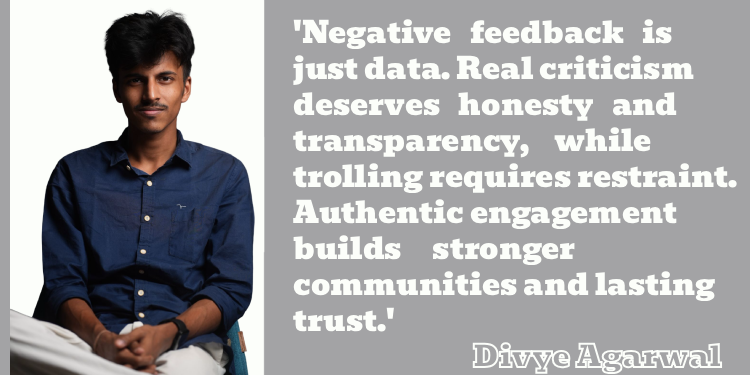
Negative feedback, when seen clearly, is just another data point. The first step is to separate meaningful criticism from pure trolling. For genuine feedback, we help founders respond with honesty and transparency, which builds trust. For trolling, it’s more about knowing when not to engage and focusing energy where it matters.
We also work proactively with founders to structure their content in a way that reduces the chances of misinterpretation by being clear in what they say and how they say it. And most importantly, we remind our clients never to take their audience for granted. If you’ve built a community, you owe it to them to keep learning, sharing thoughtfully, and staying real.
Q. The agency grew Arjun, where this Instagram from 15k followers to 200k followers in five months, what were the strategies that you used?
When we began working with Arjun, the first thing we did was invest time in understanding him, not just as a founder, but as a person. We spent two to three hours in deep conversation, learning about his journey, stories, and worldview. That foundation shaped how we positioned him as a D2C entrepreneur with experience and credibility.
Once that positioning was in place, we moved into pattern recognition. We studied the D2C content ecosystem and identified what types of content were resonating with audiences, like business case studies or content targetting specific audience segments.
We then adapted those content patterns to fit Arjun’s voice and story. The initial content focused on his personal journey to build credibility. As certain formats began performing well, we doubled down, refined our strategy based on performance data, and continued evolving with time. Importantly, everything was done without traditional scripting.
We built content from natural, unscripted conversations, shooting in just a few focused hours every couple of months. That balance of clarity in strategy, speed in execution, and deep alignment with his brand is what drove the growth.
Q. How is Bingelabs leveraging AI? Will things like AI avatars, gamification elements play an increasingly important role for entrepreneurs?
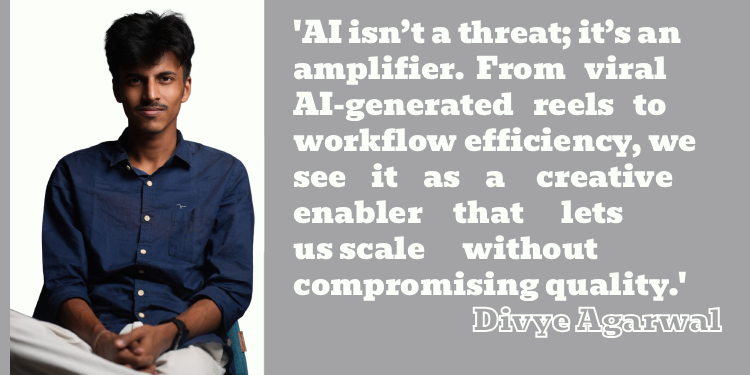
At Bingelabs, we’ve never viewed AI as a threat; in fact, quite the opposite. We’re very confident in the quality of our work, and for anyone who is genuinely good at what they do, AI becomes a powerful enabler rather than a replacement. Since AI tools have become more accessible, our workflows have only gotten smoother and more efficient.
For instance, we’ve been running several accounts where most of the content is entirely AI-generated. One of our clients has seen remarkable results; his AI-generated reels have gone viral, with one crossing over 10 million views. And the best part? He doesn’t have to lift a finger for execution, we manage everything end-to-end.
AI has given us the ability to scale content creation without compromising quality. As for the future, whether it’s AI avatars, automation, or gamified experiences, we see these as exciting tools to be explored, but only by those who understand the craft deeply. As long as we remain the best at what we do, AI will only amplify our strengths.
Q. Many startup founders have started their own podcast. How effective is this medium as a brand building tool?
Podcasts are undoubtedly a valuable content format, but only when done right. What we’re seeing now is a flood of founders launching podcasts simply because it feels like the trend to follow. Many of them believe that it’s easy; just sit, talk, and post. But the truth is, most podcasts don’t have a strong USP. They become just another long-form conversation with no unique value proposition, and because of that, we believe most of them will fade out sooner than expected.
Podcasts also grow slowly, and they rely heavily on a steady stream of interesting guests, something that’s hard to sustain. For founders who have either a very strong niche, a compelling format, or a consistent guest pipeline, podcasts can work beautifully.
But for most others, we’d recommend focusing on more scalable and engaging formats like solo YouTube videos or Instagram content. These allow for faster growth, better control, and more direct audience connection.