Siddhartha Singh and Aayush Bansal are the founders of BlackCab Agency Network. It is a new-age, integrated collective of creative, strategy, and digital marketing agencies built for today’s fast-evolving brand ecosystem. With AI reshaping creativity, influencer-driven content defining brand engagement, and the agency-client equation undergoing fundamental shifts, BlackCab’s journey and vision could make for a timely and insightful story for your esteemed publication.
Founded in 2017, BlackCab has grown into one of India’s most agile independent networks. Today, they partner with over 250 brands, including BMW, JioSaavn, T-Series, Adidas, ITC, JW Marriott, and many more through their specialist verticals:
· BlackCab: brand and campaign strategy
· Ottoman: design + packaging innovation
· Secret Sauce: content + influencer marketing
At a time when:
· AI is reshaping creative workflows and campaign planning
· Influencer- and creator-led content is overtaking traditional advertising
· Clients are demanding flexible, project-based agency partnerships
· Regional and D2C brands are fueling India’s $40B+ marketing economy growth
Their edge today lies in
· Culturally rooted, digitally agile storytelling helps brands balance technology with authentic narratives, especially in an AI + influencer age
· Flexible, integrated model, aligned with how brands now buy creative services: project-based, outcome-led
· Embedding sustainability, inclusivity, and mental health in both creative work and organisational DNA
· Expansion plans into Delhi and Bangalore, as these hubs become growth engines for digital-first brands
From reimagining icons like Bagpiper and Indri X House of Dragons to helping challenger brands like Vivaano and Meetha scale, BlackCab is helping brands navigate the new frontier where tech, culture, and commerce intersect.
Medianews4u.com caught up with Aayush Bansal co-founder BlackCab
Q. We are seeing consolidation in the creative agency space. Is martech driving this trend?
Consolidation is taking place in many different ways. Traditionally, in this industry consolidation was when larger groups of agencies, like WPP and Group M, would purchase smaller agencies for specific problem statements such as SEO or social media, or content production.
But now, yes, at the onset of martech, there is a certain amount of consolidation taking place, which is not necessarily how it was traditionally taking place. There are a lot of companies coming up which are reducing the need for resources due to technology and hence acquiring companies that have specialised technology availability, thereby allowing them to improve their resource efficiency and reduce their costs.
Q. How is consolidation impacting the space from a client–agency relationship perspective?
In many cases, consolidation also takes place in larger, traditional consolidation was taking place when groups wanted to acquire agencies with large accounts. So, for example if a group has an account, an agency has an account of a large conglomerate like an HUL or an SLA, the consolidation was done to be able to acquire these kinds of accounts.
Today, because of the onset of martech, we don’t see that having any change or impact on this.. But yes, because of the onset of martech, obviously, everything is getting streamlined and companies are finding it easier to work with agencies. Standardised processes exist, a lot of automation exists, reports come automatically, there is no loss in translation, and briefs are collected in a more structured manner.
Q. Is BlackCab Agency Network looking at acquisitions to improve its capabilities?
While we have always followed the build before we buy model, our eyes are always open to potential acquisitions which could be of value to our group of companies. Hence yes, we are always on the lookout.
Q. Clients are demanding flexible, project-based agency partnerships. Does this present a challenge in building long-term relationships?
It’s important that the creative agency is involved with the talent and the needs. Today, clients and a lot of D2C brands and founders have the in-house capability to solve a lot of these problems, and hence they require agencies only for specialized needs.
With the onset of ChatGPT and AI, we see in the future that the need for long-term engagement with an agency will reduce, and the need for specialised teams who are purely on a consultancy capacity will increase. So we must embrace this trend rather than being afraid of it.
Q. Could you talk about how the agency is fine-tuning its business model to be more flexible and integrated to align with how brands now buy creative services which is project-based and outcome-led?
As I mentioned, we are open to the fact that the industry and the way of consumption of services are changing. And hence, we have adapted to that model.
We are open to doing projects on consultancy as well as on retainer. Having said that, most of our business is still very much retainer-driven. Maybe a bit too early.
Q. Regional and D2C brands are fuelling India’s $40B+ marketing economy growth. Is this where the whitespace for growth lies?
D2C, yes for sure. It has been the fastest-growing space for creative agency demand, and that has happened mainly after COVID. So yes, it is a very important sector. It is a segment that relies heavily on marketing and performance marketing, content marketing, positioning of branding, and communications in general.
Hence, it is space consumer brands that are being made internet-first that are always going to be important, are always going to be a huge growth driving factor for creative agencies.
Q. How will AI shape creativity and what opportunities does it present for BlackCab Agency Network? Is ensuring that all employees are fluent in AI a key focus area?
With the onset of AI, a lot of the processes are becoming faster, more efficient, and more scalable. AI is allowing us to streamline workflows, improve idea generation, and create at a pace that was not possible before.
For BlackCab Agency Network, this is a huge opportunity because it lets us focus our human creativity on strategy and cultural resonance while leveraging AI for speed, personalisation, and efficiency. And yes, ensuring that our employees are fluent in AI is absolutely a key focus area for us. We believe fluency in AI is going to be as important as fluency in design or communication in the years to come.
Q. When you help challenger brands like Vivaano and Meetha scale is it about reducing the cost of market entry or making it more expensive for the leader to maintain their position?
When we hear the challenge of brand scale, it is actually both. On the one hand, it is about reducing the cost of market entry for challenger brands by giving them access to better creative, performance strategies, and positioning so they can grow faster.
But it is also about making it more expensive for the leader to maintain their position, forcing incumbents to invest more to keep their market share. That tension is where the challenger gets the edge.
Q. In navigating a new frontier where tech, culture, and commerce intersect what are the key things that brands need to keep in mind to succeed?
An understanding of where you sit in the market, how you differentiate yourself from others in the segment, who you’re communicating to, who your ICPs are, who your TG is, what their internet behavior is like.
And thereby being able to create a brand that does not work purely due to performance marketing or ads but due to its cultural resonance with the target audience that it’s trying to appeal to.
Second thing is brands need to understand that their beachhead audiences or their initial stage audiences are not the audiences for which they build the brand. Myopic thinking on this is leading to the collapse of a lot of really good D2C brands, hence it’s important to think a little more long term.
Q. How is the festive season looking like for BlackCab Agency Network?
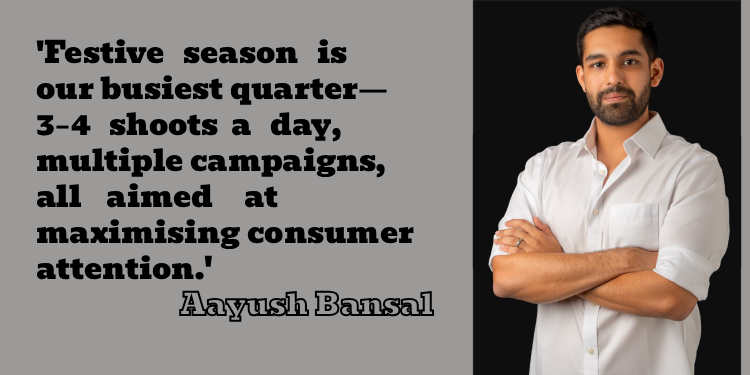
Festive season is rocking as usual. It’s always the busiest and business-wise the most impactful quarter for us. Purely because a lot of the brands we work with are consumer brands.
We’re doing almost 3–4 shoots a day, rolling out multiple campaigns, working with a lot of young brands for whom the festive season is absolutely essential to success. It’s a great opportunity where the internet is primed for attention, for conversion, people are looking out for new brands, new brands get a lot of opportunities to appeal to their target audiences. And we help brands make the most of it.
Q. How will culturally rooted, digitally agile storytelling help brands standout during the festive season when everybody will be shouting?
Once again going back to the fact that it’s very important that brands are aware of who their target audiences are. This means not only understanding their TG but also understanding what their key differentiating factors are from a brand perspective.
And thereby being able to craft communication that has a very strong cultural resonance with their audience sets. This is where I think brands will be able to stand out from their competitors in this festive season. While everyone is shouting, very few are being heard. And hence it’s important to be able to create very strong cultural resonance with your target personas.
Q. Ottoman focusses on building cohesive, considered identities that move with clarity and intent. Does this involve having a long term perspective?
Creating a very craft positioning, looking only at a consumer who is wanting to purchase craft spirits. But with a country like India, you have to be able to build for the mass of India.
And that means being able to create an identity that resonates not just with a craft consumer but with a consumer from the larger segment. Hence with Ottoman, we are very careful about how we do our research, how we understand who our audiences are, and help brands communicate to these audiences correctly.
Q. Do companies still think of brand identity as being mainly about the logo or is that thinking changing?
It is changing slowly. They are understanding that building a consumer brand is not going to happen simply by making a good logo and good packaging.
It is going to require a lot more comprehensive understanding of the consumer and connection with pop culture or subcultures that the brand can associate with. Hence brands are educated and are understanding this, especially new age digital brands.
A lot of the young founders are very well aware of this fact and are purely creating brands which are built on strong positioning and strong communication.
Q. Could you talk about the expansion plans into Delhi and Bangalore?
I think we have created a very strong and robust ecosystem and infrastructure in Bombay. We have also been able to pick up a few clients in other geographies. It is very important that we had our systems in place before we chose to scale. So we had a mission of systems for scale back in 2023 which I feel we have been able to work well upon.
Now with our new space, our new headquarters and a new flurry of hires, I think we are primed for geographic expansion. And we will begin to hire key resources in different geographies who will help us close business.
Our model is very service oriented. We act as an extended arm to most of our clients. And hence it is important for us to have hyper-local hires to be able to cater to these audiences and not just service them from afar. So we are taking our time with geographic expansion. We want to do it right, we want to do it the BlackCab way.