NP Digital is a global digital agency, founded by Neil Patel in 2007.
The company focusses on creating innovative, adaptive, and data-driven digital marketing plans. Obsessed with helping companies grow and exceed their goals, the company focusses on delivering on the mission of continually helping brands connect and engage with their audience.
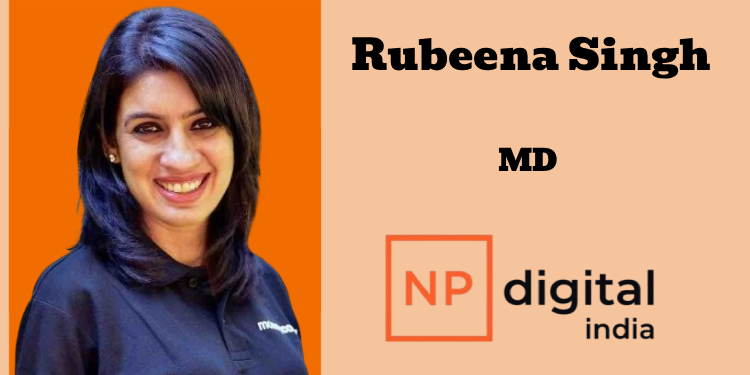
Rubeena Singh has been serving as MD at NP Digital India. With over two decades of experience in the digital marketing and media industry, she is a seasoned leader committed to driving business growth and operational excellence.
As NP Digital India MD, she leverages her deep industry knowledge to lead transformative strategies, ensuring the company stays ahead in an increasingly competitive digital landscape. Before joining NP Digital India, she held prominent leadership roles, including CEO of iProspect India, COO at Moneycontrol, and Country Manager for Josh. At AnyMind Group, she successfully expanded operations into the UAE and Saudi Arabia, diversifying the business into new segments and driving significant regional growth.
Her leadership and ability to navigate complex challenges have solidified her as a respected figure in the industry. At NP Digital India, she continues to push the boundaries of performance marketing, delivering measurable results and impactful solutions for clients across the globe.
Medianews4u.com caught up with NP Digital India MD Rubeena Singh who offers her perspective on how 2025 was for the digital marketing industry and what the company has in store for 2026.
Q. Television had a bad year in terms of ad spends. Has digital also struggled in terms of maintaining its growth rate? Has the growth rate now rationalized?
Digital hasn’t struggled, but we’ve seen the growth rate rationalise to more sustainable levels. We recorded approximately 10% year-over-year growth in 2024. Not the explosive pandemic-era numbers, but steady and predictable, which signals market maturity. The most significant shift has been consumer migration toward LLMs like ChatGPT, Google Gemini, and AI-powered search, operating alongside traditional platforms.
Q. When one looks at digital marketing, what were the key trends seen in 2025?
Three fundamental shifts defined the landscape:
a. First, consumer behavior became even more fragmented. Users engage with AI, social media, and traditional search distinctly, requiring brands to maintain strategic presence across multiple platforms. Beyond the obvious channels, we’re seeing LinkedIn, Reddit, and Quora emerge as critical touchpoints.
b. Second, brands began optimising for LLMs, ensuring visibility in ChatGPT, Perplexity, and Google AI Overviews. This is a fundamental shift in how we think about discoverability.
c. Third, despite technological advancement, the fundamentals remain paramount: Quality content, deep audience understanding, and building enduring customer relationships.
Q. In the past, digital has mainly been used for performance marketing. But in 2025, did brands increasingly use it for brand building? If so, are there examples that stand out?
Absolutely. As the market matures, brands are embracing full-funnel digital strategies. Brand building delivers three critical advantages:
Long-term equity and resilience. Strong brands create recognition, trust, preference, and loyalty. This builds a moat against market volatility, pricing pressures, and competitive threats.
Enhanced performance marketing outcomes. While performance marketing delivers short-term results, brand strength amplifies those outcomes and reduces acquisition costs over time.
Strategic resilience in a complex landscape. With rising ad costs, stricter privacy regulations, and more competition for attention, over-reliance on paid advertising creates vulnerability. Brand building unlocks untapped demand and builds proprietary, first-party audiences.
This makes brand allocation increasingly strategic.
Additionally, as paid media costs escalate, brands are investing heavily in organic presence. Organic growth builds trust, credibility, and high-intent qualified traffic. This is particularly critical as search evolves through voice, conversational, and AI-driven queries. That said, paid search remains valuable for immediate visibility in competitive environments. At NP Digital, we advocate for our One Search approach, where paid and organic strategies complement each other synergistically.
Q. How did data-driven marketing help brands connect more meaningfully with consumers in 2025?
By transforming interactions from generic to genuinely personal. Today’s consumers expect brands to understand them. They actively disengage when experiences feel mass-produced or irrelevant.
Data enables brands to decode behavior, preferences, and timing. This enables them to deliver the right message at the optimal moment. Sophisticated cross-channel strategies build loyalty because customers feel recognized across every touchpoint. It’s about being understood, not merely targetted.
Q. The company focuses on creating innovative, adaptive, and data-driven digital marketing plans. Does this entail auditing where a client’s business is and planning how to get to where they need to be?
Precisely. Every engagement begins with comprehensive auditing:
- Competitive landscape analysis: Understanding competitor strategies and performance
- Current positioning: Assessing the client’s presence across all channels
- Gap identification: Determining what’s working and what requires optimisation
- Strategic alignment: Understanding client vision, preferred messaging, and ideal media mix
From there, we develop client-specific strategies. No templated approaches. Every client presents unique challenges, so our roadmap is customised based on audit findings.
Q. How did NP Digital leverage tech innovations to differentiate itself from competition?
We did it in three ways:
- In-house research: We study real user behaviors to understand what actually drives clicks, engagement, and conversions. Our insights come from testing, not guessing.
- R&D team: Research is built into how we work. We set aside time as an organization for our research, to explore emerging technologies and developing mechanisms. What we learn gets tested with clients and trained across teams.
- Our proprietary tools
This keeps us ahead of the curve.
Q. You believe that thinking outside the box is important. As tech rapidly evolves, has this become essential to stay ahead of the curve?
It’s no longer essential but existential. With AI fundamentally reshaping search and consumer behaviour fragmenting across platforms, conventional approaches guarantee obsolescence. Winning brands today experiment continuously, test emerging platforms, and pursue unconventional strategies.
Q. Did advanced analytic solutions and marketing mix modeling play a bigger role in digital marketing in 2025?
Significantly. Budget scrutiny intensified, demanding irrefutable proof of value. Marketing measurement evolved to demonstrate ROI, optimise allocations, and enable rapid adaptation to market dynamics. Leading brands now integrate attribution modeling, marketing mix modeling, and incrementality testing for comprehensive performance. The era of intuition-based marketing has ended. Every rupee must be accountable.
Q. In 2025, did clients measure ROI according to whether the consumer listened to the entire message at a time when attention spans are rapidly declining?
We’ve observed a nuanced shift. While attention spans contracted overall, informed, information-seeking audiences invested significantly more time engaging with content from credible sources.
Quality supersedes length. A concise message from a trusted brand commands more attention than extensive content from unknown entities. Success lies in earning trust and delivering concentrated value.
Q. Was 2025 the year when retail media platforms like Amazon and Flipkart successfully challenged Meta and Google for a share of a brand’s digital ad spend?
Retail media platforms made substantial inroads, capturing meaningful budget share from traditional digital giants. The advantage is clear: These platforms offer transactional proximity. Advertising where purchase intent peaks.
Q. Is AI now playing a role across the funnel?
AI has permeated every funnel stage: Awareness, consideration, and conversion. It analyzes customer data for precision targeting, predicts behavioral trends, generates personalized creative, and autonomously optimizes campaign performance.
Modern tools automate customer segmentation, orchestrate sophisticated cross-channel journeys, and continuously enhance performance through auto-optimization. .
Q. In terms of challenges, is too much focus on hyper-personalization now starting to result in consumer trust getting eroded?
It’s a delicate balance. Personalization strengthens relationships when it’s genuinely helpful and transparently implemented. When consumers feel surveilled or manipulated, trust deteriorates rapidly. Brands need to communicate clearly about data usage and personalize in ways that add tangible value. Consumers understand that brands are not merely pushing products but are building stronger customer relationships.
The imperative is respecting boundaries while maintaining relevance.
Q. How did measurement tools improve in 2025? Does fraud continue to be a huge issue?
Measurement capabilities advanced significantly, integrating attribution, MMM, and incrementality testing with AI-powered, privacy-compliant solutions. Brands can now track cross-channel performance with more accuracy and understand true performance drivers.
However, fraud remains a substantial challenge. Global ad fraud costs continue escalating year over year, with click spamming representing the dominant form of invalid traffic. AI-powered bots now replicate human behavior with such sophistication that detection grows increasingly difficult.
Q. In 2026, what are going to be the focus areas for NP Digital?
Two strategic priorities:
Deepening AI expertise. We’re advancing our understanding of how consumers utilize AI-powered search and how we can leverage these platforms to drive client results.
One Search strategy. Developing unified approaches across traditional search, AI platforms, social media, and retail media. Search has become ubiquitous. It is no longer confined to Google, but distributed across the entire digital ecosystem.
![Beyond Ello, you can expect [x]cubeLABS to lead the transition from generic “chatbots” to Vertical AI Agents: Sridhar Muppidi](https://www.medianews4u.com/wp-content/uploads/2026/03/Sridhar-Muppidi-Ello-350x250.png)