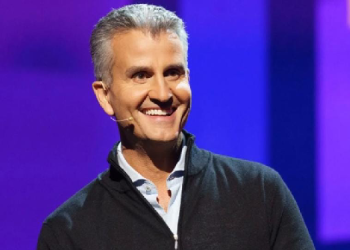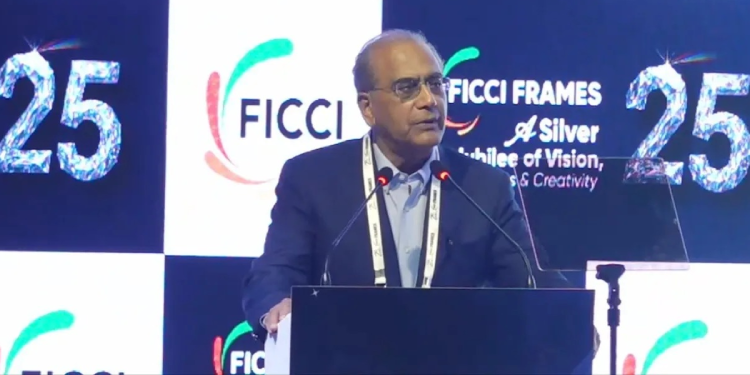
Mumbai: At FICCI Frames 2025, Aroon Purie, Chairman and Editor-in-Chief of the India Today Group, delivered a powerful reflection on five decades in media — a journey that mirrors the story of disruption, reinvention, and resilience that defines India’s media landscape today.
“It’s a privilege to be here at FICCI Frames, among the most influential minds and creators shaping India’s vast media and entertainment landscape,” Purie began, marking what will be his 50th year in the business. “If there is one lesson I’ve learned over the past five decades, it is this: disruption never ends. In fact, disruption is the only constant.”
Tracing his journey from the launch of India Today magazine — once with a readership of 5 million — to the Group’s present reach of 750 million viewers, readers, and followers across platforms, Purie showcased how each wave of change opened new opportunities. From print to television, to digital and AI-led journalism, the India Today Group continues to evolve, now even with its own AI news anchor, SANA.
Yet, beneath the progress, Purie warned of structural challenges threatening the industry’s sustainability. “Beneath all the technological disruption lies a deeper problem — the business model of news,” he said, describing how India’s massive media ecosystem, with over 1.4 lakh registered publications and 375 24-hour news channels, operates on fragile financial foundations.
He humorously described the paradox of ‘raddi economics’ in print — where newspapers are sold so cheaply that readers often recover the cost from selling old papers — and the enduring inefficiencies of broadcasting, still constrained by legacy regulations and carriage fees.
“It is beyond my understanding why the government treats cable TV like an essential commodity — like wheat or rice — whose price they must control,” he remarked candidly. “The role of government is not to regulate, but to facilitate.”
Purie expressed concern that while advertising has long funded journalism, it has also made the profession vulnerable. “When journalism’s survival depends almost entirely on advertising from corporations and governments, its independence is under constant threat of compromise,” he cautioned. Despite this, he acknowledged that the same system has enabled some of India’s most impactful journalism — from the Bofors expose to coverage of the 2G spectrum scam and COVID-19 pandemic.
However, the rise of what Purie termed ‘Billionaire News Channels’ — owned by large industrial houses for influence rather than information — poses a new kind of danger.
“They have deep pockets, and they are destroying the economic models of news channels. Their entrance makes the public believe that every channel is a mouthpiece for vested interests,” he said.
Turning to the digital era, Purie lamented how media once again surrendered value for reach.
“Digital news was our chance to fix the model. But we repeated the same mistake — giving our product away for free, chasing scale and eyeballs. The new gatekeepers — Google, Facebook, YouTube, and X — produce no journalism, yet control its distribution and monetisation,” he said.
“They are eating the breakfast, lunch, and dinner of media companies — leaving only crumbs.”
He warned that *AI* now represents the next great disruption.
“AI is being positioned as the new arbiter of truth. But when content is scraped, synthesised, and regurgitated without credit or revenue, it’s an existential threat to credible information.”
Calling for unity and innovation within the industry, Purie urged media professionals to reassert the value of trustworthy journalism:
“We must stop apologising for the value of what we create. We must persuade audiences that credible, well-researched news is a public good — and like any public good, it has a price.”
Ending on a philosophical note, he reminded the audience that storytelling remains at the heart of humanity.
“Disruption is not the enemy — it’s the new normal. The question is, do we have the courage, imagination, and integrity to seize it?
We must not be intimidated by new technologies but use them to tell stories in a more memorable and truthful way. In an era of post-truth, telling the truth matters even more. The future of truth in India — and the health of our democracy — depends on it.”