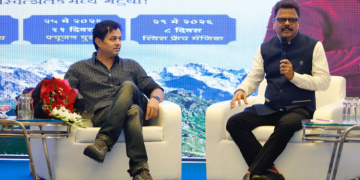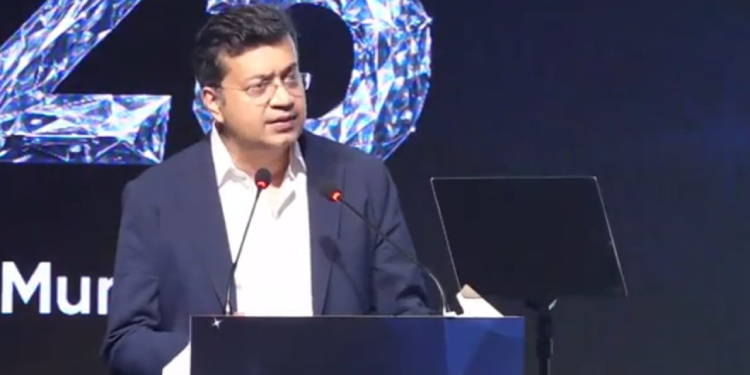
Mumbai: Delivering a stirring keynote at FICCI Frames 2025, Gaurav Banerjee, Managing Director & CEO of Sony Pictures Networks India, urged industry leaders, policymakers, and creators to collectively reimagine India’s creative economy—transforming it into a global powerhouse that matches the scale and ambition of the nation’s technology and pharma industries.
Speaking on the theme, Banerjee underscored that India’s media and entertainment sector—currently valued at nearly $30 billion and contributing around 0.7% to the GDP—remains driven almost entirely by domestic demand. “The question before us today,” he said, “is what will it take to grow this astronomically? Where will the next big leap come from?”
‘Where is India’s Global Content Giant?’
Banerjee framed the conversation around two provocative questions:
“What is stopping us from birthing an at-scale content behemoth—the Airtel or IPL of the entertainment world? And how do we build an institutional framework that can scale private investments in content the way India did with pharma or IT services?”
He reminded the audience that India’s entertainment journey has seen three major inflection points over the past 25 years: the launch of Kaun Banega Crorepati at the turn of the century, the advent of the Indian Premier League in 2008, and the rise of pan-India storytelling with shows like Satyamev Jayate and films like Baahubali.
“But the last of these breakthroughs happened a decade ago,” Banerjee noted. “We’ve been waiting for the next big leap that audiences will root for—and that wait has gone on for far too long.”
From IPL to Innovation: Building a Talent Ecosystem
Banerjee drew a compelling parallel between the IPL’s success in aggregating cricketing talent and the need for a similar ecosystem for creative industries. “Every IPL season discovers new names and nurtures world-class talent,” he said. “That’s the kind of system we need—one that reaches the most authentic storytellers and enables them to create for the world.”
He argued that India, with its 1.4 billion people and “the world’s most vibrant cultural reservoir,” should be producing globally celebrated content year after year. “We shouldn’t have to wait decades for the next Lagaan or Baahubali,” he said. “It should happen every year.”
Malayalam Cinema: A Model for the Future
Citing the Malayalam film industry as a beacon of creative and commercial excellence, Banerjee praised the ecosystem that has produced a steady stream of innovative films in recent years. “A movie like Loka, made on a ₹30 crore budget, earning ₹300 crore at the box office—that’s the kind of success that shows what’s possible when creativity meets ecosystem,” he said, referencing recent hits such as Aavesham, 2018, and Manjummel Boys.
Three Steps to Scale the Creative Economy
To catalyse such growth nationally, Banerjee outlined a three-step roadmap:
1.Build Creative Institutions: “We need centres of excellence that scout, train, and nurture talent,” he said, calling for institutions that mirror the IPL’s scouting model.
2. Foster Collaboration: He stressed the need for closer ties between academia and industry. “If Stanford came before Silicon Valley, India too must build such academic-industry partnerships for creativity.”
3. Enable, Don’t Restrain, Regulation: Banerjee cautioned against overregulation that stifles innovation. “Creativity is human capital at its purest. To unlock it, we must make regulation lighter, enabling, and future- ready. Why is our creative regulation still anchored in a colonial-era past?”
Placing Creativity at the Heart of India’s Growth Story
In his closing remarks, Banerjee emphasized that the creative industries are no longer peripheral—they must be seen as central to India’s growth and global identity. “They generate jobs, fuel innovation, export imagination, and amplify India’s soft power,” he said. “If India is to write the next chapter of global leadership, we must invest in creativity with the same boldness and vision as we are doing with technology.”
Calling upon policymakers and industry stakeholders to champion this vision, he concluded, “Let’s ensure that India’s creative economy does not sit at the margins of policy but stands at the very heart of our growth story.”