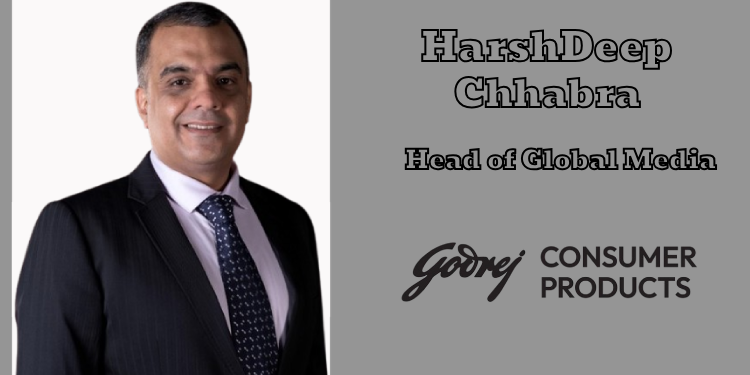
At a recent media presentation, Godrej Consumer Products Ltd. (GCPL) head of global media, HarshDeep Chhabra, unveiled a comprehensive vision for making the company’s media approach “future ready.” Now the third-largest advertiser on linear TV, with a five percent share of GRPs and the only Indian-origin company in the top five, GCPL is looking beyond scale to navigate a fragmented, attention-deficient media environment.
Chhabra’s first priority is shifting from the long-held FMCG focus on the lowest cost per reach to what he calls the lowest cost per attentive reach. This means not just getting in front of as many people as possible at the right frequency, but also ensuring that audiences are genuinely engaged with the content. GCPL has conducted in-home, real-time attention studies—eschewing artificial lab environments—to measure active and passive attention, multi-screen behaviour, and eyes-on-screen time. The granular data from these studies is being layered with BARC, Meta, YouTube, OTT, and print data to evaluate the business impact of attention in a way Chhabra calls “a big leap.”
The second focus area involves evolving from efficient mass reach to efficient hyper-local reach, and eventually, hyper-personalised reach. While mass reach remains cost-efficient, Chhabra believes the ability to activate campaigns locally and at scale—using mobile and connected TV—will soon become both viable and affordable. By fusing granular retail data with media data, GCPL plans to reach precisely targeted cohorts at the lowest possible cost, with hyper-personalisation as a longer-term ambition.
The third priority is recognising the consolidation of India’s media landscape. Today, ten media owners command 70% of adex, but GCPL anticipates this will shrink to four dominant players, with Doordarshan poised for a revival thanks to its Aadhaar-linked data, DD Freedish growth, cricket rights, and strong content ecosystem. The company will focus on deep partnerships with the biggest platforms for mass reach and best-in-class pricing, rather than chasing fragmented deals, while keeping an eye on where the “TikTok of India” might emerge.
The fourth shift is from delivering one message to many, to delivering many messages to many. GCPL is building an AI-enabled content factory using tools from JSON and Google V03 to produce high-quality, low-cost video content at unprecedented speed—cutting production timelines from 15 days to just one hour. This will reshape influencer marketing, enabling campaigns to scale without sacrificing quality or efficiency.
The fifth area sees GCPL moving beyond regional languages into local dialects, producing content that resonates deeply within micro-communities and working with influencers “as local as they get.” Closely linked is the sixth priority, which rejects the high cost of building extensive first-party data for low-value FMCG categories. Instead, GCPL envisions an “every party data” ecosystem built through partnerships, making targeted audience engagement more cost-effective and scalable.
Seventh on the list is the company’s plan to progress from artificial intelligence to what Chhabra terms “artificial imagination,” establishing an in-house AI lab at group level to drive transformation across the marketing value chain. The eighth shift is towards programmatic buying for all media, including TV, supported by unified cross-screen measurement to optimise reach and frequency across linear and connected television.
Ninth, GCPL will move from tracking competition reach solely on linear TV to tracking it across all mediums, aiming to create a single, cross-platform consumer view that transcends walled gardens through industry collaboration. Finally, the tenth focus area is a move away from chasing awards for innovation, towards seeking awards for attributable business growth. As Chhabra put it, “everything we do will be business-out,” with advertising treated as an investment rather than a cost to be minimised.
While these shifts are significant, Chhabra emphasised that some fundamentals will not change. Internet penetration will continue to rise, connected TV will keep growing beyond its current 40 million households, pay TV will decline, and India will remain largely a single-TV household market. Linear TV will continue to offer cheap, scalable, brand-safe reach, and GCPL will remain a reach-first planner, working with media owners as strategic partners.
Chhabra closed by making it clear what GCPL is not: the company will not be procurement-led, will not buy cheap inventory at the expense of effectiveness, and will not be obsessed with fame or awards. The focus will stay firmly on measurable business outcomes, ensuring that media investments deliver growth in a rapidly evolving consumer landscape.