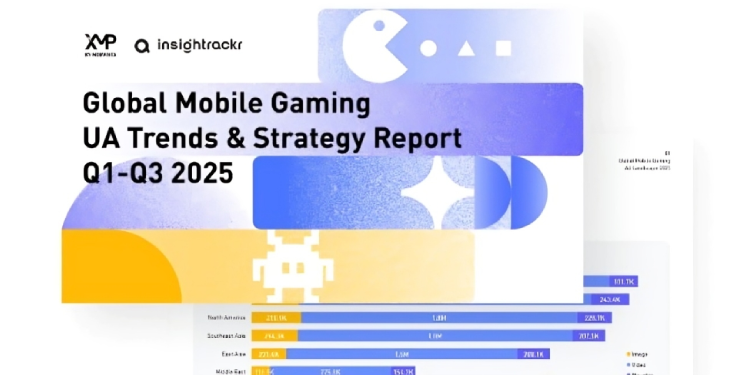
Mumbai: XMP, the cross-channel intelligent media buying platform under Mobvista (1860.HK), has released its Global Mobile Gaming UA Trends & Strategy Report, revealing a breakthrough year defined by surging ad volumes, rising interactivity, and a decisive shift toward AI-generated creative assets. As mobile gaming ad spend expands and user acquisition (UA) costs climb, the report shows how brands are leaning into AI, automation, and immersive ad formats to push performance and profitability into 2026.
The findings highlight how the rapid adoption of AI tools is transforming everything from creative development to cross-channel campaign optimisation. Advertisers worldwide are increasingly leveraging AI to streamline workflows, personalise engagement, and maintain a competitive edge amid intensifying global competition.
The report reveals strong momentum in mobile gaming markets across regions:
- Global installs jumped 7.4% YoY, reaching 38.9 billion downloads from Q1–Q3 2025.
- Android dominated with 80.8% share of global installs, while iOS held 19.2%.
- Global gaming revenue (IAA + IAP) rose 13.2% YoY, reaching US$82.5 billion.
Hyper-Casual remained the world’s most downloaded genre, while Puzzle and Action categories retained their robust performance. In terms of monetisation, Shooting and Puzzle titles topped ad-driven revenue charts.
Video continued to dominate the creative landscape, accounting for 81% of all ad formats, while hybrid formats — particularly video-playable combinations — recorded sharp growth. This shift reflects advertisers’ growing preference for immersive, interactive experiences that blend storytelling with performance.
South America emerged as the leading advertising region with the highest creative output, with video creatives constituting nearly 85% of all ads. Meanwhile, Meta maintained its leadership in global ad spend across both casual and hardcore gaming genres, followed by Google and TikTok.
The report underscores the growing influence of AI within creative ecosystems, with AI-generated videos, characters, and avatars increasingly enhancing retention and conversion. These innovations enable brands to scale creative output rapidly while tailoring engagement to diverse audience groups.
However, the year also brought challenges, including rising UA costs, cross-channel data fragmentation, and increased pressure for unified performance insights — accelerating the industry’s migration to automated, AI-supported workflows.
In response to escalating complexity, marketers in 2025 prioritised four core capabilities:
- Cross-Channel Management: Unified control over campaigns across Meta, Google, TikTok, and SDK networks.
- Unified Creative Management: Centralised hubs for video, image, and playable asset distribution.
- AI-Powered Optimization: Automation of bidding, budgets, and creative rotation fuelled by real-time data.
- Full-Funnel Transparency: Integrated performance tracking and ROI measurement across channels.
Zidan Tang, Head of XMP by Mobvista, said, “As advertisers prepare for 2026, we’re seeing a clear shift toward more automated, cross-channel workflows that streamline planning, execution and measurement across major media networks. 2025 marked a turning point for mobile advertising as advertisers moved from volume-based campaigns to creative-led, performance-driven strategies powered by AI and cross-channel visibility, which shows that mobile gaming marketing has fully entered the intelligent era.”
He added, “Advertisers are moving toward efficiency and precision. Our data shows that hybrid ad strategies and AI-driven optimization are now the rule, not the exception. XMP helps brands unify fragmented ecosystems and achieve measurable growth.”
As 2025 draws to a close, the data signals a robust and rapidly evolving ecosystem. With global ad spending rising, downloads accelerating, and immersive ads becoming the new standard, XMP’s report offers a comprehensive blueprint for the next wave of mobile advertising.
For advertisers navigating 2026, the takeaway is clear: those who embrace AI, interactive formats, and unified visibility will define the future of digital engagement and mobile gaming growth.