As f1studioz completes 13 years, it stands at the forefront of how AI, data, and design are reshaping user experience.
Designing UX for AI introduces distinct challenges and opportunities beyond traditional UX design. It involves crafting intuitive, adaptive interfaces that not only respond to user behaviour but also anticipate their evolving needs. The goal is to merge human-centred design with advanced AI systems for a fluid, seamless interaction.
From conversational interfaces, multi-modal interfaces, dashboards to predictive tools, it looks to ensure that AI solutions empower users and drive value.
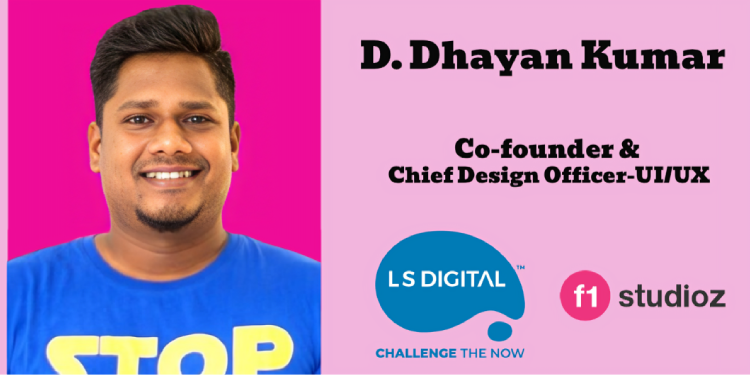
Medianews4u.com caught up with D. Dhayan Kumar, Co-founder and Chief Design Officer-UI/UX, LS Digital
Q. f1studioz has completed 13 years. How would you describe the progress made and is being obsessive a key reason for the growth of the company?
Absolutely. If there is one word that defines our journey, it is “obsession.” Not with aesthetics alone, but with meaningful product outcomes. Over the last 13 years, this mindset has helped us evolve from a boutique design studio into a product-focused UX and front-end engineering partner trusted across BFSI, SaaS, Retail, Gaming, and Telecom.
In this time, we’ve built over 40 enterprise-grade design systems, many of which power applications used by 80-100 million users. Our applied UX interventions have reduced task times by 30-60%, shortened onboarding journeys by up to 40%, and improved conversions across both B2C and B2B funnels. Teams across India, the US, and Europe rely on our token-driven frameworks that speed up multi-platform design delivery by 3-5x. This growth wasn’t accidental, it came from a relentless commitment to craft, systems thinking, and business impact, not just UI screens.
Q. In transforming from a design studio into a product-minded UX and front-end engineering partner that drives measurable business outcomes what has been the big challenge?
The biggest challenge was redefining what design truly means. For many enterprises, UX was traditionally treated as UI beautification, and shifting that perception required a fundamental mindset change — from “make it look good” to “make it work better, faster, smarter.”
This meant moving from isolated screens to holistic design systems, embedding DesignOps, governance, and tokenisation for scale, integrating front-end engineering to bridge the gap between design and delivery, and consistently demonstrating that UX is not a cost centre but a business accelerator. Today, CIOs and CPOs expect their UX partners to influence adoption, efficiency, revenue, retention, and even technical velocity — and we’ve evolved deliberately to meet those expectations.
Q. For 2026 what goals have been set in areas like growing revenue, growing the client base and what is the gameplan to get there?
By 2026, we are positioning f1studioz as a global leader in AI-infused experience and front-end transformation, with a clear focus on scale, speed, and domain depth. Our growth roadmap prioritizes expanding our presence across the US and Europe, especially within SaaS, fintech, and digital-first enterprises, while accelerating our AI-first workflows where generative, predictive, and agentic AI enhance everything from research and prototyping to high-quality front-end delivery.
We are also building specialised domain pods for BFSI, healthcare, retail, and gaming, and leveraging LS Digital’s ecosystem strengths to deliver a full-funnel transformation stack — Experience → Engineering → Growth. Our north star remains constant: delivering measurable product outcomes at speed and scale, powered by AI, systems thinking, and engineering discipline.
Q. According to predictive analytics where is the whitespace for growth?
The biggest whitespace today isn’t in the analytics itself, but in how enterprises apply it to UX, and we see four major opportunity areas emerging. First, AI-native experience redesign, where most enterprises still retrofit AI into old workflows instead of building AI-first products that replace manual decision-making with prediction and automation.
Second, modernising legacy design systems through token-driven, AI-assisted architectures that can shrink update cycles from weeks to days, a major unlock for organisations operating across multiple apps, markets, and languages. Third, hyper-personalisation, where predictive UX finally enables contextual dashboards, anticipatory suggestions, intent-based journey shortening, and intelligent nudges, moving millions of users away from generic experiences.
And fourth, front-end modernisation at scale, using predictive intelligence to optimize UI rendering, flows, and content blocks — an area still largely untapped. These are exactly the capabilities we’ve been building and strengthening over the last 3–4 years.
Q. How does f1studioz leverage the strengths and synergies with the other companies within LS Digital?
f1studioz powers the Experience layer within LS Digital’s full-funnel transformation ecosystem, creating a tightly integrated and highly synergistic value chain. Langoor strengthens customer experience and brand storytelling, Social Panga drives creativity, content strategy, and digital campaigns, while LS Digital brings depth in media, performance growth, and analytics. DataQuark completes the stack by powering the intelligence and decisioning layer.
Together, this unified ecosystem enables enterprises to move seamlessly from Insight → Experience → Engineering → Media → Growth, creating a continuous value loop in which every digital touchpoint is measurable, optimised, and constantly improved.
Q. How does f1studioz’s integrated approach mirror LS Digital’s full-funnel transformation vision?
Our approach is rooted in designing connected, end-to-end user journeys. We ensure that every touchpoint, whether it begins with discovery through media, engagement within the product, or conversion via CRM, feels consistent, intelligent, and fully measurable.
By integrating martech, data and analytics, CRM systems, media platforms, UX, and front-end engineering into a unified flow, we help brands create journeys where awareness seamlessly fuels engagement, engagement accelerates conversion, and conversion naturally builds long-term loyalty.
Q. Could you talk about recent work done with clients that stands out in categories like gaming, e-commerce and education?
Across sectors, our work has consistently delivered faster workflows, smarter decisions, and stronger business outcomes. In gaming, we simplified complex moderator and operations workflows, reducing review time by nearly 40% and enabling sharper real-time decisions.
In e-commerce, we transformed product discovery for Clopay, North America’s largest garage door brand, by building EZDoor, an AI-powered configurator that lets users visualise and customise doors instantly, cutting drop-offs and boosting conversions. In education, we enhanced student onboarding and learning journeys through behaviour-led insights and a modular design system, reducing cognitive load and improving session completion.
Q. What trends are expected in 2026 in terms of how AI, data, and design reshape the user experience?
2026 will be the year where design, data, and AI fully converge. Key trends:
- AI copilots inside every product
- Predictive UX that shortens journeys automatically
- Multimodal interaction (voice, vision, chat, gestures)
- Auto-generated UI components driven by design tokens and agentic AI
- AI-powered research, audits, and usability testing
- Data-derived design patterns that adapt in real-time
Products will feel alive, adaptive, and context-aware — not static screens.
Q. What role are neuromarketing and behavioural science playing in helping design an impactful customer experience? How does focussing on these areas help brands understand the emotions and the buying processes of consumers?
Behavioural science has always been at the core of effective UX, and its role is only becoming more critical. We apply its principles across motivation and habit formation, trust-building and risk reduction, decision architecture, and cognitive load management.
For enterprises, particularly in BFSI, education, and e-commerce—even small behavioral interventions can create outsized impact, driving higher conversions, smoother journeys, and significantly reduced friction across user flows.
Q. Will AR and VR dominate the UI/UX landscape in 2026 or are they already dominating? They help create interactive and captivating interfaces.
AR/VR won’t replace traditional UX, but it will significantly reshape how key industries operate. In retail, it enables product try-ons and hyper-personalized storefronts; in gaming, it powers immersive gameplay and advanced moderation tools; in real estate, it transforms discovery through virtual walkthroughs; and in workforce training, it creates rich 3D learning environments. Its true value lies in bridging the physical and digital worlds, enhancing comprehension, and reducing the overall effort required for users to make confident decision
Q. Is Scroll-based storytelling a key trend in UI/UX design? Instead of constantly clicking users can get a smoother and more engaging user experience.
Definitely. Scroll-based storytelling remains one of the most powerful ways to create immersive, frictionless narratives, especially for:
• D2C brand launches
• SaaS product showcases
• Founder stories
• Campaign microsites
When done well, scroll-based experiences create depth without demanding effort from the user — something modern audiences love.
Q. What role is ChatGPT playing in helping designers deliver tailor-made content experiences?
ChatGPT has become a powerful accelerator across the entire UX and content workflow. It speeds up UX writing and microcopy, multilingual content generation, rapid research synthesis, scenario-based prototyping, and even persona modelling and journey drafting.
By enabling teams to explore more variations quickly and produce context-aware, consistent content at scale, it frees creatives to focus on higher-order work — strategy, narrative depth, and brand-building.
Q. How are AI and automation redefining UX and product design? Is AI reshaping the boundaries of design?
AI is redefining the designer’s role by taking over execution-heavy tasks and amplifying strategic work. It can now auto-generate layout variations, summarise user pain points, test hypotheses, optimise flows based on behavioural signals, automate documentation, and validate usability patterns at remarkable speed.
This shift allows designers to focus more on strategy, insight, experimentation, and problem-framing. The outcome is clear: smarter products, faster delivery cycles, and far more headroom for genuine creative innovation.