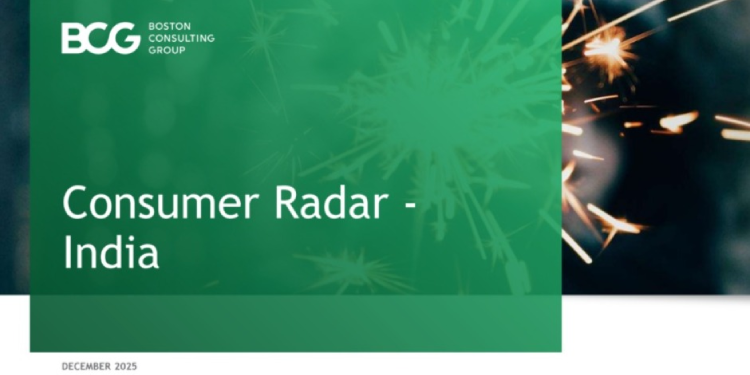
Mumbai: India is heading into 2026 with strong consumer confidence, rising spending intent, and rapid adoption of artificial intelligence, positioning it as one of the world’s most optimistic consumer markets. According to the latest Global Consumer Radar Report by Boston Consulting Group (BCG), India records a net consumer optimism of +27%, second only to China and significantly above the global average of around minus 12%.
The report highlights that over 60% of Indian consumers anticipate continued economic optimism, while only about one-third fear rising unemployment or an economic downturn. Reflecting this confidence, 60% of Indian consumers expect to increase household spending over the next six months, up from 50% in September 2024. Spending momentum is strongest in automobiles (+70%) and mobile plans and devices (+63%).
While inflation remains the primary driver of higher spending globally, India stands out with nearly one-third of consumers increasing spending due to discretionary purchases, the highest proportion among surveyed markets. However, 69% of consumers expecting higher spending cite rising prices of essentials and non-essentials as the key factor.
India is also emerging as a global leader in Generative AI (GenAI) adoption, particularly for shopping-related use cases. As of November 2025, 62% of Indian consumers have used GenAI tools, up sharply from 48% in February 2025. Notably, 64% use GenAI to guide brand and product decisions, marginally higher than the 63% who use these tools for work, placing India at the forefront of AI-led commerce.

Commenting on the India findings, Parul Bajaj, India Leader – Marketing, Sales and Pricing Practice, BCG, said, “India’s consumers are rapidly embracing a fully digital, AI-enabled path to purchase, with GenAI now firmly embedded in everyday decision-making. With 62% of consumers having already used GenAI tools, and more people applying them to shopping than even to work, India is emerging as one of the most advanced markets globally in how technology shapes consumption. For brands, this signals a decisive shift: think beyond SEO and optimize in a world of AEO (answer engine optimization) with structured, trustworthy and comparison-ready content.”

Echoing this optimism, Kanika Sanghi, Partner and Director, BCG, added, “Even as many global markets are seeing softening, Indian consumers continue to show confidence with 60% expecting to increase household spending over the next six months – there are differences across categories albeit. For businesses, the priority is to decode the drivers and shape of this shift – understanding personal preferences, category dynamics, shifting motivations and channel those insights into bold portfolio bets that match India’s strong consumption cycle.”
The report also notes that Indian consumers remain relatively unfazed by global geopolitical tensions. Only a net 17% believe that recent global conflicts or political events could slow India’s growth — the second-lowest level of concern globally after China, compared to over 60% in markets such as the UK, France, and Germany.
Sustainability continues to influence Indian consumers’ stated preferences, with eight in ten considering climate change or sustainability in daily purchase decisions, the highest globally. However, this is accompanied by a pronounced say–do gap, as only 9–15% are willing to pay a premium for sustainable options.
While 57% of Indian consumers claim openness to trying new brands, the report finds that 84% ultimately default to familiar brands, highlighting significant inertia and untapped opportunity for marketers to reshape purchase behaviour.
As India’s consumption momentum accelerates — adding a third trillion-dollar economy in just three years — resilient household demand is expected to underpin a decade-long growth cycle. Brands that successfully decode these evolving consumer dynamics are likely to lead the next phase of market expansion, even as global peers grapple with softer demand.