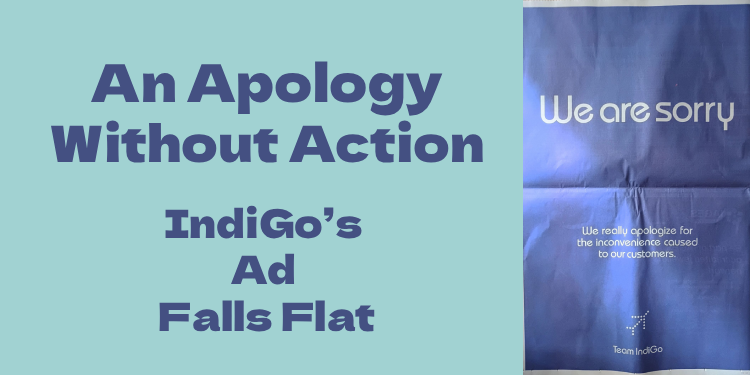
India’s largest airline may have issued a full-page apology, but for thousands of stranded passengers and a growing chorus of business leaders, IndiGo’s newspaper ad has done little more than expose the hollowness of its crisis response.
At a time when Delhi–Bareilly fares hit ₹50,000 and cancellations cascaded across the country due to crew shortages and faulty rostering, IndiGo’s choice of a minimalist, two-line apology has triggered sharper turbulence—this time in the boardrooms, on LinkedIn, and among communication strategists.
A Crisis That Spilled Into the Skies—and a Newspaper Apology Worth “a Tissue Paper”
When a company spends ₹16 lakh on a newspaper apology that holds little real value, it signals that something has gone wrong. It raises questions about the role of IndiGo’s corporate communications team, the crisis management team, and even the Civil Aviation Ministry’s accountability. Yet, there seems to be silence from all sides.
The criticism extends beyond the airline. The absence of communication from the Civil Aviation Ministry and DGCA has raised questions about oversight, preparedness, and governance in a sector dominated by a duopoly—IndiGo and Air India. If the country’s largest airline falters, the system has no buffer, and dynamic pricing algorithms send fares soaring into the stratosphere.
Minimalism Backfires: “A Good First Step That Doesn’t Step Anywhere”
Vineeta Dwivedi, PhD, SPJIMR, noted that IndiGo’s stark apology is visually effective—but operationally empty: “A simple ‘We are sorry’ works as a first step, but this ad only apologises for the emotion, not the event. No explanation, no accountability, no plan. A good apology has three layers—acknowledge harm, explain cause, commit to action. IndiGo has delivered just the first.”
Her verdict: A visible ad cannot substitute for transparent crisis communication.
“Not Enough. Not Nearly Enough.” — Industry Leaders Reject IndiGo’s Gesture
The broader executive community has been unimpressed. One set of experts minced no words:
Cold and unapologetic profiteering has been exposed. Fares surged six times, and if the airline were to compensate every passenger at six times their fare and pay every employee six times their salary, it would speak louder than any apology ever could.
The anger reflects a belief that operational lapses—not unforeseeable shocks—triggered this meltdown.
Passengers Wanted Clarity, Not Silence
Vikas Sachdeva, ZEE, captured what most stranded flyers felt: “The real issue wasn’t the delay—it was the lack of preparedness and complete silence for hours. A next-day apology ad doesn’t fix the experience.”
His summary is scathing: Consumers now expect proactive information, not post-event regret.
“Read the Room, IndiGo” — Communications Experts Slam Tone-Deaf Messaging
Communications strategist Karthik Srinivasan argued the apology triggered the opposite of its intended effect: “If the ad evokes ‘No, you aren’t’ or ‘Yeah, right!’, it’s pointless. IndiGo had 18 months to prepare for FTDL norms. The least they could do is acknowledge that.”
He even drafted what a real apology should sound like—direct, human, and action-led.
In other words: IndiGo chose the one approach least suited to the moment.
Marketing Leaders Say the Apology Failed Both Passengers and Employees
Kartik Mahadev, CMO, ZEE, dissected the missteps: Empathy for passengers? Missing.
Empathy for frontline staff? Missing. Actionable communication? Missing.
He proposed what IndiGo should have done:
- A real-time disruption hub
- Clear pre-travel advisories
- Strong helplines
- Brand-led care (e.g., free IndiGo-branded cabs for stranded travellers)
- Daily progress numbers to show recovery, not just regret
His conclusion: “Sorry is important, but without action it feels inadequate. Managed well, this could have built loyalty. Instead, trust has been shaken.”
Brand Trust “Turned to Dust”
Ashutosh Chaudharie, Vi-John Group, delivered the harshest verdict: “IndiGo had enough time to prepare. This was a failure to act early, decisively and responsibly. They allowed customers to bear the fallout of internal lapses. Brand love has turned to dust.”
He calls the episode a collapse of trust, not just service.
A Suggestion from Industry Veteran Raj Nayak: Buy Goodwill, Not Ads
In a constructive closing note, Raj Nayak offered a CEO-level remedy: “Send every affected passenger a personal apology and a two-way free ticket valid for two years. You can’t buy that goodwill with advertising.”
He added: “An airline with 65% market share must place purpose before profit. Monopolies are never good for consumers.”
IndiGo’s apology was meant to calm the turbulence. Instead, it became a symbol of what the airline—and regulators—failed to deliver: Transparency, Timeliness, Empathy and Operational accountability In a market where two airlines carry the bulk of India’s domestic traffic, failures are magnified and alternatives are limited. That makes crisis management—not just operations—a strategic pillar of aviation stability.
IndiGo will recover operationally. But reputationally, experts across communications, marketing, and business leadership agree: The airline has squandered its strongest asset—trust—and a minimalist apology cannot repair maximal damage.