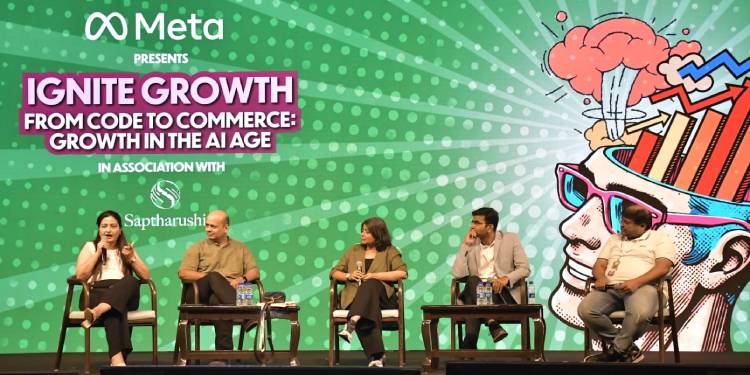
Goa: Against the vibrant backdrop of Goafest 2025, a thought-provoking panel discussion on AI in Business brought together industry frontrunners to examine the sweeping impact of artificial intelligence across sectors like consumer goods, travel, home appliances, and food delivery. Moderated by Anuradha SenGupta, independent journalist and producer, the session explored the dualities of innovation and responsibility in AI integration.
The panel included Pragya Bijalwan (CMO, Voltas Limited), Tejas Apte (Head of Media & Digital Marketing, HUL), Sanket Prakash Tulangekar (Director, MakeMyTrip), and Arjun Choudhary (VP, Swiggy)—each offering a lens into how their industries are leveraging AI to transform operations, personalization, and consumer engagement.
Key Highlights:
Pragya Bijalwan, CMO at Voltas, underlined that “AI is transforming HVAC systems by enabling personalized comfort, predictive maintenance, and efficient customer service through data-driven insights.” She emphasized the need for “AI adoption to be function-agnostic, integrated across departments rather than siloed,” and advocated for reskilling, “AI will act as an evolutionary tool rather than a disruptive threat.”
Tejas Apte of HUL showcased how AI is powering everything from innovation hubs and smart factories to marketing automation. He cited the Shikhar app’s role in helping trade partners with “inventory management and personalized marketing,” and spoke about “thousands of hyper-local campaigns generated with AI to reduce creative turnaround time.” Apte emphasized the importance of ethical usage, referencing Dove’s “Miniatures” campaign as a benchmark in responsible AI.
Sanket Prakash Tulangekar from MakeMyTrip discussed their AI assistant Myra, noting it “leverages multi-agent orchestration to handle travel queries across hotels, flights, and experiences.” He highlighted the importance of “red-teaming to stress test AI models for bias and safety,” calling it a critical part of the company’s AI roadmap.
Arjun Choudhary, VP at Swiggy, revealed that the platform is undergoing a “GenAI transformation,” with AI-powered tools supporting everything from sales and PRDs to catalogue enrichment and user personalization. “AI is now a fundamental life skill—akin to math or digital literacy,” he said, calling it a major productivity enabler.
Common Themes & Takeaways:
AI is an enabler, not a replacement: All speakers reiterated that while AI boosts efficiency, it complements human potential rather than replacing it—underscoring the need for large-scale reskilling.
Hyper-personalization at scale: Whether in cooling systems, travel planning, or food delivery, AI is helping brands deliver uniquely tailored experiences to millions.
Responsible and ethical AI: Transparency, bias checks, and accountability are essential in the deployment of AI.
Cross-functional AI adoption: AI must extend beyond tech teams, becoming embedded in marketing, operations, and business strategy.
AI as a core skill: Much like digital proficiency, AI fluency is becoming a must-have in the modern workforce.
The panel concluded with a powerful message: AI is no longer optional. For businesses to stay competitive, relevant, and responsible, they must embrace AI strategically—while anchoring it in transparency, inclusivity, and continuous learning.