As 2025 concluded, Tarandeep Singh Sekhon, Chief Business Officer at KidZania India, discusses key learnings from the year and previews the roadmap for 2026.
2025 for him was a story of deeper engagement, not just higher footfalls. Family visitation surpassed 2024 levels by Q3, but what truly moved him was witnessing how families experienced KidZania differently. Parents stopped hovering at the edges and stepped into its streets alongside their children. Average dwell time rose to 5.5 hours—that’s more moments, more conversations, more of those magical instances where a parent sees their child discover something new about themselves.
He further noted that tech-integrated experiences like its Madhya Pradesh Tourism VR Journey and the O2i Drone Hub are now among its top activities because they create shared experiences. Parents he says finally understand what excites their children, and children feel truly seen. The partnerships built—from Creambell’s Ice Candy Factory to Meetakriti’s Pottery Studio to EmOcean’s Wellbeing Center—reflect shared purpose, not promotional space. Families stopped asking “What activity next?” and started asking “What does my child want to learn about themselves?”
He noted that in 2025 annual pass memberships have surged. Families return monthly, treating KidZania as part of their rhythm—a place where real growth happens alongside real joy. The most common question now is simply, “What did my child learn today?” That’s reshaping everything that the company does.
KidZania India’s 2026 focus is about creating tech-forward, curriculum-aligned experiences that help children build real capabilities—with parents as active co-learners. Because the most powerful learning happens when families step into discovery together.
Medianews4u.com caught up with Tarandeep Singh Sekhon, Chief Business Officer at KidZania India.
Q. KidZania has crossed 7.2 billion visitors in India and 1 billion abroad. What factors have contributed to this growth?
KidZania’s growth has been driven by its strong positioning as an immersive, role-play-based learning ecosystem rather than a conventional entertainment destination. Our growth hasn’t been accidental. It is the result of a deliberate pivot from being a static ‘destination’ to becoming a dynamic ecosystem. Unlike conventional theme parks that rely on adrenaline, we bank on aspiration. We have sustained this momentum by treating our experience as a living curriculum, one that evolves as fast as the real world does.
The secret sauce is our adaptive integration model. We don’t just sign sponsors; we onboard industry stakeholders who help us co-author the content. When a child engages with a brand at KidZania, they aren’t just playing; they are building a relationship based on trust and utility. This unmatched credibility is why parents keep bringing them back, and why schools view us as an extension of the classroom rather than a simple day off.
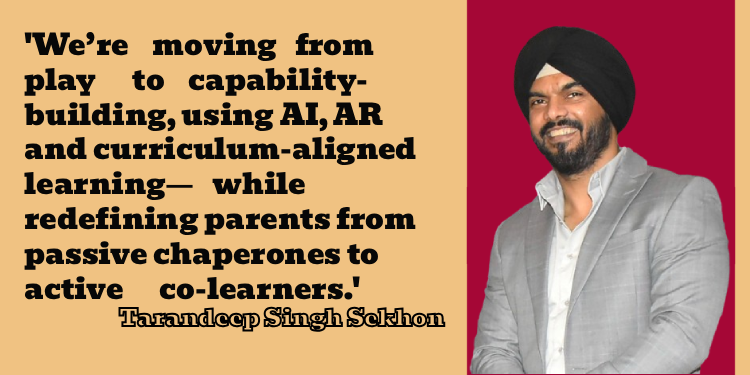
Q. The 2026 focus is clear: creating tech-forward, curriculum-aligned experiences that help children build real capabilities – with parents as active co-learners. What would this entail?
This focus will translate into experiences that integrate technology such as AI-led simulations, AR-enabled storytelling, and data-backed learning outcomes mapped to school curricula and life skills. We are moving beyond ‘play’ to capability building.
The era of passive observation for parents and simple role-play for kids is behind us; the future is collaborative, tech-integrated skill acquisition. Crucially, we are focusing on redefining the parent’s role from ‘chaperone’ to ‘co-pilot’. We are designing specific touchpoints where parents don’t just watch from the sidelines but actively participate in the learning loop, tracking their child’s progress through data-backed insights. This is how we deepen our value proposition: by proving to parents that a day at KidZania isn’t just time spent, but potential unlocked.
Q. Could you talk about the expansion plans in cities like Hyderabad, Bengaluru and also outside India in 2026?
KidZania’s plans for 2026 are to focus on growing in major cities while carefully choosing locations that fit the brand in the long term. Metro cities remain a top priority because of their large number of young families, strong focus on education, and growing number of high-quality malls. However, we are still scouting for a purpose-built space that meets KidZania’s needs.
Internationally, we are targetting high-potential markets like Hong Kong, São Paulo, Taipei, and Athens; cities that demonstrate a sophisticated appreciation for experiential learning. In these regions, we are locking in partners who bring not just capital, but strong networks and operational pedigree. The goal isn’t just to open doors, but to embed ourselves into the local cultural fabric from Day 1, ensuring sustainable, long-term growth.
Q. Could you talk about the focus on deeper engagement done in 2025 and did it help the company standout in a category that includes players like Smaash?
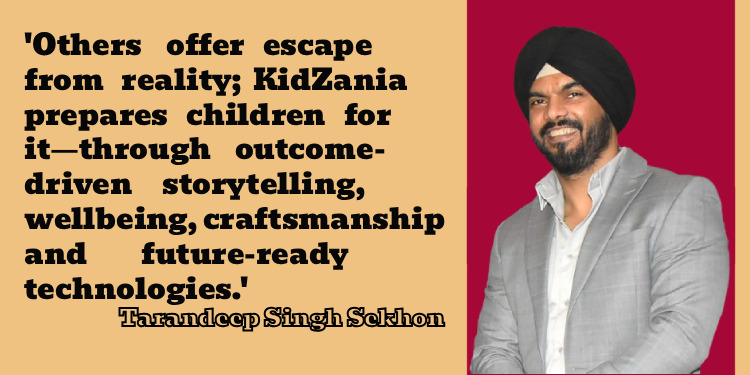
In 2025, KidZania placed a strong emphasis on deeper engagement by enhancing storytelling, role authenticity, and outcome-based learning rather than transactional play. We distinguished ourselves from contemporary pure-play arcades by rejecting transactional gaming in favor of outcome-based narratives. We transformed our floor from a playground into a training ground. We partnered with Madhya Pradesh Tourism to introduce mission-based quests powered by AR to connect with our audience.
We pioneered well-being through our EMOCEAN integration and brought tactile craftsmanship back with Meetakriti’s pottery studio. We embraced the future with O2i’s drone technology modules. This duality created a ‘stickiness’ that arcade games can’t replicate. That is why we stand apart: others offer an escape from reality; we offer preparation for it.
Q. Could you shed light on how KidZania will grow brand partnerships and interactive learning experiences in 2026? What categories are being looked at?
For 2026, our partnership strategy is shifting from ‘visibility’ to ‘integration’. We are actively targeting sectors that define the modern economy. Financial services and Healthcare remain foundational, but we are aggressively expanding into Sustainability and Food & Nutrition, teaching kids the ‘seed-to-table’ and ‘waste-to-wealth’ lifecycles. We are also looking to open the doors to today’s Creator Economy, including the Digital & Tech sectors to demystify new-age careers, from coding and AI ethics to digital content creation. We want children to understand the mechanics behind the screen. If a brand can teach a child a skill they will use ten years from now, that is a partner we want to sign.
Q. KidZania has done deals with Creambell’s Ice Candy Factory, Meetakriti’s Pottery Studio, EmOcean’s Wellbeing Center. Is its USP the quality of experiential marketing that it delivers for brands that engage parents as well?
Our USP isn’t just ‘experiential marketing’. When we partner with brands like Creambell, Meetakriti, or EmOcean, we aren’t just selling a product; we are validating a lifestyle and a value system. For a parent, seeing their child engaged in a safe, constructive activity, whether it’s understanding how ice candy is made or the discipline that goes into creating pottery, immediately elevates that brand from a ‘consumable’ to a ‘partner in development.’
We convert passive consumption into active learning. This is the holy grail for marketers: intergenerational trust. We don’t offer 30 seconds of attention; we offer 20 minutes of deep, tactile immersion. Parents leave with a sense of gratitude toward the brand for teaching their child something new. That emotional dividend, where a brand is associated with a child’s growth, is something traditional advertising simply cannot buy.
Q. Before KidZania does a brand partnership with a company like Madhya Pradesh Tourism what does it look for?
Before entering a partnership with a brand like Madhya Pradesh Tourism, KidZania evaluates whether the collaboration aligns with its learning philosophy, child safety standards, and experiential framework. KidZania looks at how a brand’s story can be translated into a meaningful, hands-on experience that introduces children to concepts such as culture, heritage, geography, sustainability, and responsible tourism in an age-appropriate and engaging manner, in the case of Madhya Pradesh Tourism.
The focus is on enabling children to learn about real-world processes and values such as planning travel, preserving heritage sites, and understanding our ecosystem – while ensuring the experience feels authentic and educational, rather than promotional.
Q. When kids are able to learn and experience how a product like Parle biscuits is made, does it result in a good growth in pester power and sales growth for brands?
Experiential learning environments like KidZania tend to influence brand affinity more deeply than traditional advertising. When children engage with the brand and get a behind-the-scenes experience of how a product like Parle biscuits is made, it builds familiarity, trust, and an emotional connection that stays with them.
This understanding and engagement can naturally translate into increased brand preference, positive word-of-mouth at home, and long-term recall rather than just short-term pester power.
Q. From a technology perspective how is KidZania enhancing AR and VR experiences for kids?
KidZania is using AR and VR to enhance physical role-play with digital learning layers. At Madhya Pradesh Tourism Center at KidZania through VR rides children can virtually explore destinations and understand the rich culture of Madhya Pradesh . Role-plays like Drone Pilot at O2i Drone Hub, enable kids to simulate real-world applications in a safe environment. These technologies make learning more engaging while maintaining a balance between screen interaction and hands-on activity.
Q. Typically does KidZania do multi-year deals with brands or do many brands temporarily come in like say for the festive season?
KidZania primarily focusses on long-term, multi-year partnerships that allow brands to build sustained engagement and evolve experiences over time. This gives them the benefit of business seasonality, enabling brands to refresh narratives, introduce festive or calendar-led themes, and keep experiences relevant across different times of the year while maintaining continuity.
However, the platform also accommodates shorter-term or seasonal activations, particularly during festive periods, provided they align with the learning ethos and add value to the overall experience.