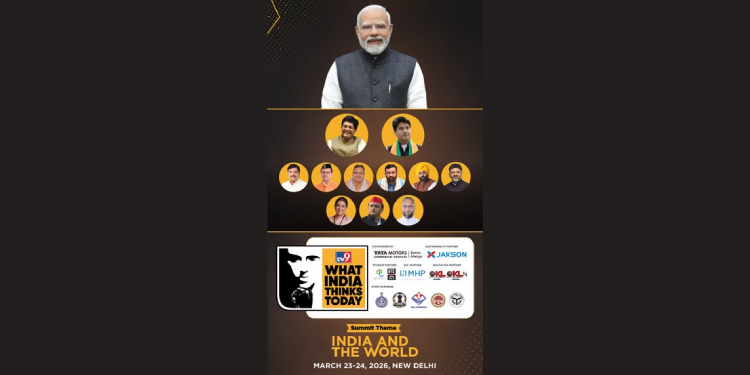
Mumbai: TV9 Network’s flagship annual conclave, the What India Thinks Today (WITT) Summit 2026, concluded after two dynamic days of wide-ranging discourse at its New Delhi venue. India’s most expansive multi-domain public policy and culture summit, WITT 2026 convened political leaders, policymakers, sports icons, artists, and technology innovators under one roof to examine the forces shaping contemporary India and its place in the world.
The summit opened on March 23 with Prime Minister Narendra Modi delivering the keynote address on the theme “India and the World,” gracing the WITT stage for the third consecutive year, a distinction that underscores the platform’s growing importance in shaping national discourse. In a wide-ranging address, the Prime Minister spoke on the ongoing conflict in West Asia and its global economic consequences, calling for restraint and compassion. “It is now time for restraint and compassion,” he said, reiterating India’s consistent diplomatic stance. The PM highlighted that even amid global turmoil, India had continued on its development trajectory with inauguration and commencement of projects from South to North since the outbreak of hostilities. The keynote set the tone for a summit that spanned multiple domains including governance, geopolitics, cricket, cinema, artificial intelligence, culture, and spiritual identity.
GOVERNANCE & POLITICS: INDIA’S STATE LEADERS SPEAK
The summit served as a candid forum for state governance debates, drawing Chief Ministers from across the political spectrum. Telangana Chief Minister A. Revanth Reddy, speaking at the TV9 Satta Sammelan, articulated a people-first governance philosophy and drew pointed distinctions between India’s varying development models. Contrasting the so-called ‘Gujarat model’ as synonymous with the current Central Government’s approach, he described Telangana’s as a ‘rare model’ underlining the state’s distinct developmental priorities, while also raising concerns about the under-representation of Southern states in national forums.
Madhya Pradesh Chief Minister Mohan Yadav struck a note of assertiveness on internal security, declaring that Left-wing extremism had been effectively eliminated in the state, with those who surrendered imprisoned and the rest neutralised. He also highlighted rising investor confidence in the state and ongoing preparations for the upcoming Kumbh Mela.
Punjab Chief Minister Bhagwant Mann defended his government’s record with characteristic candour, stating that his administration had not only fulfilled all electoral promises but exceeded them within four years. He cited the closure of 19 toll plazas for commuter relief and the creation of the Sadak Suraksha Force as evidence of his administration’s responsive governance.
Senior Congress leader and Karnataka Deputy Chief Minister D.K. Shivakumar used the platform to express confidence in his party’s prospects in the upcoming Assam Assembly elections, while also addressing allegations against him as politically motivated, noting that despite raids conducted at over 70 locations, no wrongdoing was found.
GEOPOLITICS & NATIONAL SECURITY
A charged conversation on India’s energy security, foreign policy, and digital infrastructure unfolded across the summit’s two days. Union Minister for Communications and Development of North Eastern Region, Jyotiraditya Scindia, was among the headline speakers on Day 2, bringing a forward-looking perspective on India’s role as a global digital power. Scindia articulated India’s ambition to be not merely a consumer of advanced networks but a builder of trusted digital infrastructure for the world, a vision anchored in the government’s push for indigenous telecom development, a record-breaking 5G rollout, and expanding 4G connectivity to every village in the country. His remarks reinforced the summit’s central theme of India’s growing confidence and influence on the world stage.
CRICKET, SPORTS & INDIA’S WINNING CULTURE
WITT 2026 devoted significant attention to Indian cricket’s extraordinary run of success. Sourav Ganguly, former India captain and BCCI president engaged in a wide-ranging conversation on leadership, culture, and the future of the game. Ganguly advocated for player freedom and trust as the hallmarks of great captaincy and praised the depth of India’s current T20 squad. When pressed on the all-time great captains’ debate, Ganguly chose MS Dhoni citing his World Cup victories as the decisive factor while diplomatically declining to rank Sachin Tendulkar and Virat Kohli against each other.
In a session focused on India’s women’s cricket revolution, national team bowling coach Aavishkar Salvi spoke at length about the success formula behind India women’s ODI World Cup triumph, crediting not just in-team preparation but the structural foundation laid by the BCCI and the Women’s Premier League (WPL) in building a pipeline of world-class talent.
AI, TECHNOLOGY & THE AI² AWARDS
The summit made a bold statement about India’s growing relationship with Artificial Intelligence by hosting the
AI² Awards 2026 a first-of-its-kind recognition platform celebrating the convergence of human creativity and machine intelligence. The awards honoured creators, filmmakers, and innovators who are pioneering AI-assisted storytelling and content creation, reflecting TV9 Network’s conviction that technology and imagination are no longer separate pursuits.
CULTURE, SPIRITUALITY & SOCIAL DISCOURSE
WITT 2026 deliberately expanded beyond politics to address India’s cultural and philosophical landscape. Renowned poet and Kathavachak Kumar Vishwas engaged the audience in a nuanced discussion on India’s unique conception of Dharma arguing that India’s spiritual and ethical tradition defies simple Western categorisation. Vishwas also called on state administrations to exercise greater reverence and sensitivity in their dealings with spiritual leaders, scholars, and artists, criticising the recent arrest of an 80-year-old Shankaracharya as a failure of institutional humility.
Veteran lyricist Sameer Anjaan and storyteller Neelesh Misra jointly addressed the trending controversy around a Nora Fatehi song, broadening the discussion into a larger reflection on changing music trends, lyrical accountability, and the evolving creative culture of Bollywood. Their conversation sparked a nuanced debate about the responsibilities of artists in shaping popular culture.
-Based on Press Release