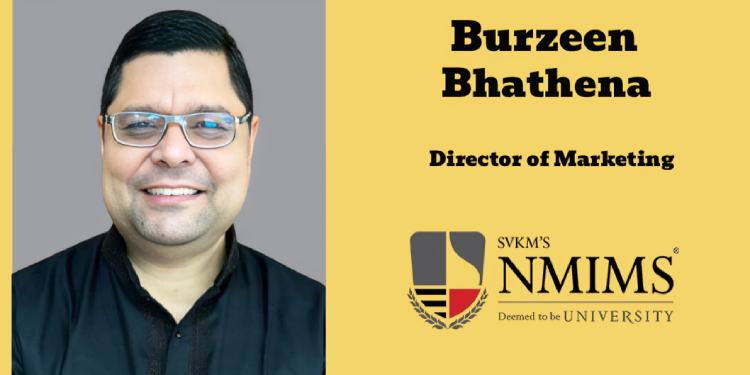
NMIMS, is a premier institution in India known for its excellence in education and innovative approaches to higher learning. Burzeen Bhathena has been serving as Director of Marketing at NMIMS.
As the driving force behind NMIMS’s marketing strategy, Bhathena has been instrumental in positioning NMIMS as a leader in the competitive landscape of higher education. His deep expertise in digital marketing, brand positioning, and innovative marketing tactics has not only enhanced our visibility but also significantly improved student engagement and retention.
He offers insights on topics including:
Marketing Strategies: The unique approaches implemented at NMIMS to attract a diverse pool of prospective students.
Digital Transformation: How digital marketing has reshaped our outreach efforts, with examples of successful campaigns.
Brand Positioning: Strategy for positioning NMIMS in the competitive education market.
Performance Marketing & PR: Measuring the success of marketing campaigns and integrating PR with marketing to enhance brand’s visibility.
Content Marketing & Innovation: The role of content in strategy and how we stay ahead of marketing trends with innovative tactics.
Influencer marketing: About the changing roles in influence marketing in B schools.
Future Outlook: Challenges and opportunities for educational marketing in the next five years and how NMIMS is preparing for them.
He offers fresh perspectives on marketing in the education sector.
Medianews4u.com caught up with Burzeen Bhathena, Director of Marketing NMIMS.
Q. From a marketing perspective, what are the priorities and focus areas for NMIMS in 2026?
With a legacy of over 44 years, NMIMS has grown to become one of India’s leading multi-disciplinary and multi-centric universities with 17 schools across eight campuses offering programmes in Management, Engineering, Commerce, Humanities, Law, Hospitality, Music and Design.
This diversity has been our strength and responsibility. Our priority in 2026 is to ensure that our communication speaks the language, aspirations and cultural context of our current and prospective students.
One of the biggest challenges for any marketer is the diverse nature of our country where aspirations, consumption habits and family influences change every few hundred kilometres. Being a multi-centric university, with campuses across eight tier I and II cities, a single monolithic campaign would not drive the desired results and outcomes.
Over the last few years, we have fine-tuned our messaging and have even included regional content creators and influencers who understand the local nuances and can communicate credibility in a language understood and trusted by the local students. We will even extend this approach for our upcoming campus in Ahmedabad, where local context and cultural fluency will play a critical role in early brand acceptance.
Another key focus area is a shift from static creatives to storytelling-led communication. Our students are now our biggest and best organic influencers. They share their real-world experiences, learning journeys and peer-to-peer insights that connect more strongly than polished marketing messages.
For 2026, our priorities are set very clearly – authentic storytelling, student-led advocacy, and building communities of learners.
Q. How has digital marketing reshaped NMIMS’ outreach efforts?
Digital marketing has transformed our outreach from just a simple “reach” to “smart reach.” Outreach has always been about scale, how many students we could reach through our ads, listings or mass communication channels. However, it is now all about precision, context and intent.
Digital platforms have helped us understand where a student is in their decision-making journey. A Class XII student exploring options for different undergraduate programmes needs a very different conversation compared to a graduate evaluating a specialised postgraduate programme.
Digital marketing has made it possible to customise design, content and messaging relevant to the prospective students at each stage, rather than pushing the same information to everyone.
Digital marketing is no longer just a lead-generation tool. We are using it to shape perception, answer questions and reduce anxiety around the entire admissions process. We have significantly improved both engagement quality and enquiry maturity by deploying relevant content including student testimonials, explainer videos and 2
experience-based storytelling. Digital marketing has helped NMIMS become more humane by listening better, responding smarter, and engaging students in a way that feels personal rather than transactional.
Q. Could you provide examples of successful campaigns from 2025 and explain how these will be built upon in 2026?
Our campaigns serve two clear objectives: build awareness for our campuses in their respective regions and attract high-quality students for our UG and PG programmes. One of our most impactful campaigns in 2025 emerged from an insight gained through our secondary research across online forums and student communities.
While our prospective students had all the relevant information pertaining to eligibility, application processes and deadlines, the biggest unanswered question was a lot more emotional: “How do I crack the (chosen) NMIMS entrance exam?” We have all gone through this same anxiety during various stages of our lives.
Recognising and understanding this pain point, we launched a human-centric campaign, “This Time Last Year”. The campaign featured first-year students who had appeared for these very entrance exams just a year back. They spoke candidly about what worked, what didn’t, and how they navigated the same phase prospective students were currently in. The relatability and authenticity struck a chord.
The results were beyond any engagement metrics. The campaign reduced repetitive queries to our student experience (call centre) teams and improved the quality of incoming registrations.
More importantly, it became a powerful storytelling format that built trust. In 2026, we plan to expand this by deepening peer-to-peer narratives and using it as a recurring content property to support brand credibility and informed decision-making.
Q. Could you shed light on the strategy for positioning NMIMS as a brand in the competitive education market?
NMIMS’ brand positioning is rooted in credibility, consistency and contemporary relevance. In a highly competitive education landscape, our focus is on being the most trusted voice, not the loudest one. NMIMS is positioned as a university that balances academic rigour with real-world relevance. We ensure that our positioning is consistent across all campuses and schools, reinforcing the idea of the “one NMIMS experience,” regardless of which campus the student is studying at.
Another pillar of our strategy is authenticity. Rather than using over-polished narratives, our faculty members, students and alumni articulate what NMIMS stands for. Their stories bring credibility that traditional marketing cannot replicate.
We communicate NMIMS as an institution that has evolved by regularly updating the curriculum, embracing technology, and responding to changes in industry and society. Our ability to combine legacy with agility is what truly sets us apart in a crowded market.
Q. Why is it important for universities to position themselves as brands, and what would you like to see happen in this area in 2026?
In 1947, India had about 20 universities. By 2025, that number has swelled to 1,200+ universities. While this reflects progress, it has also intensified competition for quality students, faculty and credibility. Another key metric to consider is India’s Gross Enrolment Ratio (GER) in higher education which is currently at just 29%. The government aims to increase the GER to 50% by 2035, but with the current growth rate at just 2%, achieving this target looks extremely challenging. Additionally, the entry of foreign universities into India further raises the bar on quality, perception and student expectations.
Indian universities can therefore no longer rely on legacy or location in the current environment. They need to clearly articulate what they stand for and what students gain beyond a degree. Positioning universities as brands is about clearly demonstrating quality, consistency and relevance.
We are taking a leadership position by ensuring academic rigour remains uniform across campuses, whether a student is in Mumbai, Hyderabad or Chandigarh. Conducting exams across all campuses on the same day, regularly updating the curriculum, and strong governance frameworks reinforce this consistency. Indian universities must collectively shift their focus from volume-driven narratives to quality-led positioning, where learning outcomes, employability, and innovation define
the brand promise.
Q. Has AI made the task of balancing performance marketing with brand building easier?
AI has eased the long-standing tussle between performance marketing and brand building. Marketers were always forced to choose between short-term results and long-term equity. AI has helped bridge that gap. AI has helped improve audience segmentation, content optimisation and predictive analysis.
We are now able to align messaging with intent, ensuring that even performance-led communication reinforces brand values rather than diluting them. AI has also reduced manual inefficiencies making tasks like media optimisation, A/B testing, content personalisation and response analysis faster and more accurate. This allows the marketing team to focus on strategy, storytelling and creative thinking, areas where human judgment still takes precedence.
AI has also helped us understand what content builds trust versus what merely drives clicks. This insight allows us to invest smarter, ensuring that brand narratives and performance outcomes work in tandem.