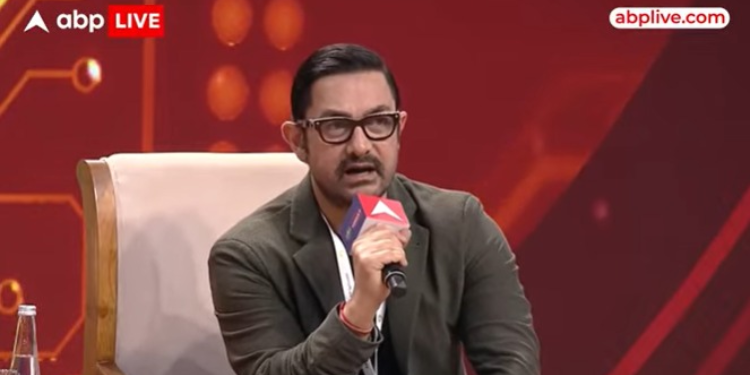
New Delhi: Celebrated actor and filmmaker Aamir Khan delivered a candid critique of the Hindi film industry while outlining a roadmap for its revival at ABP Network’s India @2047 Summit, a flagship platform focused on shaping India’s transformation into a fully developed nation by the centenary of its independence.
Speaking during a session titled “The Attention Industry: Telling the Best Stories”, Khan asserted that the Indian film industry is not short on stories but needs a shift in mindset. “Bollywood is making bad films. I firmly believe no one can stop a good film, and no one can make a bad film succeed,” he said, urging filmmakers to draw inspiration from the thriving South Indian cinema.
Khan cited changing consumer behavior, especially post-pandemic, and flawed business models as key reasons behind Bollywood’s declining theatrical pull. “With films releasing on digital platforms within eight weeks, audiences have fewer reasons to visit theatres. The pandemic has significantly altered our habits,” he noted.
While acknowledging that box office collections remain important, Khan emphasized that they shouldn’t be the sole metric of success. “A film’s impact goes beyond its commercial performance,” he said.
A Call for Structural Support
Highlighting the infrastructure gap, Khan compared India’s cinema screen count with other countries: “China has about 90,000 screens, the US has 35,000, while India stands at around 10,000. Hindi films get access to just 5,000 screens. This limits our ability to scale globally.”
He welcomed government initiatives like the Waves program aimed at supporting the entertainment sector and called for collaborative policymaking. “We need reforms in licensing and infrastructure incentives to grow this industry meaningfully,” he added.
Offering a glimpse into his next film Sitare Zameen Par, Khan revealed it builds on the inclusion theme from his earlier hit Taare Zameen Par, but with a comedic touch. “While Taare Zameen Par made us emotional, Sitare Zameen Par uses humor to drive realization. It’s a story that entertains and provokes thought.”
Khan described his character, Gulshan, a short-tempered basketball coach, as a stark contrast to the empathetic teacher he portrayed in Taare Zameen Par. “The film conveys the message that everyone has their own version of normal,” he added.
The actor also reiterated his long-standing dream of bringing the Mahabharat to the big screen. “It’s a story that can’t go wrong, but one must approach it with immense responsibility. The character of Krishna inspires me deeply,” he shared.
Khan addressed his absence from the re-release premiere of Andaz Apna Apna, citing the tragic Pahalgam incident. “We were too shocked to celebrate. I believe every Indian wants justice for such acts of violence.”
Reflecting on his visit to Kashmir after the abrogation of Article 370, Khan remarked on the sense of calm and return to normalcy in the region, acknowledging that the post-pandemic atmosphere may have also contributed.
Known for his performance-driven business approach, Khan clarified his model of profit-sharing over upfront remuneration. “I don’t charge fees. I earn only if the film is profitable. I didn’t take any money for Laal Singh Chaddha. If it fails, I take that failure on myself,” he said. “Artists must be accountable. We should put our money where our mouth is.”