As cricket fever sweeps the country during the ICC Men’s T20 World Cup, News18 India has launched Stump Mic, a fan-first cricket talk show hosted by Anand Narasimhan, Managing Editor – Special Projects & Senior Anchor – News18 India and Network18. Designed as a conversational alternative to analysis-heavy programming, the show blends expert insight with candid, personality-driven discussions. Airing throughout the tournament from February 7, Stump Mic marks a strategic step in News18’s larger push to build sports as a dedicated content vertical.
In this interaction with MediaNews4U, Narasimhan outlines the editorial philosophy, cross-platform strategy, and long-term vision shaping the network’s evolving sports roadmap.
1) Cricket coverage during a World Cup is often analysis-heavy and data-driven. What prompted News18 India to launch Stump Mic as a lighter, fan-first format at this moment?
Anand Narasimhan: From a fan’s perspective, how do we really want to discuss cricket? It’s usually a group of enthusiasts sitting together — yes, there’s insight and analysis, but there’s also fun, banter, storytelling and shared emotion.
The idea behind Stump Mic was to keep the conversation casual and relatable. For deep statistical breakdowns, viewers already have commentary and host broadcasters doing a fantastic job. Rather than replicate that, we wanted to create something that moves into what I call the “cricketainment” space — a format that keeps the conversation engaging, informal, and accessible, without losing its substance.
Stump Mic was therefore envisaged as a conversational, chatty show, one that mirrors how aficionados actually discuss the game. It’s not 100% statistic-driven; instead, it appeals to the emotional quotient of cricket fans. We’re still talking serious cricket, just in a way that feels organic and enjoyable.
2) The sports news ecosystem is crowded during a World Cup. What makes Stump Mic stand out in terms of tone, format, or positioning?
Anand Narasimhan: The term Stump Mic itself suggests hearing something you’re not usually meant to hear — candid, behind-the-scenes moments. That defines our tone. It’s informal, not irreverent.
Today, news platforms face restrictions, limited match footage, no live commentary, and no live scoreboards. These constraints make traditional coverage difficult. But what isn’t restricted is original content.
So we chose to build original cricket content, conversations with experienced players, current cricketers and candid voices who speak openly, without being offensive but without holding back either.
In terms of positioning, I would say the show fills a distinct gap in the news television space. At present, there are few — if any — news-led formats that approach cricket in this manner. We are consciously trying to engage the younger generation while simultaneously appealing to the connection every cricket fan carries.
We are not speaking only to the expert in the viewer; we are speaking to the cricket fan in them. That shift in focus — from analysis-first to fan-first — is what differentiates Stump Mic in a crowded World Cup ecosystem.
3) As you mentioned, the name Stump Mic evokes candid, unfiltered moments from the field. How does that philosophy shape the tone and editorial approach of the show?
Anand Narasimhan: Usually, when a question is asked, you get the obvious answer. But there’s also the answer that comes when the mic is supposedly off. We turn the mic on for that answer.
In newsrooms, we often chase controversy or headline moments. In that process, we sometimes overlook nuanced conversations. With Stump Mic, we let conversations flow organically instead of steering them toward pre-decided angles.
The show is largely spontaneous. Guests are not briefed on what to say. They bring their experiences, personalities, and camaraderie — many have played with or against each other.
At its core, it’s still cricket. I often say it’s like an idli — the base remains the same — but we add a tadka, a chutney, a twist. The essence is intact, but the flavour is different. That’s what makes it appealing.
We believe this approach offers viewers something familiar yet refreshingly different — a cricket conversation that feels real, engaging, and true to the spirit of the game.
4) The show runs specifically during the ICC Men’s T20 World Cup. Was it always envisioned as a tournament-led property, or do you see it evolving into a larger cricket franchise?
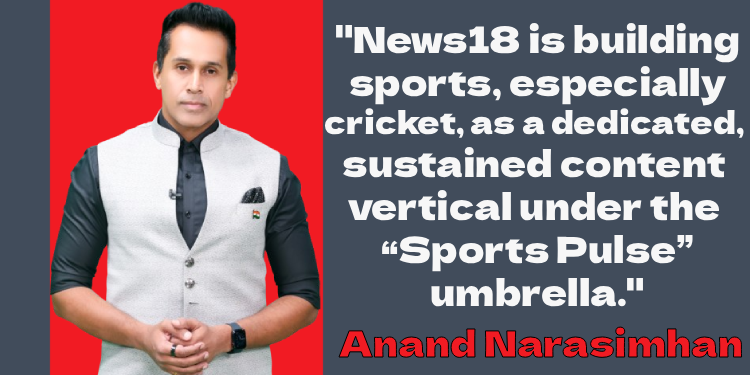
Anand Narasimhan: At a broader level, the News18 Network is taking sports — and cricket in particular — very seriously. We are in the process of building a larger umbrella property under what we call ‘Sports Pulse’, to create sustained, consistent sports coverage rather than event-specific spikes.
We’re preparing for the 2027 ODI World Cup, the Olympics, the FIFA World Cup, the Commonwealth Games, and India’s aspiration to host the 2036 Olympics. This is just the beginning.
Stump Mic will focus primarily on major multilateral tournaments where India is on the big stage and select key bilateral series. But we’re also developing other properties — including a weekly cricket magazine show and IPL-focused programming. The larger strategy also includes expanding into more fan-engagement-led formats.
This is the first of many initiatives you’ll see in the next 12–18 months.
5) How do seasoned cricketing voices like Sanjay Manjrekar, S Sreesanth or Monty Panesar complement the energy of a digital-native voice like Yuvraj Dua?
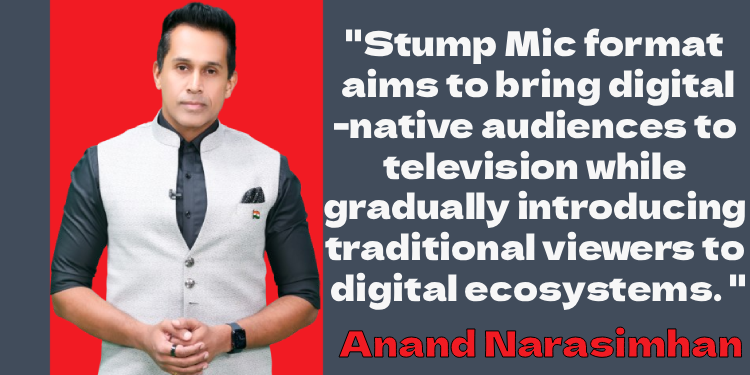
Anand Narasimhan: Yuvraj Dua represents the digital-native audience: viewers who consume cricket content across platforms, follow conversations on social media, and connect with personalities in a more informal, relatable manner.
Many of our panellists themselves have strong social media followings, which further helps integrate audiences across platforms. The objective is not to choose between television and digital — it is to create a “give-and-go” dynamic where both ecosystems benefit.
Ultimately, Stump Mic is designed to connect the conventional TV viewer with the potential future TV viewer, and simultaneously bring digital audiences into the broadcast fold. It is about convergence — blending credibility with relatability in a way that reflects how cricket is consumed today.
6) The show integrates on-ground reporting and fan reactions. Why was it important to bring live stadium energy into the studio format?
Anand Narasimhan: The idea is that you must always keep your ear to the ground and stay connected to what’s actually unfolding there. That’s why we have someone like Vimal Kumar on the show. He’s very popular, travels extensively, and is truly a journeyman journalist in the best sense, constantly on the move, covering the game from different venues.
He has his own strong social media following and shares a rapport with many of the players. That’s precisely why we have a dedicated segment with him — what we call Vimalwa ka Doosra. He brings a different perspective, almost like the ball that swings the other way, goes the other way. His perspective complements the studio conversation by adding on-ground realism.
It ensures we’re not simply sitting in a studio crafting opinions in isolation. We remain connected to the pulse of the stadium, the atmosphere, the players, and the fans.
And as I’ve said before, at its core, it’s still the same idli — the essence remains unchanged. We’re just presenting it with a slightly different ‘tadka’.

7) Who is the primary audience for Stump Mic — hardcore cricket enthusiasts, casual viewers, or digital-first younger audiences?
Anand Narasimhan: I believe our primary audience is the passionate cricket fan — someone who wants to know a little more than what they already know, who is curious to learn beyond the obvious, and who genuinely enjoys the game.
Cricket isn’t a subject they need to mug up, nor is it a competition they need to win. It’s an experience they enjoy. These are viewers who will take a few insights from our show and carry them into their own cricket banter and conversations. That’s exactly the audience we’re trying to speak to.
8) As the host, what has surprised you most about the show’s early reception or on-air moments so far?
Anand Narasimhan: What has pleasantly surprised me is the vibe, the natural chemistry among all of us. There was an amazing positive energy on the show, something we didn’t expect to generate so strongly right from the very first episode.
From the get-go, everyone was fully invested. They embraced the casual tone, enjoyed the fun element, and allowed the conversation to flow organically.
The start has been encouraging. The response across both television and digital platforms has been positive. But it’s still early days. In cricketing terms, we have negotiated the first few overs well. Now the focus is on settling in, building momentum, and constructing a long innings over the course of the tournament.
9) Do you believe Stump Mic can bring digital audiences to television, and what is the strategy behind that cross-platform approach?
Anand Narasimhan: I think what we’re trying to do is create content that works seamlessly across platforms, allowing natural cross-pollination to take place. We’re giving viewers the flexibility to watch us wherever they prefer — on television or digital — across News18 India, the broader News18 digital ecosystem, and Sports Next.
There are also deferred telecasts on some of the other platforms and channels across the network, ensuring the show reaches audiences through multiple touchpoints.
The idea is simple: offer viewers a compelling sample, draw them in, and allow the content to speak for itself. If they connect with it, they’ll stay with us and talk about it.
We’re only two episodes in, so it’s still early days. We’re hopeful that by the time we reach India vs Pakistan, the momentum will be significantly stronger. Beyond that, it’s our work that will ultimately do the talking.
10) Beyond the World Cup, what does this show indicate about the future of sports programming on news channels?
Anand Narasimhan: I believe generating original content is going to be both a challenge and a necessity for everyone in this space. Formats like this may show a way forward, how we can create meaningful cricketainment without relying heavily on match footage, live commentary, or on-field visuals.
Those are restrictions that inevitably separate news platforms from host broadcasters. So the responsibility is on us to think differently.
This is, perhaps, a fresh approach to building original content that is engaging, informative, and entertaining, while staying within the framework we operate in.
And importantly, it still retains a certain rhythm and flavour, something that keeps the conversation lively and enjoyable.
11) Stump Mic has begun in its current format during the ICC Men’s T20 World Cup. Can we expect it to evolve in future avatars? How do you see it growing into a larger, more engaging platform?
Anand Narasimhan: Going forward, if all goes well and the show grows the way we envisage it, I believe fan engagement will only increase. The fan-friendly posture of the show and the kind of content we aim to build around cricket and sport on News18 will continue to expand.
That doesn’t mean the big voices will step back. They will absolutely remain central to the conversation. However, the interaction with fans, their reactions, their expectations, and what they genuinely want to hear will start playing a bigger role in shaping the content.
We intend to build stronger bridges between the fan and the expert, creating a space where both perspectives coexist and enrich the conversation.
Ultimately, the goal is to make the platform even more fan-centric while retaining depth and credibility.
12) Anand, as someone tasked with driving special projects at News18, what new initiatives can we expect from you and the Network18 platform going forward?
Anand Narasimhan: There are a lot of new initiatives. Under the Sports Pulse umbrella, I can say we are extremely bullish and aggressive about developing cricket and sports as dedicated verticals.
The idea is to treat sport not as occasional programming, but as a structured genre where sustained conversations and consistent programming will take place.
Alongside that, you will also see us actively strengthening established hard-news genres in the coming years, developing them as verticals as well. We are closely observing the shift in audience preferences.
The 12–15-year-olds of yesterday are the 20–25-year-olds of today. Their subject interests, their news consumption habits, what they expect information on, and even their appetite for infotainment, all of that is evolving.
We are conscious of this shift. A significant part of our future content strategy and special projects will be driven by tapping into these emerging audiences and curating programming that resonates with them.