Mumbai: The 19th edition of the Indian Premier League 2026 has opened with strong momentum, both in audience scale and advertising effectiveness, signalling a structurally evolving media ecosystem.
Viewership for the first two matches has surged 26% to 515 million, significantly outpacing last season’s opening numbers. At the same time, the advertising landscape is undergoing a shift—with 25% fewer brands but a 12% increase in ad volumes, indicating that marketers are consolidating spends and intensifying exposure to maximise returns.
Against this backdrop, early data from the SCORE IPL Ad Effectiveness Solution by Synchronize India and Unomer, measuring VR Score (visibility and recall) after 10 days, reveals a sharply defined hierarchy of brand impact.
Tata Dominates Recall as Title Sponsorship Proves Decisive
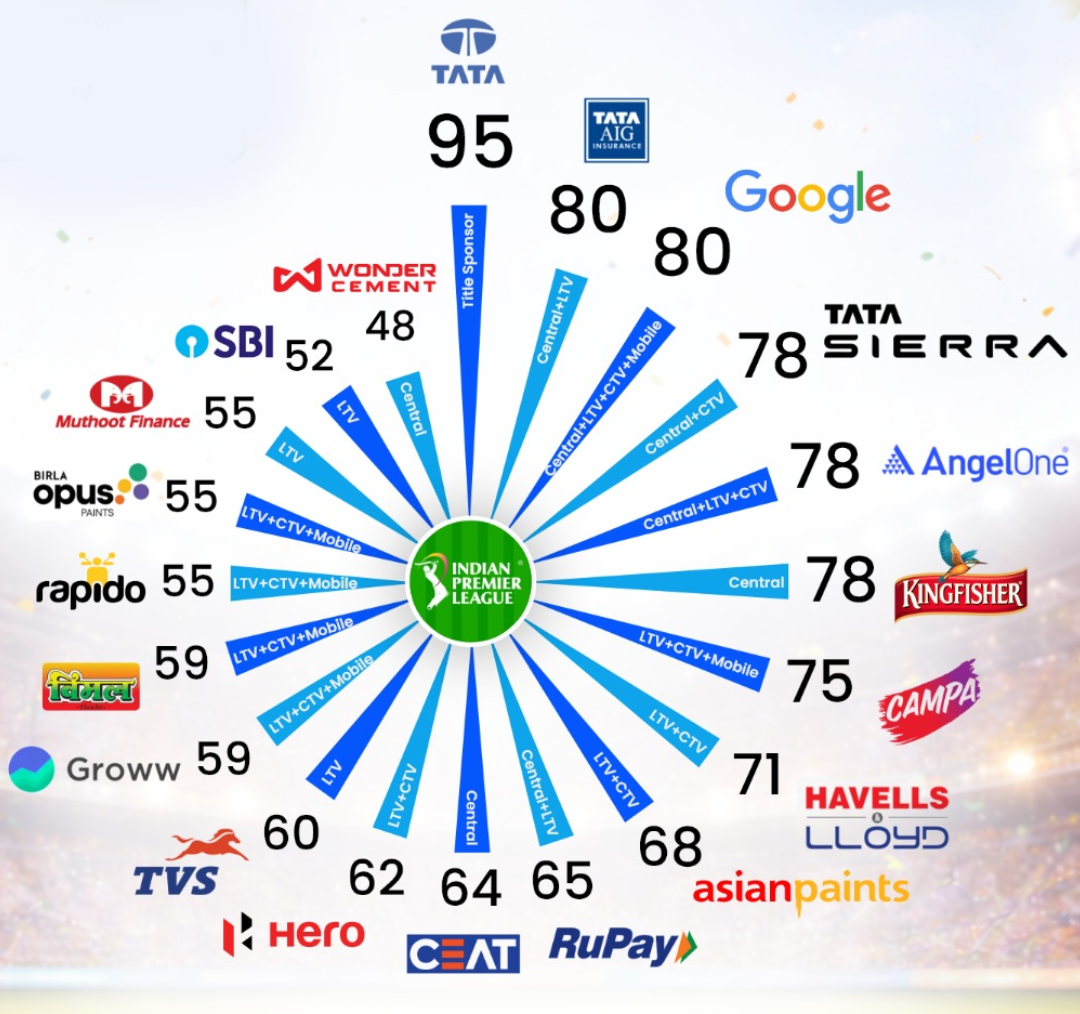
At the top of the rankings, Tata stands out with a VR Score of 95, significantly ahead of all competitors. The performance underscores the enduring power of title sponsorship, where brand ownership of the league translates into unmatched recall through pervasive visibility across broadcast, digital, and on-ground integrations. The gap is substantial, with Tata AIG Insurance and Google following at 80, highlighting how even aggressive advertisers trail the scale advantage of title association.
High-Impact Cluster Driven by Multi-Screen Strategies
A second tier of brands—Tata AIG, Google, Tata Sierra, Angel One and Kingfisher—occupies the 78–80 band, reflecting strong recall driven by multi-platform presence and sustained exposure. These brands have effectively leveraged a combination of Linear TV, Connected TV and mobile to reinforce visibility across touchpoints. Their performance demonstrates that recall is no longer built on a single channel, but through consistent cross-screen amplification.
Mid-Tier Shows Limits of Partial Visibility
Brands such as Campa, Havells Lloyd, Asian Paints, RuPay and CEAT fall into the mid-tier, with scores ranging between the mid-60s and mid-70s. While these brands maintain an active presence in the tournament, their recall performance suggests that partial or less aggressive media strategies limit their ability to compete with top-tier advertisers. Even official partners like RuPay and CEAT illustrate that sponsorship without sufficient media weight does not automatically translate into top recall outcomes.
Lower Tier Reflects Fragmented Strategies
At the lower end of the spectrum, brands including Groww, Vimal, Rapido, Birla Opus, Muthoot Finance, SBI and Wonder Cement register scores between 48 and 59. These advertisers appear to rely on narrower platform strategies or lower ad frequency, which constrains their visibility in a cluttered and high-frequency environment like the IPL. As a result, their ability to convert presence into meaningful recall remains limited.
Fewer Brands, Higher Intensity: A New IPL Ad Playbook
One of the most defining shifts this season is the consolidation of advertisers. Despite a 25% reduction in the number of participating brands, overall ad volumes have increased by approximately 12%. This indicates that fewer brands are now commanding a larger share of voice, leading to higher frequency and stronger visibility. The exit of fantasy gaming players such as Dream11 and My11Circle initially created a revenue gap, but Google’s expanded participation has helped bridge this gap, ensuring sustained monetisation for both the league and broadcasters.
Platform Mix: LTV Still Leads, Digital Strengthens
An analysis of the top 20 brands after the first 10 matches highlights the continued dominance of Linear TV, with the majority of leading advertisers relying on it as their primary visibility driver. Connected TV has emerged as a strong secondary platform, while mobile is increasingly being used as a reach extender rather than a primary medium. The most effective strategies appear to be those that combine central sponsorship with broadcast or streaming integrations, enabling brands to maximise exposure across formats. This integrated approach is reflected in the fact that a majority of such advertisers feature prominently in the top recall rankings.
Creative Strategy Shift: Shorter, Faster, More Frequent
Another notable shift is visible in creative execution. The share of 10-second advertisements has increased significantly compared to last year, while longer 15-second formats have declined sharply. This indicates a clear move towards frequency-driven advertising, where brands prioritise repeated exposure over extended storytelling. While this approach enhances recall in the short term, it also raises a critical question for marketers—whether the focus on brevity and repetition may come at the cost of deeper narrative engagement and long-term brand building.
Sponsors vs Recall and the Widening Visibility Divide
A comparison between IPL 2026’s top sponsors and their recall performance reveals a nuanced and increasingly polarised landscape. While Tata, as title sponsor, converts its association into clear dominance with a score of 95, central sponsor Angel One also demonstrates strong recall through effective multi-platform execution. However, other official partners such as RuPay and CEAT remain in the mid-tier, indicating that sponsorship alone is insufficient without aggressive media amplification.
At the same time, brands like Google, which combine ecosystem presence with high-frequency advertising, have managed to achieve top-tier recall without relying solely on sponsorship positioning. This reinforces the idea that media intensity and integration are as critical as sponsorship rights.
The broader implication is a widening recall divide. With the highest score at 95 and the lowest dipping below 50, IPL 2026 reflects an increasingly unequal visibility landscape where a handful of brands dominate consumer mindshare, while others struggle to register impact. This divergence highlights how execution, scale and cross-platform presence are now the key differentiators in converting IPL participation into measurable brand recall.
IPL 2026 Signals a Shift to Efficiency-Led Advertising
The early trends from IPL 2026 indicate a clear shift towards efficiency-led advertising. Scale remains critical, as demonstrated by Tata’s dominance, but success is increasingly determined by how effectively brands integrate across platforms and optimise frequency. With fewer advertisers commanding greater visibility and shorter creatives driving higher repetition, the IPL is evolving into a high-intensity advertising battleground where execution, not just presence, defines success.