
Arun Raghav, Founder of BEglobal and BEdigitech, leads an integrated 360-degree digital marketing company headquartered in Dubai, with offices in 5 countries and a presence in over 120 global markets. With a strong advertiser–partner network, the group delivers impactful campaigns across display, video, CTV, social, mobile, and affiliate channels. By blending scale, technology, and performance marketing expertise, Arun has positioned the company as a trusted partner for brands seeking transparent, measurable, and growth-driven digital solutions.
Together, these entities embody Arun Raghav’s unified mission: to deliver omni-channel, data-driven, and technology-forward marketing that delivers measurable outcomes across platforms and geographies.
Q1. How would you describe the maturity of the CTV advertising ecosystem in India compared to markets like the U.S. or U.K.?
Arun Raghav: India’s CTV advertising ecosystem is still in its nascent stages compared to more mature markets like the U.S. and the U.K. This reflects a broader—and perhaps unfortunate—reality: despite being a leading global economy with the largest population, India’s total advertising spend represents only a small fraction of the global market. While we have incredible scale and one of the world’s largest consumer bases, this underscores the need for greater maturity across all media, especially in a fast-growing segment like CTV.
A key challenge I’ve observed is the industry’s struggle to truly grasp the nature of CTV. Many view it simply as an extension of digital—a “big mobile screen”—when in fact, it is an advanced version of television. The fundamental difference lies in monetization. The space is dominated by digital-first ad tech companies that often lack deep experience in TV planning and monetization. I’m confident that if we collectively focus on improving the quality and strategic understanding of CTV as a medium, India can bridge this gap and stand on par with the U.S. and European markets within the next three to four years.
With ad spend projected to cross ₹2,500 crore and household penetration nearing 60 million by the end of 2025, the momentum is undeniable.
Q2. What unique challenges and opportunities does the Indian CTV landscape present for programmatic buyers?
Arun Raghav: The biggest challenge for programmatic buyers in India’s CTV landscape is undoubtedly fragmentation. The ecosystem lacks a unified platform, a consistent operating system, and standardized ad formats or players. Additionally, a “controlled inventory” approach from certain content owners creates hurdles for ad technologies designed to streamline supply. This fragmented environment makes seamless execution and comprehensive measurement difficult.
That said, I remain optimistic. We’re seeing a slow but steady movement toward solving these challenges, which will unlock significant opportunities for programmatic buyers. Once the supply chain is streamlined, brands will be able to buy and target with enriched data sets—maximizing the impact of their CTV advertising and moving beyond basic reach to deeply personalized, effective campaigns.
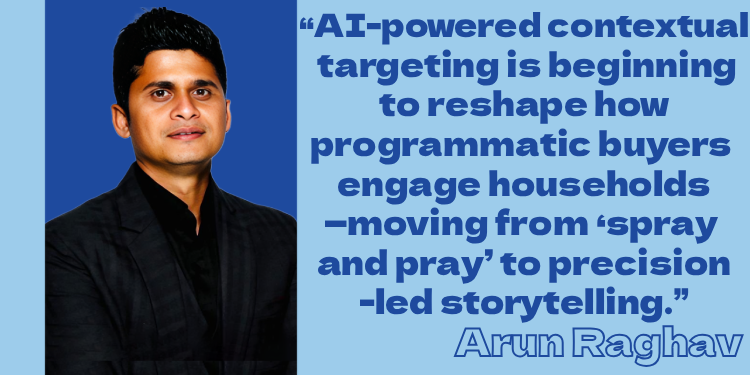
AI-powered contextual targeting is beginning to reshape how programmatic buyers engage households—moving from “spray and pray” to precision-led storytelling.
Q3. Are Indian audiences consuming CTV differently than global audiences? What trends are shaping local viewer behaviour?
Arun Raghav: Indian audiences are indeed consuming CTV in unique ways. The most significant trend is the “family viewing” dynamic. Unlike the highly personalized, individual consumption habits often seen in the U.S. or U.K., CTV in India is a shared, household experience. Reports from Kantar indicate that one in four Indians are now “digital-only” users, and CTV viewership is no longer a metro-centric trend, with equal reach in both urban and rural areas. This points to a mass-market opportunity that differs from the medium’s initial premium positioning.
CTV viewership has seen a remarkable 48% year-on-year growth, reaching 70 million users—triple the global average. This shift isn’t just about what content is watched, but how it’s consumed: longer session times and a greater willingness to engage with ad-supported content. This is a crucial distinction marketers must understand.
Q4. Are Indian brands adopting CTV more for brand-building or performance-driven campaigns? Is this balance shifting in 2025?
Arun Raghav: The early approach to CTV in India was heavily influenced by a “digital-first” selling mindset, which led advertisers to view it primarily as a performance-driven medium. This was a fundamental misstep. CTV ads, much like traditional TV ads, are not just about performance—they’re about creating an experience. The medium is inherently built for brand building and awareness.
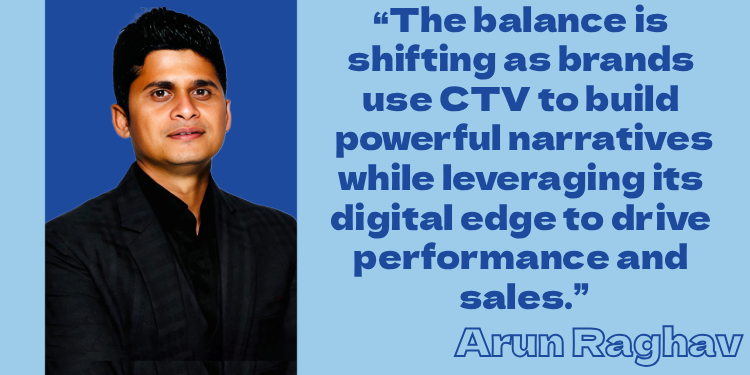
That said, digital’s power lies in its ability to connect brand-building efforts to measurable outcomes. While the initial focus was on performance, the industry is now beginning to understand that CTV’s unique strength lies in its hybrid nature. The balance is shifting as more brands realize they can use CTV to craft powerful brand narratives and then leverage its digital capabilities to drive performance—such as website visits, app installs, or even sales—thereby proving the value of their top-of-funnel investment.
Innovative formats like pause ads, QR overlays, and shoppable creatives are enabling brands to blend storytelling with action, further blurring the line between brand-building and performance.
Q5. Do you see a future where CTV becomes the primary digital touchpoint for households in India, overtaking mobile in influence?
Arun Raghav: I firmly believe that CTV is the only digital touchpoint for entire households—not just individual users. Unlike mobile, which is a personal device, CTV offers a shared, family viewing experience. Data supports this belief, showing a promising future for the medium, as viewers are already spending more time on CTV than on linear TV. This increased engagement—driven by internet connectivity and a vast range of content—is making CTV the central hub for entertainment in every household.
While mobile will remain a critical personal device, the influence of CTV as a collective, living-room medium will be unmatched.
Q6. As CTV becomes more mainstream, how should marketers rethink their media planning to ensure optimal reach and frequency across screens?
Arun Raghav: The market is increasingly aware of CTV’s potential, but limited understanding of fragmentation and the absence of unified measurement remain major hurdles. Marketers must move beyond siloed approaches. The new paradigm for media planning should be holistic and screen-agnostic.
For example, a best practice is to design campaigns for a sequential experience—starting with high-impact video on the big screen and continuing with retargeted messaging on mobile. Data from recent reports shows that this cross-screen harmonization can lead to significant uplifts in brand recall and ad effectiveness.
Marketers should focus on leveraging first-party data and unified identity solutions to maintain frequency control and ensure a seamless consumer journey—whether the viewer is on their TV, phone, or tablet. Tools like multi-touch attribution and attention-based metrics now enable advertisers to connect CTV exposure with downstream actions across devices and platforms.
Q7. What are the biggest myths or misconceptions marketers still have about investing in CTV, especially in emerging markets?
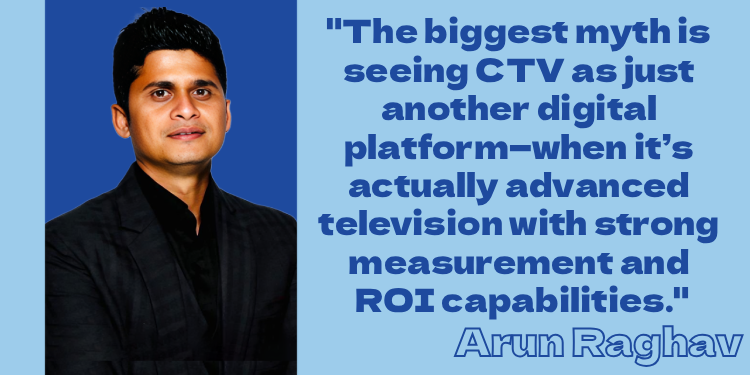
Arun Raghav: The most persistent myth is that CTV is just another digital platform. In reality, it’s an advanced version of television. This misconception prevents the medium from being elevated to its rightful place in media plans. Marketers who treat it as a purely digital channel fail to leverage its incredible brand-building power.
Another common myth is that CTV advertising lacks sufficient measurement and ROI tracking. While this was once a valid concern, advancements in identity resolution and cross-device tracking now allow for far more precise measurement. Campaigns can now track everything from video completion rates to post-view conversions—including website visits, app installs, and even purchases—using pixel-based tracking, QR overlays, and cross-device identity graphs. These tools bring CTV measurement on par with digital, while preserving the brand-building power of television.
This is a far cry from the limited measurement capabilities of traditional TV—and a myth that must be debunked for the industry to move forward.