Be.ing painfree is a women’s health innovation company, and the inventor of World’s first and Patented Cramp Relieving Sanitary pads. It’s a new-age menstrual care brand focused on addressing menstrual discomfort through science-led solutions. Recognising that most menstrual products historically focused only on hygiene, the company is building a new category called functional menstrual care, bridging menstrual hygiene with pain management. Its technologies are patented in India for both product and process, powering a new category. Their work has received multiple national recognition, including WTFund by Nikhil Kamath (Top 9 startups from Cohort 1), underscoring its potential to drive meaningful innovation in women’s health and redefine the future of menstrual care.
Medianews4u.com caught up with Dr. Sharmistha Mondal founder Be.ing Painfree
Q. The hygiene market is competitive. What is Be.ing Painfree’s USP?
The hygiene market is definitely competitive, but if you look closely, most innovations in the category have been incremental.
Over the years, brands have focused on improving absorbency, adding wider backs, making pads rash-free, or introducing sustainable materials. All of these are meaningful improvements, but they still revolve around one core function of managing menstrual flow.
What’s interesting is that very few innovations have truly addressed the one problem almost every woman talks about during periods, pain and physical discomfort. For many women, the real disruption during menstruation isn’t the bleeding. It is the cramps, inflammation, fatigue, bloating, and the overall discomfort that can affect daily life.
That’s where Be.ing painfree is fundamentally different. We are essentially bridging two categories that traditionally never intersected, menstrual hygiene and pain management. Our sanitary pads are patented in India, both in terms of product and technology, and are designed to help address menstrual cramps through a targeted relief approach while still delivering high-performance hygiene.
What powers this is our work in plant science, where we use carefully selected bioactive compounds with enhanced efficacy and combine them with advanced delivery mechanisms that allow the actives to interact with the body more effectively during use. The goal is to support the body’s natural response to menstrual discomfort while the product continues to function as a high-quality hygiene solution.
So instead of simply helping women manage their period, we are focused on helping them continue living, working, and moving through their day, simply Being painfree!
 Q. Which markets are being targetted for growth in 2026?
In 2026, our focus is primarily on India, because the scale of unmet need here is enormous. A large percentage of women still struggle with severe menstrual pain, and very few products actually address that problem.
Within India, we are focussing on tier 1 and tier 2 cities initially. At the same time, we are also designing models that will allow us to reach semi-urban and rural communities through partnerships, CSR programmes, and institutional collaborations.
Post six months, as menstrual pain is a global problem, so international markets are definitely part of our roadmap!
Q. What marketing campaigns and innovations can one expect in the coming months? Will the media revolve around digital or will traditional media also play a role?
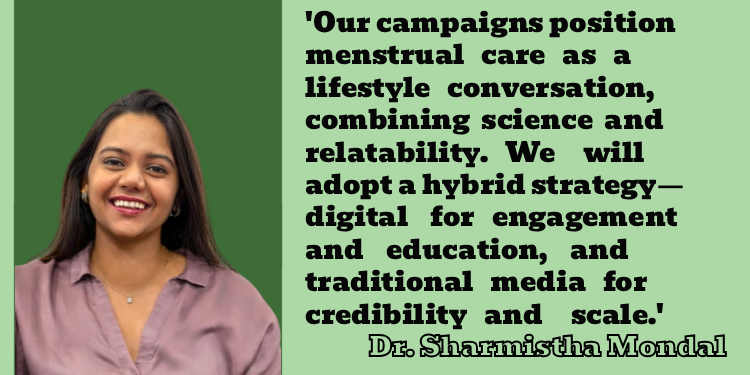
We do not see menstrual care as just a medical or hygiene conversation, it is very much a lifestyle conversation as well. Periods influence how women work, travel, exercise, and move through their daily lives. So our communication positions Be.ing painfree as part of a modern lifestyle where women don’t feel the need to slow down simply because they are on their period.
At the same time, many women still grow up believing that period pain is something they simply have to endure, and that mindset really needs to change. A large part of our campaigns therefore revolves around science, awareness, and real, relatable experiences that help women better understand what their bodies are going through and the choices available to them.
Digital media will naturally be a major driver, especially platforms like Instagram and YouTube, where women actively seek health information and engage in conversations around wellness.
Traditional media always carries immense credibility, particularly when it comes to health innovations. So our approach is very much a hybrid strategy, digital for engagement, community, and education, and traditional media for credibility, scale, and wider awareness.
Ultimately, the goal is to build a lifestyle brand that normalises better menstrual health and empowers women to continue living fully, even during their periods!
Q. Will the marketing message revolve around passive protection toward integrated relief and functional well-being?
Absolutely. That shift is exactly what we are trying to champion.
The future of menstrual care will be integrated and functional, addressing pain, inflammation, bloating, and overall well-being, not just menstrual flow. Our philosophy is simple, menstrual care should support women in continuing their daily lives comfortably, whether that’s working, studying, traveling, exercising, or simply going about their day without disruption.
For far too long, the expectation has been that women should adjust their lives around their periods. We believe it should be the other way around.
In fact, that idea is embedded in our very name. The “Be.” in Be.ing painfree represents continuity, the idea that life should keep moving, uninterrupted. Periods are a natural part of life, but they shouldn’t dictate how women live it.
Because ultimately, periods shouldn’t press pause on life, women should simply keep Being.
Q. Is normalising and empowering conversations about menstruation a big challenge in the country?
The conversation around menstruation has certainly improved in recent years, but there is still a long way to go.
When it comes to periods, there is often an unspoken assumption that “she should already know this.” Because of that, many young girls grow up without clear information, simply figuring things out on their own. Over time, this leads to the belief that severe pain is normal, or that talking openly about periods is somehow inappropriate.
What we are seeing now, however, is a generational shift. Women are asking more questions, seeking better solutions, and becoming far more aware of their bodies and their health choices.
But creating real progress requires collective effort. Brands, doctors, educators, and the media all have a role to play in shifting menstruation from something whispered about to something understood as an important part of women’s health.
The more openly we talk about it, the faster we move from silence to informed care.
 Q. Will Be.ing Painfree’s use influencers to spread the message?
Yes, we will definitely work with influencers, but our definition of an influencer is slightly different.
For us, an influencer is anyone who can genuinely educate, help, or empower women. It doesn’t necessarily have to be someone with a certain number of followers. It could be anybody who simply speaks honestly about their experiences and helps other women understand their bodies better.
Menstrual care is deeply personal, so authenticity matters far more than scale. The goal is building trust and encouraging honest, informed conversations around women’s health.
Our approach is also very thoughtful. Before any collaboration, our focus is on getting the product into their hands and letting them experience it themselves. When someone recommends something related to health, it’s important that they genuinely believe in it.
Promotional collaborations can certainly come later and of course we respect the time and effort creators put into their work, but ideally, anyone speaking about our products should first trust the product and the science behind it. Because when the belief is real, the conversation becomes far more meaningful.
Q. How will Be.ing Painfree approach rural marketing?
Rural markets require a very different approach compared to urban digital campaigns.
Awareness and accessibility both play a major role there. Our strategy will involve grassroots education, partnerships with healthcare professionals, NGOs, and community health workers, and programs that focus on menstrual health literacy.
We are also exploring subsidised and CSR-led distribution models so that effective menstrual care solutions can reach women who may otherwise not have access to them.
Many corporates in India already allocate funds toward CSR initiatives, especially in health and women’s empowerment. We would love to partner with such organisations to help take innovative menstrual care solutions to underserved communities. With the right collaborations, CSR can play a meaningful role in improving access to better menstrual care for millions of women.
Q. In terms of on-ground marketing will Be.ing Painfree partner with schools and colleges to educate young girls about menstruation?
Yes, this is something we feel strongly about.
Menstrual health education is most impactful when it begins early, particularly in schools and colleges, where young girls are just starting to understand their bodies and their cycles. We are looking to collaborate with educational institutions, healthcare professionals, and youth communities to conduct structured awareness sessions that go beyond hygiene and also talk about pain management, body awareness, and menstrual well-being.
Alongside education, we are also exploring practical access solutions, such as installing menstrual product vending machines in campuses and institutional spaces. The idea is to ensure that young women not only receive the right information, but also have easy and dignified access to menstrual care when they need it.
Importantly, access to menstrual hygiene has increasingly been recognised as a matter of dignity and fundamental rights. Courts in India, including observations from the Supreme Court, have emphasised the importance of ensuring menstrual hygiene access for girls and women, especially in educational institutions.
So for us, this is not just a product initiative, it is part of a broader effort to ensure that education, access, and dignity around menstruation go hand in hand.
Q. What trends are being seen when it comes to the evolving conversation around integrated menstrual care?
The biggest trend is that women are increasingly viewing menstrual care through the lens of overall wellness rather than just hygiene.
There is growing interest in solutions that address pain relief, hormonal balance, inflammation, gut health, and lifestyle support during periods.
Another trend is that consumers today are far more research-driven. They want transparency, science-backed formulations, and products that actually deliver measurable benefits. This shift is pushing the industry to move beyond basic products and develop holistic menstrual health solutions.
Q. Could you talk about Be.ing Painfree’s social media strategy to participate in this conversation?
Our approach to social media is very intentional. Menstrual health sits at the intersection of science, lifestyle, and lived experience, and social media allows those three to come together in a very powerful way. Our strategy is built around education, credibility, and relatability
Firstly, we focus on translating science into everyday language. A lot of women experience pain, bloating, fatigue, or inflammation during their cycle but don’t always understand why it happens. Social media allows us to break down these concepts in a way that is simple, visual, and accessible.
Secondly, we focus on community-led storytelling. Real experiences from women often resonate far more deeply than brand messaging. When women share what their cycles feel like and how they manage them, it normalises the conversation in a very organic way.
And thirdly, we approach it from a lifestyle lens. Periods are not just a health event, they intersect with work, travel, fitness, productivity, and everyday life. So our content reflects that reality rather than isolating menstruation as a purely clinical topic.
Ultimately, our goal is to make Be.ing painfree a trusted voice in the broader menstrual health conversation, a space where women don’t just see products, but find knowledge, relatability, and empowerment.
 Q. What role is AI playing in product innovation?
Creating a new category requires extremely intensive R&D. Our work involved analysing insights from over 8,000 scientific studies, multiple clinical data points, and interdisciplinary research across pain pathways, plant bioactives, and delivery mechanisms.
AI has been a powerful aid in this journey. It helps us process and synthesise vast amounts of scientific data, identify patterns, and accelerate research decisions that would otherwise take years to piece together manually. In many ways, AI has acted as a research multiplier.