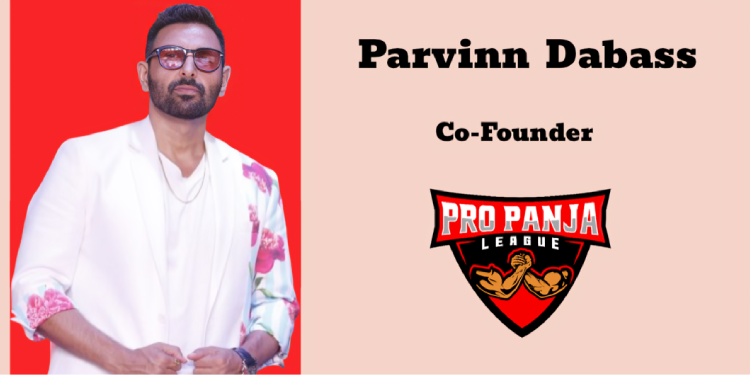
Pro Panja League is India’s first professional arm-wrestling league, co-founded by actor and entrepreneur Parvin Dabas along with his wife, Preeti Jhangiani. Launched in 2020, the league aims to spotlight and elevate the sport of arm wrestling through a structured, televised format. The inaugural full season took place in 2023, featuring six franchise teams and over 180 athletes, including men, women, and specially-abled participants.
With matches aired on Sony Sports Network and streamed via FanCode and DD Sports, the league garnered over 270 million views online and 32 million on TV, making it a breakout success in Indian sports entertainment. Ahead of its second season, the league introduced the Panja B League to discover grassroots talent across the country.
Medianews4u.com caught up with Parvinn Dabass – Co-Founder, Pro Panja League
Q. What was the gap seen in the market that led to the creation of Pro Panja League?
Well, the gap seen in the market was for a non-cricket league of course, a combat sports league which was non-violent in nature. I feel the masses in India tend to prefer non-violent sports, but at the same time, they want something entertaining and a little different, yet still very Indian. And this kind of checked the boxes in all those matters, you can say.
Q. How is it disrupting how India engages with non-mainstream sports?
I think, professionally and in terms of viewing, you can say that India is really waking up to new and entertaining sports. But at the end of the day, you cannot generalize, it’s all about that specific sport and not just about the sport, but how it’s presented. People are not just falling in love with the sport but also its presentation.
So, that’s why we try to ensure our presentation is international and glamorous. That has been our USP. And I think we’ve managed to do that in a way that nobody else in the world has, at least for the sport of Panja wrestling.
Q. Why is it important for the Pro Panja League to build real fandom before monetization?
I wouldn’t say that we want to build real fandom before monetization, but I think our focus has been real fandom because it leads to monetization. At the end of the day, monetization happens from views especially for a sport like this. A lot depends on how many people and what kind of people are watching, and then you dive into the data, the insights, and the specifics.
So, the important thing is we know who our audiences are and it’s actually much wider than we thought. You’re providing them an entertaining sport and getting them connected to the athletes. It’s really interesting since you’re talking about fandom, someone recently told me that, up till now in India, people would talk about the matches and the fans but now they’re also talking about what’s happening outside the matches.
What players are doing, who is calling out whom that’s really the next level of fandom, when they start getting into not just the matchups but also everything happening around them.
Q. What goals have been set in terms of break-even, growing the fan base, etc.? What is the investment that has been made in the revenue model?
The break-even is projected between the third and fourth year. And of course, growing the fan base is something we were just talking about. Apart from the season, we also do events throughout the country. We take the sport to all places.
What we’ve also done is build an aspirational model our fan base is not just Indian anymore. It’s international, because the Pro Panja League is now seen as the biggest and best arm-wrestling event in the whole world.
The investment that has been made in the revenue model well, it’s a large investment.
Let’s just say that. It’s quite a big number. The revenue model includes sponsorships, media, content, and some part of it is franchise fees but that’s not really the focus of our revenue model. Our framework is also to get franchisees profitable as soon as possible.
Another key revenue stream is syndicating international rights, which we’re already starting to do. Like I said, the level of our event is the best in the world.
Another revenue model includes grassroots-level events. And there are a couple of other layers we’re going to be adding, which I don’t want to speak about just yet. But there’s quite a solid revenue model, both in the short term and the long term.
Q. How is the relationship with Sony Sports Network progressing?
Well, I have to say that the relationship with Sony Sports is really, really great. They are amazing and such excellent partners. The whole team feels so personal it’s like a family. It’s just amazing how much they appreciate what we’ve done and how much they’ve put themselves out there to help us and grow the sport.
It’s really been an amazing and open relationship. It’s helped in promoting the league and making it what it is. There’s nothing but appreciation for the Sony Sports Network team.
Q. How has using Bollywood through star-studded promos led to better recall?
Yes, using Bollywood for star-studded promos has definitely led to better recall. We’ve done tie-ups not just with Bollywood stars but also with movies.
We first did a tie-up with Gadar 2 and Sunny Deol Ji we had him in our promo and then with the film Vedaa and John Abraham, which was great as well. And of course, we have Suniel Shetty, who’s a partner of ours in the league itself. He’s featured in this year’s promo and done an amazing job with the theme “Beast Mode On.”
So, we’re very blessed to have names that attract immediate attention, especially around the time of their film releases. It’s all been amazing.
Q. Arm wrestling is being positioned as a sport ‘for the people, by the people’. How has this positioning helped the sport grow across the country and what has been the big challenge so far?
Yes, arm wrestling is being positioned as a sport for the people, by the people because that’s exactly what it is. And this positioning has helped the sport grow across the country.
Before I talk about challenges, let me just say that it’s one of the few sports where men, women, specially-abled youth, sub-juniors, and masters everybody can participate. Even people with different athletic skills, of all sizes and shapes, can take part.
Even if you’re a bit overweight, you can still come on the table, be strong, and give it a shot. Of course, it’s important to be safe and learn the correct techniques to avoid injury. But having said that, it’s really a sport for the masses and all people.
Q. Could you talk about the brainstorming with the creative agency that led to the #LagaPanja campaign that used meme culture, short-form video, and fan challenges to drive mass engagement?
The brainstorming that led to the #LagaPanja campaign involved our in-house agency, Swen Communities, and a very passionate team that understands arm wrestling and more importantly, sport and combat sport.
We constantly try to innovate and experiment with different ways to engage fans. I have to say, the Laga Panja campaign in the first season actually came out of a meeting with Sony Sports, where we discussed what to call it. It’s an Indian sport, and in that meeting, this name came up.
I have to thank the Sony Sports marketing team Neville Bastiano and everyone with him who helped us come up with this, along with us. The Laga Ab Panja campaign full kudos to them for being so involved with us.
Q. How have sponsors reacted to the league?
In the first year, nobody really knew what the league or the sport would look like, so there was natural hesitation. But now, sponsors are reacting really well to the league.
We should have some very exciting announcements in the next couple of days. I think they’re also seeing how they can engage and align their products with our league.
It’s a very specific kind of sport with unique characteristics that are usable by quite a few different product categories you’ll see that this season. We hope to grow even more in terms of sponsors, especially with agencies who are the decision-makers on where sponsorship budgets go.
Q. What are the plans to grow the league in the years to come?
The plans to grow the league in the years to come are manifold both domestically with different layers of arm-wrestling events and content creation, and internationally.
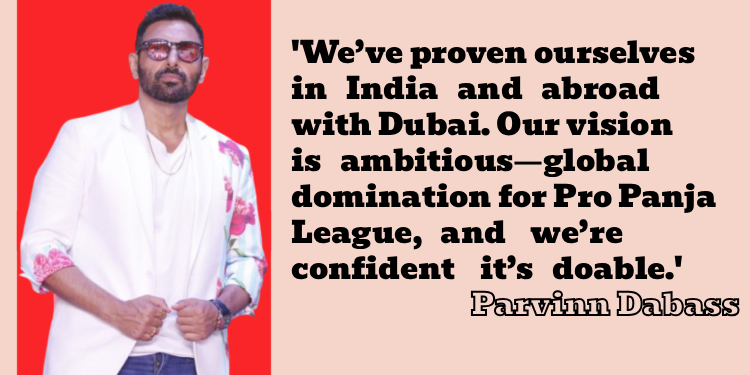
We’ve already done an event in Dubai, and we plan to spread our wings further abroad. We do have very specific plans, but I’ve always believed in doing first and then talking, so I don’t want to speak too much about those just yet.
But they are quite ambitious. And I personally feel that, since we’ve already shown what we can do with this sport here, they are doable and replicable across the world.
Having said that, it’s global domination and we’re laughing.