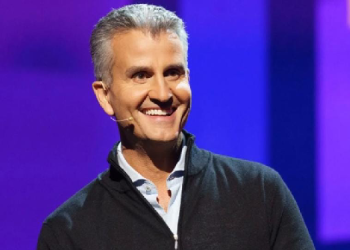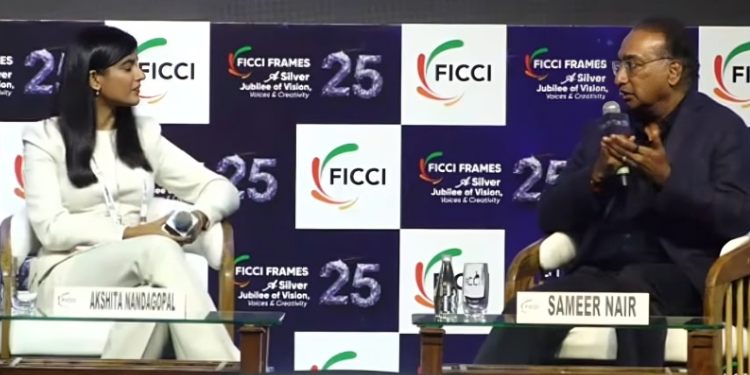
MUMBAI: Speaking during a Fireside Chat with Akshita Nandagopal, Senior Editor & Anchor, India Today TV at FICCI Frames Applause Entertainment MD Sameer Nair said we are already in a state of considerable disruption. When asked about AI he noted that he looks at AI more like a tool. “I think it’s good. And the film industry, the media, entertainment industry and especially the entertainment industry has always been welcoming to technology.”
He noted that the movie business works on the business of make-believe. “When you see ‘Jurassic Park’, ‘Terminator’, ‘2001 A Space Odyssey’, ‘Interstellar’, we have always shown you a possible future. ‘Interstellar’ has already taken you to the edge of the black hole.
“We are waiting for the scientists to catch up. So, when AI arrives in our life, we welcome that. I think it’s a great thing.” There has been special effects, computer animation, now we have AI. He spoke about the need for AI to aid in the suspension of disbelief. You should not be able to spot the AI which is a special effect. A special effect he noted is something that does not draw attention to itself. “When the dinosaur is chasing you through the forest, you believe it’s a dinosaur. So, if AI is able to deliver that, it will be a wonderful tool to use.
“I think it will revolutionise filmmaking, it will revolutionise the way we are doing things, it will make things easier, maybe cheaper, maybe smarter. But if it is plasticky, if it’s sort of, you know, like rough around the edges, obviously AI, then one might as well see animation.”
He noted that AI is going to change the world completely and it’s going to be a big disruptor. He said that it is important for people to embrace it like the first time when Excel, Microsoft Excel came along.
The question then posed to him is, if AI will replace? An AI actor Tilly Norwood went viral for how real she was. India Today has an AI anchor in its studio called Sana. Nair responded saying that the AI actor also needs direction, needs filming. The AI actor also needs a story.
He wondered if there would be a point in time where AI is doing everything from end to end, where no human is involved in it. That he acknowledged is a possibility. “All I think is that all of us then will have to sit here and watch something that’s been made by an AI that has no obvious human experience apart from whatever it’s collected off the net. Because at the end of the day, AI is also operating from scraping off the net, taking our own collective imaginations and experiences and putting it together and doing that, which is what we do in any case.”
He noted that though human beings talk so much about AI, they are AI. “We are also looking at our own experiences and creating new things out of that. This is a tool. This is a machine tool. We must use it well.” He compared to the big earth movers. They help dig earth. You have to do it with a shovel before and before that with sticks. Earth movers are not going to make a building on its own.
Nair when asked about cracking the OTT code and what the secret sauce is he said that the company has not cracked the OTT code or anything like that. “Storytelling is a really difficult sort of enterprise and often times after all the hard work you put into it and then finally you show it to an audience they go, eh. That’s really how life is.”
Applause Entertainment he noted tries and tells interesting stories. “We try and think about the kind of story we want to do. I am personally a big favourite of contemporary history, I like to do stories which involve real life people. We try and tell those stories in as entertaining a manner as possible, not being judgmental about anything.”
He noted that ‘Black Warrant’, ‘The Hunt’ are not really historical pieces, not academic in nature at all. “I’m an entertainer, so we tell entertaining stories. Now, Black Warrant for us is not the story of the inner story of the underbelly of the RGL. It’s actually a young adult workplace drama. Three young people from different backgrounds come to their first day at work. Only they are not MBAs and it’s not Procter and Gamble, it’s the RGL.
“Criminal Justice on Hotstar has reached its fourth season. The original British version had done two, the Americans did one, we’ve done four. So, we took the lawyer character of Pankaj Tripathi and we built a whole show around him.
“So, by the time we reach season four and it’s done really well, we are no longer telling the original British ‘Criminal Justice’, we are actually talking about the world of Madhav Mishra. It’s his universe and we all exist in it. That’s what storytelling is. Storytelling is doing different things. There is no one fixed rule or format.
“Each story has its own, got its own DNA, its own journey, its own destiny. Many times we make things that fail.”
He noted that contemporary history is a very nice mining ground for ideas and for stories. There is also room for more business biopics. Besides the Scam franchise he feels that the company must also do the business barren franchise, which is just celebrating what we’ve achieved as compared to the scandal of it all. “We recently acquired the rights to the Jeffrey Archer books. I think he himself is like an Indian Manmohan Desai. So, he really tells these very nice, rich, complicated tales. So, there is no formula. I think the real idea is to tell stories often times of what people may have heard of, may not know everything about, may have some sense of things and then to really breathe life into these things.”
Nair was asked about finding a middle ground between change and a classic that still works today. He noted that with ‘KBC’ Amitabh Bachchan is the classic. “KBC in large part has got to do with a great format. A great host, who obviously is holding it all together. And it’s changed hands. It used to be with us at Star first. Then it went to Sony.
I think various teams have changed on it. Various producers have changed on it. You know, I think even Sid Basu has taken a break. So, Mr. Bachchan still forges on. One constant. So, I think all credit to him for that.But again, great audiences, great content always finds its audience. And there is a certain degree of brand loyalty that gets built. And people like to see that.People like familiarity. Everyone talks about change. But, you know, audiences typically have moods.
“So, there is a time for change and there is a time for familiar. There are times when you want to just be sort of comfortable and relaxed in doing what you are doing. And you don’t really want to get into a murder mystery at 11 in the night not always. ‘KBC’ is going on. ‘ Big Boss’ is going on. It’s a comfort watch. People like it.”
Nair also noted that people like to re-watch comedies. You know what the joke is but you want to see it again and laugh again as if it’s a fresh piece. Nair was asked about 25 years of FICCI Frames and the changes that have taken place in the industry in that time frame. He noted that in 2005 TV ruled supreme. What is so obvious today were very distant storm warnings back then. In 2005, there was no Facebook, no Twitter, no YouTube. The iPhone hadn’t happened yet.
None of that had happened. “So, for us, I suppose, for the entire media and entertainment industry, print, TV, all included, this was all some distant kind of dark clouds on the horizon. You dial forward 10 years, by 2015, all of this had become like barbarians at the gate threatening to break down the citadel and do all of that. And now, 10 more years later, 2025, we find ourselves as traditional media and entertainment, you know, almost existing as a very minor player or increasingly minor player in this trifecta of Netflix and that on one side, YouTube and that kind on one side, all of social media on the other. And now we are seeing AI arriving into our life.”
He added that everyone saw it coming. Most players have pivoted. Almost everyone does streaming. They also have TV. Everyone is doing everything, flowing with the crowd, making the changes. “I think everyone has a fair idea of where the market is.” Changes haver happened in areas like advertising that have created challenges. “In the year 2000 or 2005, say, we would be selling ad spots in hundreds of thousands of dollars. Today, I think ad spots are sold for pennies.”
How content was consumed was very time bound, linear television. Now, it’s become anytime, anywhere. “You can resume watching everything. Everything exists next to each other. You don’t really need to have a Hindi channel and a Tamil channel and a Malayalam channel. It can all be at the one place. There have been lots of revolutionary changes that have happened. But a lot of this is all connected to the world of distribution, to the world of technology.
“But I think people are still consuming content. People are still wanting to be entertained. People are still watching movies. People still want to laugh and cry get scared. As everything changes, I think content also changes. But audiences also change. But people want to hear stories.”