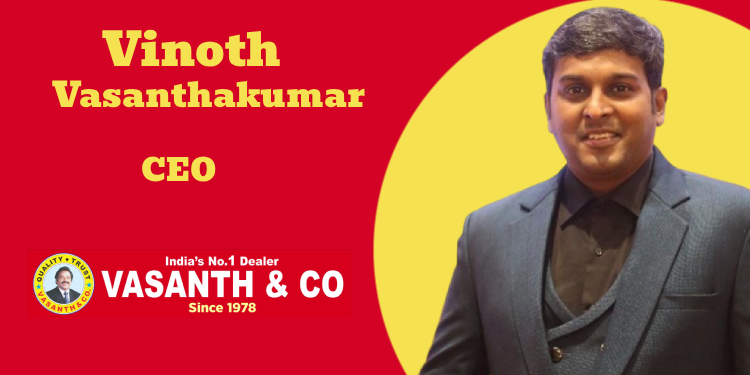
In this second part of the two-part exclusive interaction with MediaNews4U, Vinoth Vasanthakumar (Vinoth Vasanth), the CEO of Vasanth & Co. delves deeper into how the brand balances emotional connect with sales strategy, why his late father continues to remain the true face of the company, and how financing options, digital transformation, and tier-2 and tier-3 expansion are shaping Vasanth & Co’s next phase of growth.
Part 2: Brand, Sales Strategy, and Future Growth
1) Whenever you advertise across mediums, is your strategy focused purely on sales conversion, or do you also prioritize audience connect and long-term brand recall?
Vinoth Vasanthakumar: Our strategy has always been two-fold: driving sales while building a strong emotional connect with our consumers. For us, consumer loyalty is the backbone of our business, and sustaining it across generations is just as important as immediate sales. We firmly believe that without emotion, there can be no sustainable sales. At Vasanth & Co, the emotional connect is deeply rooted in our legacy. My late father, Shri H. Vasanthakumar, continues to remain the face of our brand even today. He is remembered as a trusted icon of authenticity, and consumers still fondly refer to our outlets as “Annachi’s shop.” That trust and familiarity, built over decades, form the foundation of our customer loyalty.
Our campaigns are designed to carry this legacy forward, ensuring that future generations also associate the brand with the same values of trust, service, and reliability. Of course, our campaigns highlight offers, EMI benefits, and other promotions to drive sales, but beyond the transactional aspect, our focus is on fostering emotional loyalty. Price discounts and freebies can attract customers in the short term, but they do not guarantee retention. True loyalty comes from the bond consumers feel with the brand, and that is what protects us from competitive pressures in the long run.
2) Your father continues to be the face of Vasanth & Co. In this context, how do you view celebrity endorsements, especially when many brands rely on them as a loyalty and sales-driving factor?
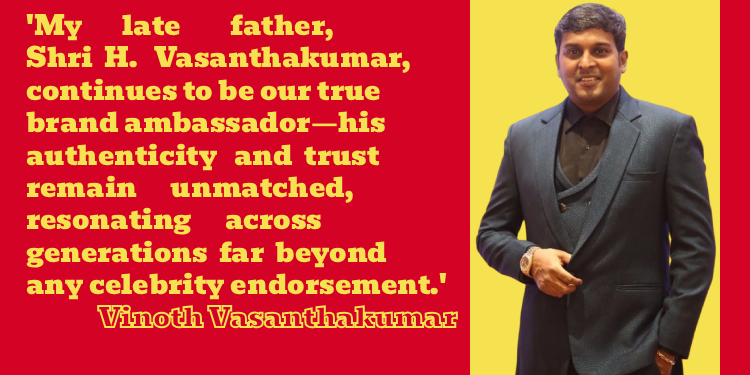
Vinoth Vasanthakumar: We have never engaged a celebrity as a brand ambassador for Vasanth & Co. For us, my late father, Shri H. Vasanthakumar, is and will always remain the true brand ambassador. His legacy, trust, and authenticity are what our consumers connect with, and that emotional bond is far more powerful than any celebrity endorsement. Over the years, we have associated with models and mid-level stars for our advertising campaigns, but never with top-tier celebrities. Interestingly, several models who featured in our ads went on to become successful actors in the film industry. Yet, even as they grew in stature, we have always kept the brand face centered on my father, whose image continues to resonate with customers across generations. In the digital space as well, our campaigns are built around his legacy.
We run engaging activities and offers structured around his persona, which ensures strong recall among audiences of all age groups. Consumers today are very discerning—they value reliability and trustworthiness over glamour, especially when it comes to important household purchases. That is where our legacy plays a pivotal role. At the same time, we do adapt to changing trends. Recently, we have experimented with influencer marketing campaigns to connect with younger, new-age audiences. About 20% of our advertising spend is now directed towards promoting gadgets, laptops, smartphones, and smart TVs, as these categories are increasingly driven by Gen Z and young decision-makers.
3) The festive season plays a major role in driving annual sales. What is the role of EMIs and your tie-ups with financing partners like NBFCs in your overall sales strategy?
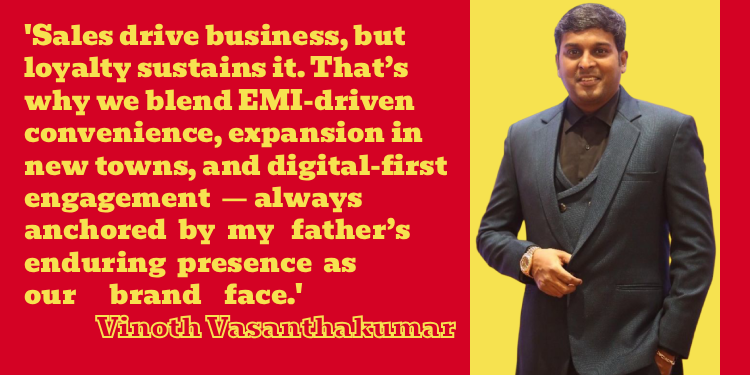
Vinoth Vasanthakumar: EMIs are a lifeline of our sales strategy and form an integral part of every campaign we roll out. Whether it is print, television, radio, or digital, our communication always highlights product pricing along with attractive EMI options. This has become a decisive factor in converting in-store footfalls into actual purchases. The “buy now, pay later” culture has been steadily embraced by our
customers across all age groups and product categories, and it continues to drive sales significantly. More than 50% of our overall sales today are EMI-driven. Credit cards alone contribute nearly 25% of this, supported by cashback offers and loyalty points that appeal to our high-value customers. UPI payments, which began with smaller ticket sizes, are now facilitating purchases of up to ₹50,000.
This ease of instant, cashless transactions has made UPI one of the fastest-growing enablers of sales, especially in tier-2 and tier-3 markets, growing at nearly 200% year-on-year. Our partnerships with financing companies such as Bajaj Finserv, HDB, HDFC, IDFC, and others provide consumers with flexible repayment plans, sometimes starting as low as ₹5,000. These options make even premium products highly affordable. In addition, global brands like Apple and Samsung have further strengthened this ecosystem by offering upgrade schemes, student discounts, and exchange policies, all of which encourage quicker purchase decisions.
4) You spoke about your in-house team for e-commerce. What is your e-commerce transformation plan?
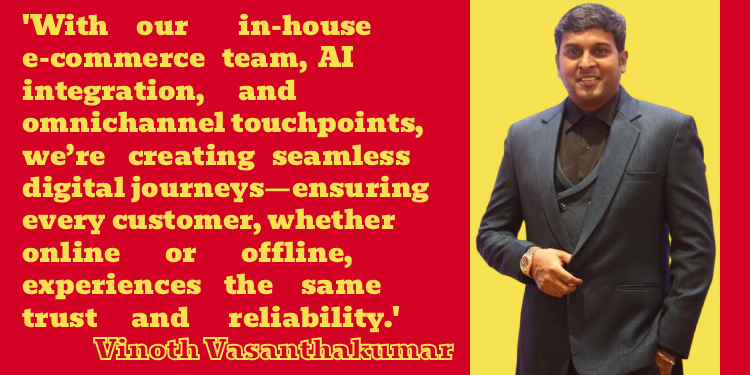
Vinoth Vasanthakumar: We have a dedicated in-house team driving our digital transformation, with a strong focus on e-commerce. Our new portal is being designed with advanced features, prioritizing user experience and interface. To begin with, we plan to integrate e-commerce within our stores by setting up exclusive kiosks where consumers can experience the platform firsthand. The next phase is to leverage AI to track customer behavior, engagement, and purchase patterns. This will help us understand drop-offs, retarget incomplete transactions, and improve conversion rates. Additionally, we are building robust feedback mechanisms to capture consumer insights and enhance overall engagement. Our objective is to create a seamless omnichannel experience—whether on mobile, desktop, or in-store touchpoints. Features like QR-enabled newspaper ads and digital tools across points of sale will ensure that consumers can connect with us at every stage of their purchase journey.
5) What is the current business outlook for Vasanth & Co, and how are you shaping your growth strategy in the coming years?
Vinoth Vasanthakumar: With over 130 stores currently, we are progressing strongly. Our focus is on expanding into tier-2 and tier-3 towns across Tamil Nadu. In the last year, out of 10 new retail stores, eight were launched in these regions and only two in Chennai. This reflects our strategy of strengthening our presence in semi-urban and regional markets. In our upcoming expansion of 11 more stores, 10 will again be in tier-2 and tier-3 towns, with only one in Chennai. At the same time, we are focused on deepening our footprint in the Greater Chennai market. Between now and 2028, we plan to launch 70 new stores across Tamil Nadu, of which 40 will be in tier-2 and tier-3 towns and 20 in the Greater Chennai region. Beyond 2028, further expansion will be evaluated based on performance. We are also strengthening our backend operations. Currently, we operate six warehouses across Tamil Nadu—in Chennai, Coimbatore, Salem, Trichy, Madurai, and Palayamkottai. To support new product categories and growing volumes, we plan to expand this network with additional master hubs over the next five years.
Geographically, we are consolidating our presence in areas like Tiruttani, Vellore, and Tiruvannamalai, and opening second stores in districts like Krishnagiri and Dharmapuri. We are also increasing our footprint in the delta region with upcoming showrooms in Nagapattinam, Karaikal, Thiruvarur, and Thanjavur, in addition to a large-format 25,000 sq. ft. showroom in Pondicherry. Over the next three years, we also intend to explore expansion into other states and potentially international markets. Looking ahead, we see furniture as a new growth category and will integrate it into our larger-format stores. Additionally, the recent GST restructuring is expected to benefit our business by reducing rates on several high-value categories, thereby stimulating demand.