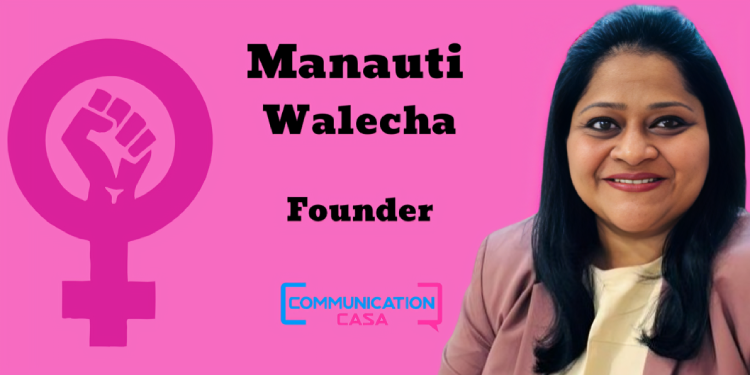
Manauti Walecha is the Founder of Communication Casa and a seasoned communications professional with nearly two decades of experience in public relations, brand building and strategic communications. A graduate of Ram Lal Anand College, University of Delhi, with a Bachelor’s degree in Insurance, she chose to pursue her passion for communications over a campus placement opportunity and later completed her post-graduation in PR and Advertising from YWCA, Delhi, along with earning a Licentiate from the Insurance Institute of India.
Walecha began her career in 2006 at a boutique PR agency and steadily grew across agency and corporate roles, including business development. A defining moment came when she took a principled stand against unethical workplace practices, reinforcing her belief in fairness and integrity. In 2017, she restarted as a freelancer, building a strong independent practice over five years before founding Communication Casa in 2022. Built on trust, transparency and people-first leadership, the agency today partners with brands and startups to craft credible narratives and execute impactful go-to-market PR strategies.
Born and raised in Delhi and currently based in Noida, Manauti’s values of discipline, honesty and perseverance stem from her middle-class upbringing, and she remains committed to building organisations where ethics come before hierarchy and leadership replaces authority.
On the occasion of International Women’s Day, Medianews4u.com caught up with Manauti Walecha, Founder, Communication Casa.
Q. As a woman entrepreneur, what have been the key learnings?
As a woman entrepreneur, my journey has been shaped by a few powerful learnings. First, show up every single day. Resilience is non-negotiable — irrespective of personal battles, market slowdowns, or moments of self-doubt, consistency builds momentum. Second, let your actions build your confidence. You don’t need constant validation when your work speaks for itself. Third, trust your instincts — especially in rooms where you may be the only woman at the table. Intuition is a strength, not a weakness. Fourth, practice financial discipline by choosing the right clients over quick revenue; sustainable growth always outweighs short-term gains. Fifth, believe in collaboration over competition.
Partnerships rooted in trust and a shared vision create far greater impact than going it alone. And above all, relationships matter the most. Businesses grow through trust, credibility, and the strength of the connections you nurture along the way.
Q. What trends are being seen in terms of women entrepreneurs forming startups in the PR and Communications industry?
I am witnessing a massive shift toward niche specialisation. Women entrepreneurs are moving away from “generalist” agencies and now focus on sectors like Food & Beverage, Technology, Entertainment and Influencer Engagement. Also, unlike traditional volume-driven PR models, many women founders are building firms that focus on niche positioning, founder-led storytelling and reputation management. Women entrepreneurs are building firms that are relationship-led, and insight-driven rather than purely transactional.
Q. Do we need better mentorship programmes for women entrepreneurs and more family support?
Absolutely! Mentorship is essential at every step of growth. Structured mentorship — especially from those who have built and scaled businesses can help women navigate funding, negotiations, leadership transitions, and strategic expansion methods. On the other hand, family support is equally important.
Business and entrepreneurship are highly unpredictable and take a toll on entrepreneurs’ mental health. Emotional support at home creates the mental bandwidth to take business risks. Also sharing the load with household responsibilities contributes to women entrepreneurs’ mental peace.
Q. Does the key to success for women entrepreneurs lie in being in a scalable area where others aren’t looking?
Success often lies where the noise is lowest. In PR, many focus on the same “glamour” sectors like the Entertainment, Food and Beverage, Celebrity PR, etc. However, the real growth lies in areas like B2B sectors-the supply chain ecosystems or deep-tech communications. Many professionals find these sectors ‘boring’ but by providing high-value, bespoke strategies in technical sectors, one can build a moat around their business.
Q. What trends are being seen in women leaders and changemakers creating meaningful impact across entrepreneurship and communication?
Women leaders today are building businesses that combine profitability with purpose. They are building human-centered businesses. They are redefining leadership to be more collaborative, inclusive, transparent, and value-driven. In communication specifically, women changemakers are believing in community building where relationships matter the most and eventually lead to mutual growth.
Q. What have been the learnings from Communication Casa?
My learnings as the founder of Communicatin Casa are that “A good idea is only known as that when it’s sold as that.” We always prioritise straight-talking and value transparency. Knowing what we can’t do is as important as knowing what we can. and conveying the same in a true manner to the client and other stakeholders.
Another key learning is that culture defines longevity. A strong internal value system and genuine trust in your team reflect externally in the quality of work you produce and in how the world perceives your leadership. What you build within ultimately defines what you create outside.
Q. The public relations industry has better female representation than many other sectors. What is the reason for this?
PR and communications naturally reward emotional intelligence, empathy, relationship-building, and narrative understanding — skills where women have historically been encouraged to excel. However, while representation at mid-levels is strong, leadership parity still requires attention. More women are now transitioning from practitioners to founders, which is a positive structural shift.
Q. Does Communication Casa prioritise work-life balance for female employees so that they stay loyal?
We prioritise work-life integration rather than just balance.And this applies not only to the female team members but to the male members as well. After all, everybody has their personal life, which needs attention and respect. PR is demanding, and flexibility is essential. We encourage outcome-driven performance rather than presenteeism. Above all, loyalty comes from respect, growth opportunities, and trust — not just flexibility. When employees feel heard and valued, retention naturally follows.
Q. The company places ethics before hierarchy, leadership replaces authority, and people are valued as much as performance. How challenging has this been given business pressures?
While business pressures are constant, we do not view these principles as optional. It isn’t ‘challenging’ in the sense of a struggle, but it does require constant intentionality. Ethics, leadership, and respect for people should be in-built human emotions. There is nothing above this.
Q. What role is AI playing in helping the agency define the client’s voice, build credibility, and execute impactful go-to-market PR strategies?
AI is becoming a strategic enabler in every industry. In our industry too, it plays a vital role as it allows us to analyze media narratives, monitor industry conversations, and create sharp, concise content. However, AI supports strategy — it can not replace human insight. Defining a client’s voice still requires deep listening, contextual understanding, and cultural nuance. AI enhances speed and precision, but credibility is still built through relationships and authentic storytelling.
Q. Is predictive analytics going to play an increasingly important role in 2026?
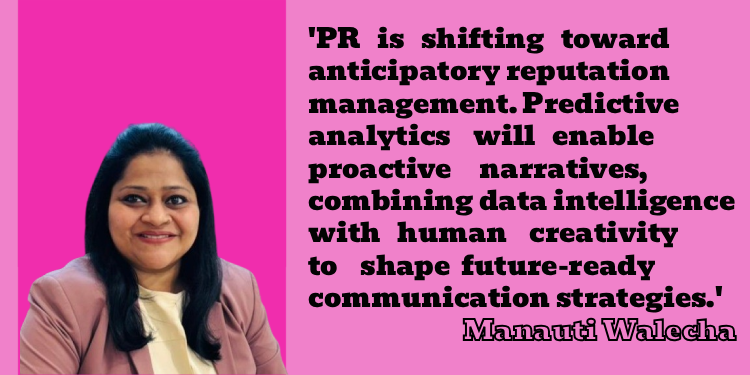
Yes, predictive analytics will play a significant role in shaping communication strategy. In 2026, PR will move beyond reactive storytelling to anticipatory reputation management. Data-led forecasting of media trends, understanding audience preferences, identifying emerging trends, and industry movements will allow agencies to design proactive narratives. The future of communication lies in combining data intelligence with human creativity.