MMA this year announced that it had officially evolved into the Marketing + Media Alliance (MMA).
This the company says marks a decisive shift from association to alliance – a global community led by CMOs and powered by the entire marketing ecosystem to solve the industry’s hardest problems with evidence, experimentation, and enterprise-level impact.
The repositioning signals a foundational commitment to advance marketers’ ability to create value by uniting CMOs, media, and partners to shape the future of marketing, brands, and business.
The Alliance aims to build on years of rigorous work across multi-million-dollar Think Tanks and Labs, from AI, CX and attribution to data, retail media and organisational design – now being localised and scaled in India through initiatives like IMPACT, SMARTIES, Data Unplugged, roundtables, webinars and more.
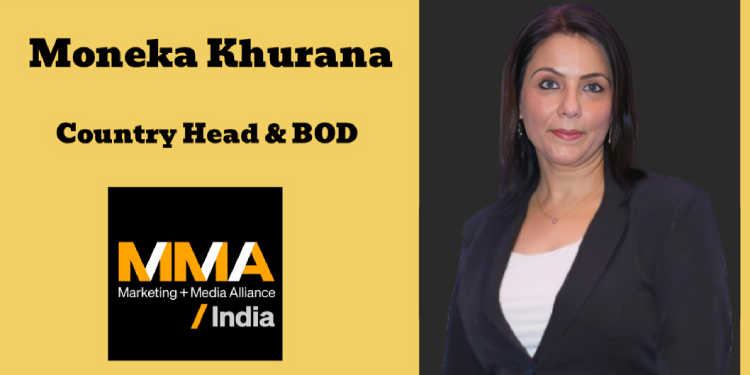
Medianews4u.com caught up with MMA India country head, BOD Moneka Khurana.
Q. What factors prompted MMA to rebrand as the Marketing + Media Alliance?
The future of marketing demanded we break our own mold – so we did. The decision to rebrand from MMA Global to the Marketing + Media Alliance (MMA) was catalyzed by a profound industry truth: today’s marketing challenges can’t be solved in silos. The word “Alliance” now captures who we truly are – a collective force convening CMOs and the entire ecosystem, working shoulder-to-shoulder to engineer the next era of marketing advantage.
Our evolution reflects a sharpened commitment to evidence, experimentation, and enterprise-level impact – placing marketers at the center, media in the mix, and the alliance at work, moving the industry forward with proof, not platitudes.
This shift is visible in our multi-million-dollar global think tanks (like MATT, MOSTT, ALTT, and DATT), which have produced industry-defining breakthroughs in measurement, growth frameworks, and AI-driven personalisation – locally powered and pressure-tested by our Indian board and members.
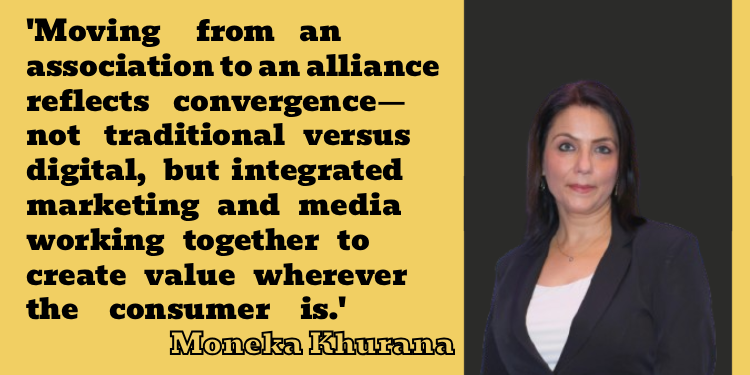
Q. What does the organisation’s shift from association to alliance entail? Does the shift mean that the focus will be on both traditional and digital marketing compared with the past?
Moving from “association” to “alliance” signals a foundational commitment to inclusion, collaboration, and actionable progress. We didn’t just rebrand; we rewrote what it means to create industry change. It’s not about old versus new, traditional versus digital – it’s about convergence and creating value wherever the consumer is.
Our alliance integrates the best of marketing and media worlds, convening leaders from brands, media, agencies, and tech to solve the marketing ecosystem’s hardest questions. By uniting the ecosystem – across digital, traditional, emerging channels – we’re building a unified front for experimentation, learning, and growth.
The MMA’s multi-format events like IMPACT, SMARTIES, and Data Unplugged ensure our members are not just keeping pace but setting it, operationalizing insights across every channel.
Q. What is the gameplan going to be to scale initiatives like IMPACT, SMARTIES, Data Unplugged, roundtables, webinars?
Our approach for 2026 is about depth, breadth, and accessibility. Impact is only as meaningful as it is scalable – and that’s where the Alliance stands apart. We are expanding IMPACT, SMARTIES, and Data Unplugged by creating multi-city, hybrid models – fusing physical forums with always-on digital engagement.
For instance, SMARTIES has evolved beyond awards into an ongoing platform for sharing case studies and lessons, catalyzing a learning loop for marketers at all levels.
Our executive roundtables and webinars now include curated peer-learning cohorts, giving members the chance to pressure-test new frameworks and operationalize change faster. We’re also leveraging the power of our Labs, which validate marketing’s next models – AI, CX, data – in partnership with India’s top brands, before rolling them out at scale.
Q. What are the hardest problems that the marketing ecosystem is facing as we head into 2026?
Heading into 2026, the biggest challenges are:
- Proving marketing’s real impact on business outcomes – moving beyond vanity metrics to value creation.
- Navigating AI’s exponential evolution without losing sight of brand distinctiveness and ethical imperatives.
- Building cross-functional teams and data systems that can keep up with the pace of change.
- Bridging the gap between experimentation and scale in a fragmented media environment.
- Talking the language of the CFO to build scalable marketing and faith in the role of marketing in driving business.
Marketers aren’t just chasing answers – they’re confronting questions no one has dared to ask. At MMA, our think tanks are addressing these directly – developing enterprise-ready frameworks for measurement (MATT), marketing org strategy (MOSTT), data & CX strategies (DATT). Our research during the 2025 edition of Data Unplugged, for example, demonstrated the need for new attribution models and the critical role of predictive analytics in driving spend efficiency.
Q. What were the key trends seen in the marketing space in 2025?
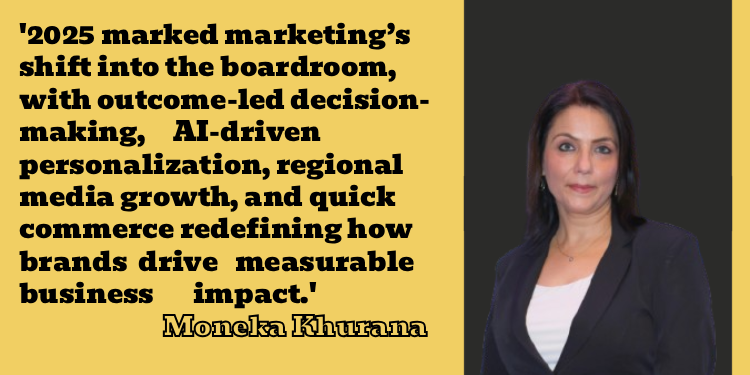
2025 was the year marketing stepped off the sidelines and into the boardroom. This year saw:
- Powering Growth Against Constraints: Marketers doubled down on driving business impact – even with leaner budgets and tighter resources – by embracing strategic frameworks and outcome-oriented planning.
- Legacy & Challenger Brands: Reciprocity in Action: There was a visible exchange between established brands and insurgents. Legacy brands embraced agility and experimentation, while challenger brands leveraged institutional strengths and scale, reflecting the “learning from each other” mindset we champion.
- The Rise of Regional Media: Regional content became a powerhouse, with marketers leveraging language, culture, and hyperlocal creativity to drive deeper consumer engagement.
- Quick Commerce & Retail Media: Q-commerce emerged as a key growth engine, while retail media matured into a full-funnel platform connecting commerce, marketing, and technology.
- The Gen Z Imperative: Brands adopted a reverse-mentoring mindset – recognising Gen Z as collaborators, not just consumers, and tailoring engagement to their diverse content habits across metros and the heartlands.
- Inclusive AI: The conversation around AI evolved to include not just efficiency but inclusivity – highlighting the need to close gender gaps and ensure diverse representation in how AI tools are designed and deployed.
These narratives became the blueprint for marketing excellence in 2025, shaping both boardroom priorities and frontline execution. MMA’s IMPACT forums and SMARTIES winning case studies brought these trends to life, making them actionable for marketers across categories.
Q. Was one big trend seen in 2025 the fact that most campaigns were not approved without a clear focus on business outcomes?
Absolutely. If it doesn’t move the needle, it doesn’t make the cut anymore. The industry pivoted hard towards outcome-based marketing – CMOs demanded, and boards expected, every rupee spent to tie back to enterprise value.
MMA’s Marketing Attribution Think Tank (MATT) provided the models and language to support this shift, arming brands with tools to prove long-term impact, not just short-term sizzle. Across SMARTIES entries, the winning work demonstrated a clear business case, often backed by advanced data modeling, not just campaign impressions.
Q. As a result will vanity metrics reduce considerably in importance in 2026?
Yes, the industry is moving decisively away from superficial metrics. 2026 is where likes and shares finally take a backseat to lifetime value. With advanced analytics and cross-channel attribution, marketers can now connect the dots between marketing activity and bottom-line growth.
MMA’s Data Unplugged initiative has been at the forefront – showing brands how to unlock the full value of first-party data, measure incremental lift, and focus on metrics that actually matter. The pressure from CFOs and boards for “proof, not platitudes” will only accelerate this trend.
Q. Did AI transform the marketing function across sectors and organisations in 2025? Any examples that stand out?
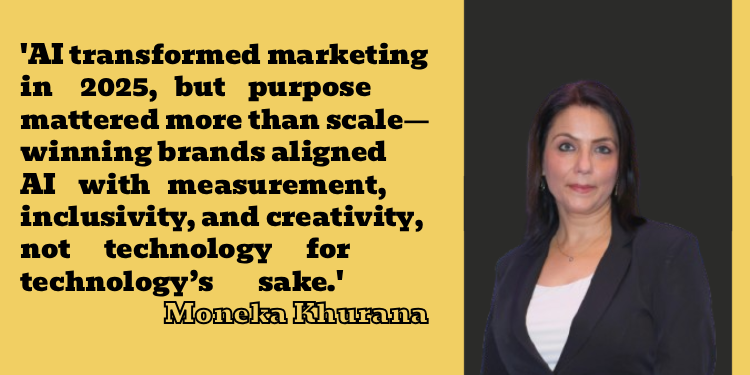
AI fundamentally reengineered how brands connect, create, and convert. AI’s true impact was seen in how brands approached personalization, predictive analytics, and operational efficiency – but always through the lens of business outcomes, not technology for technology’s sake.
For example, the Kroger case study from MMA’s CAP (Consortium for AI Personalization) research stands out: by leveraging advanced AI personalisation, Kroger was able to drive significant lifts in customer engagement and incremental sales, setting a new industry standard for what responsible, data-driven marketing can achieve.
Our research also showed that brands integrating AI with a clear focus on measurement and inclusivity were able to unlock value across the customer journey, not just in isolated campaigns. MMA’s ALTT (AI Leadership Think Tank) and our global research continue to drive these best practices across the ecosystem, replicated in India with our local AI Council and taskforce.
Q. While AI is key, was there too much use of AI in marketing in 2025? Is that a challenge?
2025 saw a surge in AI deployment, but not all of it was strategic. More isn’t always better – AI’s power lies in its purpose, not its prevalence. Some brands fell into the trap of “AI for AI’s sake,” risking brand dilution or ethical missteps.
The challenge is now clear: calibrate AI with brand values and creativity, not just efficiency. MMA’s work around agentic AI with our partners advocates for a “human + machine” approach, ensuring technology amplifies – not replaces – distinctiveness. The focus for 2026 is on intentional, ethical, brand-aligned AI applications.
Q. In 2025 were there a lot of examples of challenger brands adopting smart marketing tactics to challenge entrenched legacy players?
Challenger brands seized the advantage by adopting agile marketing and rapid experimentation. Just like David didn’t just fight Goliath in 2025 – he outsmarted him with data. MMA’s SMARTIES case studies showcased several D2C and fintech brands using micro-segmentation, influencer partnerships, and AI-driven creative testing to punch above their weight.
These brands were often first to market with bold, culturally relevant work, challenging legacy players to adapt or risk irrelevance.
Q. How will the role of the CMO further evolve in 2026 based on what was seen in 2025? Your expectations.
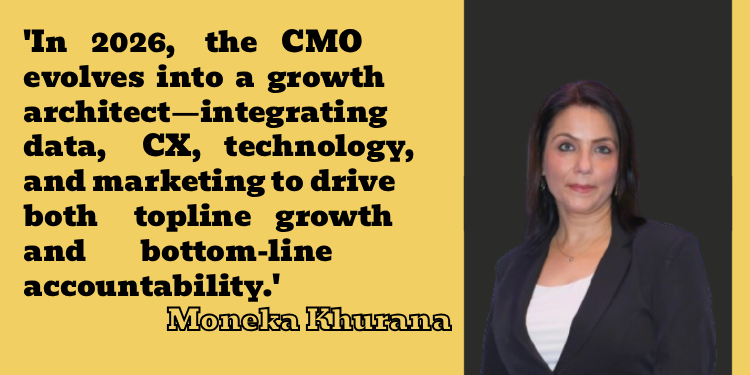
It’s time for the title of the CMO to retire and be called the CGO. In 2026, CMOs will double down on their role as enterprise value creators – integrating marketing, data, technology, and CX to drive holistic business transformation. The CMO is no longer just the voice of the brand – they’re the architect of business growth.
MMA has been evangelising the “growth CMO” – leaders with cross-functional influence, accountable for both topline and bottom-line outcomes. The CMO’s seat at the leadership table is now a given – what matters is how they wield it to shape business models, culture, and capability for the next era.
Q. Did the role of predictive analytics grow in importance in terms of brands deciding where to allocate marketing spends?
Predictive analytics is now foundational to smart marketing investment. Intuition is out – intelligence is in. MMA’s Data Unplugged forums demonstrated how leading brands used machine learning to anticipate demand, optimise channel mix, and improve campaign ROI.
Boards now expect marketers to justify spend with predictive models, not just historical data. This trend will only intensify as first-party data becomes the competitive edge in a post-cookie world.
Q. The RMG ban saw a drop in festive spends. Do you see other categories stepping up to fill the gap in 2025?
Indeed, the drop in RMG-related festive spends created opportunities for sectors like FMCG, e-commerce, and personal finance to step up. but when one category pulls back, others see an opening – 2025 was a year of agile pivots.
Brands used the vacuum to claim more share of voice and wallet, with Diageo, Nestle, and Amazon Ads scaling up integrated festive campaigns. MMA’s roundtables surfaced innovative approaches, including cross-category collaborations and community-led activations, to capture consumer attention during this crucial period.
Q. In 2025 how did Marketing and CX collaborate to drive business growth?
Growth isn’t a siloed function – it’s engineered at the intersection of marketing and experience. The most successful brands in 2025 broke down the silos between marketing and CX, creating integrated journeys that personalized every touchpoint and drove measurable business outcomes.
At MMA, our Customer Experience (CX) Maturity Assessment tool became a key enabler for marketers – helping organizations benchmark, strategize, and operationalize seamless CX across channels. These frameworks empowered brands to move from transactional touchpoints to holistic experiences that boost NPS, retention, and customer lifetime value.
At SMARTIES, winning case studies consistently showed that even incremental improvements in the customer journey, when backed by data and unified teams, delivered disproportionate business growth.
Q. Will the brands that win in 2026 be the ones who focus on CX through innovations like Agentic AI?
The brands that win find ways to focus on evolving CX consistently – agentic AI or not is secondary. Tomorrow’s winners won’t just have the best campaigns – they’ll deliver the best experiences, powered by AI. Agentic AI is the engine for next-level CX – enabling brands to anticipate needs, personalise at scale, and delight customers in real time.
MMA’s research in 2025 showed early adopters achieving significant gains in customer loyalty, advocacy, and revenue growth. The playbook for 2026 is clear: invest in AI-driven CX innovation, integrate across functions, and measure what truly matters – customer outcomes, not just campaign reach.
Q. Closing thoughts?
This has been a year of transformation, but the story is just beginning. At MMA, we invite all marketing leaders ready to shape what comes next to join our movement – the future will be built by those who push boundaries, test boldly, and create value at every turn.