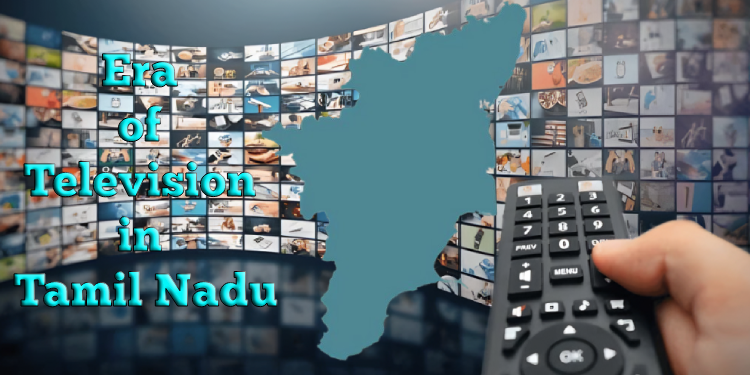
Today, the Tamil General Entertainment market reaches 7 crore people weekly, translating to 92% of TN households, while Tamil GEC alone commands more than 55% share as per BARC data, reflecting the depth of TV’s penetration and relevance in everyday life.
Looking back, the journey of Tamil Nadu’s television industry began with a significant transformation in audience preference—from the limited choices of terrestrial broadcasting through Doordarshan during pre 90s to the explosion of entertainment offered by Satellite Channels during the Cable and Satellite (C&S) Era in the late 90s. This shift provided viewers with greater variety, richer content, and improved visual quality, laying the foundation for a robust entertainment ecosystem.
From Terrestrial to Satellite: The Rise of Regional Giants
The early days of the Cable & Satellite (C&S) era witnessed the entry of first movers like Sun TV, Raj TV, and others. Sun TV quickly emerged as the undisputed market leader, dominating Tamil Nadu’s television landscape for the first 15 years. Its success was powered by a unique blend of content and distribution strength. The channel’s near-monopoly status ensured high ROI for advertisers and attracted an influx of investment from private producers.
Content, especially fiction in the form of daily soaps, flourished. Local production houses like Radaan Media (founded by actress Radhika), Minbimbangal (by K. Balachander), and Vikatan Group led the way, while national players like Nimbus, Balaji Telefilms, and UTV actively sought slots on Sun TV. This era marked the emergence of diverse programming—from intense family dramas to experimental narratives.
Distribution Disruption: MSOs, DAS & DTH
The landscape of TV distribution evolved dramatically in the 2000s. The entry of Multi-System Operators (MSOs) brought order to previously fragmented cable networks. The launch of Arasu Cable TV by the TN Government in 2007, and its subsequent revamp, created democratisation in TV channel distribution and opened the gates for larger media networks.
During the DAS (Digital Addressable System) regime, newer players such as TCCL and VK Digital and others entered the fray, enhancing competitiveness. Channels started benefiting from Pay TV (subscription) revenue in addition to advertising. The democratized ecosystem also allowed Vijay TV and Zee Tamil to enter the race aggressively, reshaping the competitive dynamics.
Disruption Through Differentiation
As part of its regional expansion plans, Star India entered the Tamil GEC space by acquiring Vijay TV in 2003, and started positioning itself distinctively through content differentiation. While initially a modest player, it gradually gained traction through innovative fiction and non-fiction content and leveraged the DAS regime to its competitive advantage.
On the fiction front, shows like ‘Kavyanjali’ made early breakthroughs, challenging Sun TV’s prime-time dominance. On the non-fiction front, Vijay TV set a new benchmark with shows like Super Singer, Jodi No.1, and ‘Kalakkapovadhu Yaaru’. With RODP (Run On Day Part) buying formats, the channel offered advertisers innovative ways to build frequency.
Vijay TV’s ability to attract both corporate and retail advertisers made it a strong commercial contender. Over the years, brands seeking high-impact and youth-centric viewership found a reliable partner in Vijay TV, thereby altering the advertising dynamics in Tamil television.
Fiction Reimagined: Empowering the Protagonist
As the game for eyeballs intensified, channels began elevating production quality and storytelling sophistication. Backed by Star India’s research capabilities, Vijay TV transitioned from melodramatic narratives to aspirational storytelling that resonated with young and urban viewers.
Shows were also infused with modern human emotions and romantic storylines, attracting a younger audience. One defining show was ‘Kana Kanum Kalangal’, a school-based teen drama that broke away from conventional formats and built a loyal youth audience across multiple seasons.
Protagonists were portrayed as empowered individuals navigating family, career, and society, mirroring the changing aspirations of Tamil Nadu’s women. This content formula became a standard recipe for success for the Tamil GEC ecosystem and Zee Tamil tasted success with its show ‘Sembaruthi’ finding its way to the top charts.
The Big Bang: Bigg Boss and the Impact Property Era
The launch of the Bigg Boss Tamil format in 2017, hosted by Kamal Haasan, was a pivotal moment. Despite initial skepticism about its fit with Tamil sensibilities, the show became a massive hit, redefining what event television could be.
It opened up a wave of innovative advertising opportunities, with brands clamouring for visibility during its 100-day run. Initially supported by large corporate brands, Bigg Boss Tamil later attracted regional retail brands, with Nandu White Dhotis and KAG Tiles, both aspiring retail brands being prime sponsors of the previous season, proving its mass connect.
Bigg Boss further solidified Vijay TV’s dominance in the non-fiction genre alongside other high impact properties like ‘Cooku with Komali’, ‘Super Singer’,‘Mr & Mrs Chinnathirai’, and ‘Jodi’. Zee Tamil has recently seen notable success with Sa Re Ga Ma Pa as a key non-fiction offering, while Sun TV continues to explore a flagship show in the genre.”
Connected Viewing and Changing Consumption
The past decade has seen a rise in CTV (Connected TV) and hybrid set-top boxes, blending linear and digital viewing. Tamil Nadu’s broadcasters, especially Vijay TV (with JioHotstar), Zee Tamil (with Z5) and Sun TV (with SunNXT), have adapted quickly with a platform-agnostic strategy, ensuring reach across satellite and digital platforms.
Today’s Landscape: Who Watches What?
The Tamil GEC space is a highly segmented genre in terms of viewership. Sun TV and Zee Tamil programming is heavily skewed toward fiction content with shows like Kayal & Edhir Neechal on Sun TV and Karthigai Dheepam on Zee TV, that resonate with traditional household viewing habits. According to industry insiders, these channels cater primarily to audiences aged 40 and above, especially in rural and urban areas. In contrast, Vijay TV focuses on urban audiences aged 18 to 35 years.
Vijay TV’s content strategy includes a balanced mix of high-impact non-fiction properties and aspirational fiction shows designed to engage a younger, more elite demographic. Signature non-fiction properties that become cultural phenomena. On the fiction front, shows like Bhagyalakshmi, Pandian Stores 2, Ayyanar Thunai and Siragadikka Aasai have garnered strong viewership and loyalty.
As per BARC Data (Week 15–27, 2025, 13 Week Average) for TN Urban 15–50 ABC, the most advertiser-relevant demographic segment, Star Vijay leads the market with 277 GRPs, followed by Sun TV at 230 GRPs, and Zee Tamil at 162 GRPs. While the viewership metric on the 2+ Universe of BARC data may reflect a different number, its relevance for broadcasters lies in showcasing their comprehensive reach within the ecosystem.

Adding his view on what Tamil television must do to stay relevant for the next decade, Anup Chandrasekharan, COO – Regional Content, IN10 Media Network, said, “As Tamil television continues to enjoy a loyal viewer base, it is important to recognise that the audience we once knew has evolved significantly. To stay relevant, the industry must move away from playing it safe and instead embrace bold, original storytelling over recycled tropes.”
“We must begin writing for today’s woman—aspirational, discerning, and increasingly intolerant of outdated clichés. It’s time to put writers at the forefront, as the future of content belongs to creators, not just stars. There is also a growing need to explore hyperlocal narratives with authenticity and nuance, reflecting real ambition rather than relying on stereotypes. Our primetime viewing block, particularly between 7 to 10 pm, needs to be reimagined with innovative formats that resonate with contemporary sensibilities. Moreover, we must stop seeing digital as competition and start leveraging it to extend storytelling universes meaningfully. Reinvention is no longer a choice—it is imperative for survival.” he added.
A Cultural and Commercial Juggernaut
Over three decades, Tamil Nadu’s television industry has grown from a Doordarshan-dominated mono-choice ecosystem to a dynamic, competitive marketplace where content innovation, distribution technology, and viewer insight drive success.
From the early hegemony of Sun TV to the differentiated disruption by Vijay TV and the growing presence of Zee Tamil, Tamil television is no longer just about eyeballs—it is about engagement, aspiration, and identity. Another highly expected launch, Colors Tamil got caught in the storm of COVID-led content disruption, the rapid shift to streaming platforms and the subsequent Viacom18–Star merger.
The journey from terrestrial to satellite, analog to digital, and broadcast to broadband has not only reshaped entertainment but also deeply influenced culture, commerce, and community in Tamil Nadu.
Stay Tuned for more on this Special Series – Era of Television in Tamil Nadu