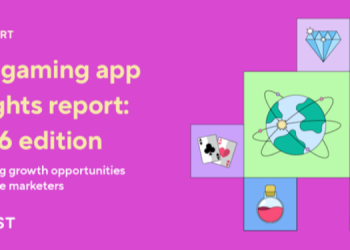
Bengaluru: AppsFlyer, the Modern Marketing Cloud, has released its State of Gaming for Marketers 2026 report, revealing how the rapid adoption of AI, escalating creative output, and rising global user acquisition (UA) spend reshaped mobile gaming marketing dynamics through 2025. The report highlights how marketing activity is expanding faster than player attention, significantly raising the cost and complexity of standing out across iOS and Android platforms.
According to the report, AI-enabled production tools have driven a sharp increase in advertising volume, with creative output scaling rapidly across all spending tiers. In 2025, top gaming advertisers produced between 2,400 and 2,600 creative variations per quarter, marking a 25–30% year-on-year increase. This surge intensified pressure on paid acquisition channels, as paid install share rose 10% YoY across platforms, while ad impressions climbed 20%, increasing competition for the same pool of players.
As marketing ecosystems became more fragmented, AI-powered tools emerged as an operational necessity rather than an experiment. The report notes that 46% of AI assistant queries focused on reporting and performance breakdowns, underlining marketers’ growing need for faster insights and decision-making amid rising data volumes.

“AI has dramatically increased the speed and volume at which games and marketing assets reach the market,” said Adam Smart, Director of Product, Gaming at AppsFlyer. “The result is not a shortage of creativity, but a surplus of it. As paid activity and creative supply expand faster than player attention, marketing success depends on how effectively teams can measure, interpret, and act on an increasing volume of fragmented signals.”
The report also offers a focused view of the Indian gaming market, positioning it among the fastest-growing large gaming economies globally. Gaming UA spend in India rose 19% YoY, while hypercasual UA spend surged 60% YoY on Android, reinforcing the platform’s role in driving scale economics. However, monetisation pressures were evident, with casual game in-app purchase (IAP) revenue declining sharply by 35%, signalling growing challenges in converting scale into sustained revenue.
AppsFlyer’s State of Gaming for Marketers 2026 is based on anonymised and aggregated data from thousands of gaming apps worldwide. The analysis covers installs, ad spend, creative production, monetisation trends, AI-assisted workflows, and media source usage across iOS and Android throughout 2025, offering a comprehensive view of how AI and scale are redefining competition in mobile gaming marketing.