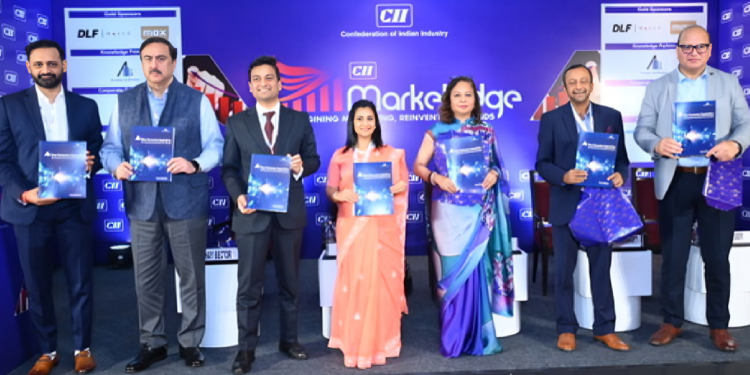
Delhi: India’s consumer landscape is undergoing a significant transformation, driven by research-led buying, rapid delivery expectations, and increasingly fluid purchase journeys, according to a new report by Alvarez & Marsal in partnership with the Confederation of Indian Industry (CII).
Titled “The New Consumer Imperative: Rewiring Commercial Models for Growth,” the report is based on a survey of 2,019 respondents across 54 cities, supported by government data, platform disclosures, and industry research. It identifies six key behavioural shifts that are reshaping how Indian consumers discover, evaluate, and purchase products.
The findings reveal that 83% of Indian shoppers now rely on reviews before making a purchase, while 77% expect delivery within two hours, underscoring the growing importance of proof and speed in purchase decisions. Consumer journeys are becoming increasingly non-linear, with 73% exploring multiple channels and 64% completing purchases across two or more platforms to meet a single need.
The report also highlights the rise of “basket fluidity,” with 70% of consumers buying outside their initially intended category and 62% prioritising outcomes over product categories. Additionally, over 73% of consumers selectively opt for premium products within specific categories, regardless of income levels, reflecting a more nuanced approach to premiumisation.
At the same time, the study underscores a growing tension between personalisation and privacy. While 98% of consumers are more likely to purchase when engagement is personalised in real time, 88% say they would abandon a brand if the interaction feels intrusive.
Bharat Garg, Managing Director – Consumer, Consumer Tech and Retail Practice, Alvarez & Marsal India, added, “Indian consumers today validate purchases far more actively, with 83% relying on reviews before buying and 73% exploring multiple channels during the purchase journey. This shift means traditional brand-led marketing alone is no longer enough. Companies must build credibility wherever consumers evaluate choices – through authentic reviews, creator influence and strong presence across digital platforms. Brands must now compete where consumers evaluate, not just where they transact.”
Mani Singhal, Managing Director & Co-Lead, Consumer, Consumer Tech and Retail Practice, Alvarez & Marsal India, said, “India’s consumer market is entering a new phase of growth as rising incomes, digital access and evolving expectations reshape how people discover and choose brands. While this is known, the commercial models to serve the new consumer need a re-think. It’s almost like the consumer is faster and the business is on a treadmill to catch up. Companies that align their strategies with the behaviour of the new Indian consumer will be best positioned to capture the next phase of consumption growth.”
Ms Pushpa Bector, Chairperson, CII MarketEdge 2026 and Senior Executive Director and Retail Head, DLF, highlighted, “As India moves toward 2030, strong and credible brands will play a vital role in simulating domestic demand, expanding exports, attracting investment, and positioning India as a distinctive economic force in the global marketplace. The question before us is not how to capture the domestic market but how can India build brands that are globally respected and competitive.”
The report outlines six defining consumer shifts: the rise of generation-agnostic behaviour, proof-seeking purchase decisions, demand for instant gratification, selective premiumisation, channel and brand fluidity, and the privacy-personalisation paradox. It also identifies two structural trends—channel fluidity and basket fluidity—as key forces shaping modern commerce.
As consumers increasingly move across platforms and categories, the report suggests that traditional business models built on fixed categories and linear journeys must evolve. It recommends that organisations adopt outcome-led product strategies, strengthen omnichannel presence, prioritise trust-driven marketing, and build agile operating models capable of responding to real-time consumer behaviour.
With India’s digital and consumption ecosystems continuing to expand, the report concludes that businesses that adapt quickly to these shifts will be best positioned to capture the next phase of growth in the country’s evolving consumer economy.